Translate this page:
Summary
Physical Characteristics
![]()
![]() Citroncirus webberi is an evergreen Tree.
See above for USDA hardiness. It is hardy to UK zone 7 and is not frost tender. It is in leaf all year. The species is hermaphrodite (has both male and female organs).
Suitable for: light (sandy), medium (loamy) and heavy (clay) soils. Suitable pH: mildly acid, neutral and basic (mildly alkaline) soils. It cannot grow in the shade. It prefers moist soil.
UK Hardiness Map
US Hardiness Map
Synonyms
Plant Habitats
Woodland Garden Sunny Edge; South Wall. By. West Wall. By.
Edible Uses
Edible Parts: Fruit
Edible Uses:
The acid fruit can be used for drinks and marmalade[183, 200]. The fruit is 5 - 7cm in diameter[200].
References More on Edible Uses
Medicinal Uses
Plants For A Future can not take any responsibility for any adverse effects from the use of plants. Always seek advice from a professional before using a plant medicinally.
None known
References More on Medicinal Uses
Other Uses
Rootstock
This species can be used as a rootstock for the sweet orange, conferring a greater tolerance to cold weather[183].
Special Uses
References More on Other Uses
Cultivation details
Prefers a moderately heavy loam with a generous amount of compost and sand added and a very sunny position[1, 200]. When growing plants in pots, a compost comprising equal quantities of loam and leafmould plus a little charcoal should produce good results[260]. Do not use manure since Citrus species dislike it[260]. When watering pot plants it is important to neither overwater or underwater since the plant will soon complain by turning yellow and dying. Water only when the compost is almost dry, but do not allow it to become completely dry[260]. Reasonably cold resistant, dormant plants can tolerate temperatures down to about -10°c, especially if they are grafted onto a Poncirus trifoliata rootstock[200]. The young growth in spring, even on mature plants, is frost-tender and so it is best to grow the plants in a position sheltered from the early morning sun[K]. A group of hybrids of garden origin, Poncirus trifoliata x Citrus sinensis[183]. Generally, these hybrids combine the qualities of cold hardiness and bitterness from Poncirus trifoliata with the larger more orange-like fruits of Citrus sinensis[183]. They are occasionally cultivated for their edible fruit, but more usually for their use as a rootstock, there are some named varieties[183, 200]. 'Morton' has very juicy fruits and is cold resistant[200]. 'Rusk' is very juicy and much less bitter than most forms[200].
References Carbon Farming Information and Carbon Sequestration Information
Temperature Converter
Type a value in the Celsius field to convert the value to Fahrenheit:
Fahrenheit:
Plant Propagation
The following notes are based on Citrus species. They are probably applicable here as well, even though this is a bi-generic hybrid, since any seed might be produced polyembrionically. The seed is best sown in a greenhouse as soon as it ripe after thoroughly rinsing it[164, 200]. Sow stored seed in March in a greenhouse[3]. Germination usually takes place within 2 - 3 weeks at 13°c. Seedlings are liable to damp off so they must be watered with care and kept well ventilated. The seed is usually polyembrionic, two or more seedlings arise from each seed and they are genetically identical to the parent but they do not usually carry any virus that might be present in the parent plant[200]. When large enough to handle, prick the seedlings out into individual pots and grow them on in the greenhouse for at least three growing seasons before trying them outdoors. Plant them out in the summer and give them some protection from the cold for their first few winters outdoors. Cuttings of half-ripe wood, July/August in a frame. Layering in October.
Other Names
If available other names are mentioned here
Native Range
Coming Soon
Weed Potential
Right plant wrong place. We are currently updating this section.
Please note that a plant may be invasive in one area but may not
in your area so it's worth checking.
Conservation Status
IUCN Red List of Threatened Plants Status :
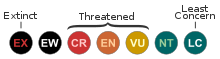
IUCN Red List
Growth: S = slow M = medium F = fast. Soil: L = light (sandy) M = medium H = heavy (clay). pH: A = acid N = neutral B = basic (alkaline). Shade: F = full shade S = semi-shade N = no shade. Moisture: D = dry M = Moist We = wet Wa = water.
Support Plants For A Future
Plants For A Future relies on regular donations to keep our free database and search facilities going, to pay for ongoing research, improvements and enhancements, and to develop and publish new books.
Read more
Choose Currency
Donate in £ GBP
Donate in $ USD
Donate in € EUR
Securely pay via PayPal or Credit/Debit Card without an account.
Expert comment
Author
J.W.Ingram.&H.E.Moore.
Botanical References
200
Links / References
For a list of references used on this page please go here
Readers comment
| Add a comment |
|
If you have important information about this plant that may help other users please add a comment or link below. Only comments or links that are felt to be directly relevant to a plant will be included. If you think a comment/link or information contained on this page is inaccurate or misleading we would welcome your feedback at [email protected]. If you have questions about a plant please use the Forum on this website as we do not have the resources to answer questions ourselves.
* Please note: the comments by website users are not necessarily those held by PFAF and may give misleading or inaccurate information.
|
Subject : Citroncirus webberi
|
|
|
|