

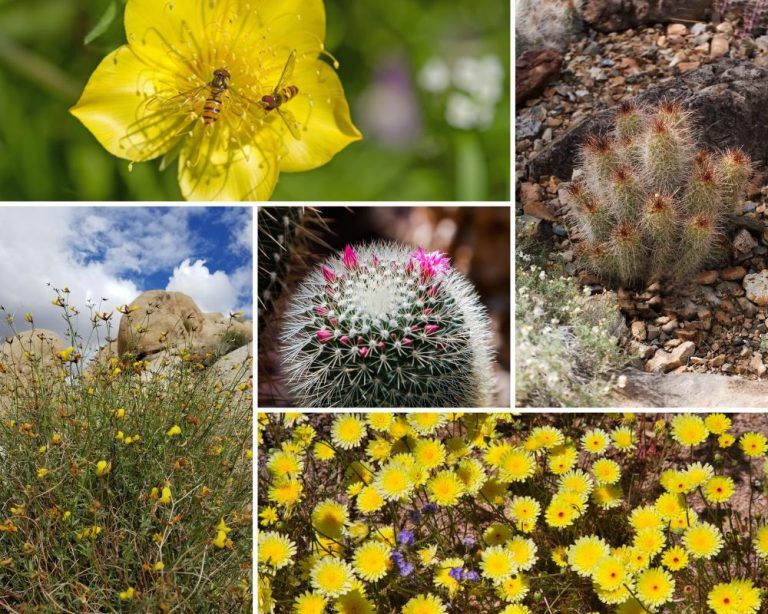
Sixteen new species joined the PFAF database in October, alongside substantial updates to 23 existing plant records.
The Plants For A Future Southwest Expansion moved through thorn scrub, wolfberry thickets, cactus country and blazingstar seed heads in October 2026. This month’s work added or improved 39 plant profiles, bringing together dependable desert fruits, traditional seed foods, pollinator plants and several species whose ecological value is far greater than their value to a forager.
The sixteen new records range from the juicy berries of Baja and Arizona wolfberries to tiny cactus fruits and the nutty seeds of desert wildflowers. They also underline two recurring lessons: traditional use does not remove the need for modern safety context, and slow-growing or protected wild plants should be appreciated rather than harvested.
October at a glance
- 39 plant profiles were added or updated.
- Sixteen plants are new to the PFAF database.
- The new plants span six botanical families, with particularly strong additions among cacti and blazingstars.
- October adds detail on desert fruit, edible seed, xeriscaping, pollinators, conservation and plant chemistry.
All plants added or updated in October 2026
Follow any name below to open its full PFAF database profile. Plants marked new were added to the database this month.
- New: Acmispon rigidus
- Lycium andersonii A. Gray
- Lycium berlandieri Dunal
- New: Lycium brevipes Benth.
- New: Lycium exsertum A. Gray
- Lycium fremontii A. Gray
- Lycium pallidum Miers
- Lycium torreyi A. Gray
- Lycopus americanus
- Lycopus asper Greene
- Lycopus uniflorus Michx.
- Lygodesmia grandiflora
- Lygodesmia juncea
- Madia glomerata
- Smilacina racemosa
- Smilacina stellata
- New: Malacothrix californica
- Malva neglecta
- Malva parviflora L.
- Malva verticillata
- New: Cochemiea dioica
- New: Cochemiea grahamii
- New: Mammillaria heyderi
- New: Mammillaria meiacantha
- New: Cochemiea tetrancistra
- New: Cochemiea thornberi (syn. Mammillaria thornberi)
- New: Cochemiea wrightii
- Marrubium vulgare
- Medicago lupulina
- Medicago polymorpha
- Melilotus albus
- Melilotus indicus
- Melilotus officinalis
- New: Mentzelia affinis
- Mentzelia albicaulis
- New: Mentzelia congesta
- New: Mentzelia dispersa
- New: Mentzelia involucrata
- New: Mentzelia laevicaulis
New plants added to the PFAF database
The ratings below use the familiar PFAF five-point scale. A low edible rating does not mean a plant lacks value: many of October’s cacti are more important as slow-growing components of desert biodiversity than as sources of their small edible fruits.
| Species | Common name | Family | Edible | Medicinal | Other | Main importance |
|---|---|---|---|---|---|---|
| Acmispon rigidus | Shrubby deervetch | Fabaceae | 1 | 0 | 2 | Pollinator shrub and butterfly host with toxicity warning |
| Lycium brevipes | Baja wolfberry | Solanaceae | 5 | 2 | 3 | Excellent desert fruit and wildlife thicket |
| Lycium exsertum | Arizona wolfberry | Solanaceae | 5 | 0 | 2 | Dependable sweet fruit in arid landscapes |
| Malacothrix californica | California desert dandelion | Asteraceae | 3 | 2 | 2 | Traditional toasted seed and early desert flowers |
| Cochemiea dioica | Strawberry cactus | Cactaceae | 2 | 0 | 2 | Edible red fruit, ornamental and wildlife cactus |
| Cochemiea grahamii | Graham’s pincushion cactus | Cactaceae | 2 | 1 | 2 | Pink flowers, small fruit and desert biodiversity |
| Mammillaria heyderi | Little pincushion cactus | Cactaceae | 2 | 2 | 2 | Long-lived rock-garden cactus and wildlife fruit |
| Mammillaria meiacantha | Little nipple cactus | Cactaceae | 2 | 2 | 2 | Small desert cactus with minor edible fruit |
| Cochemiea tetrancistra | Common fishhook cactus | Cactaceae | 2 | 0 | 2 | Hook-spined cactus with conservation value |
| Cochemiea thornberi | Thornber’s fishhook cactus | Cactaceae | 2 | 0 | 2 | Sonoran cactus, pollinator flowers and wildlife fruit |
| Cochemiea wrightii | Wright’s pincushion cactus | Cactaceae | 2 | 0 | 2 | Outstanding flowers and minor edible fruit |
| Mentzelia affinis | Yellowcomet blazingstar | Loasaceae | 3 | 0 | 2 | Traditional Kawaiisu seed food and desert annual |
| Mentzelia congesta | United blazingstar | Loasaceae | 3 | 0 | 2 | Traditional seed meal and dryland wildflower |
| Mentzelia dispersa | Bushy blazingstar | Loasaceae | 3 | 0 | 2 | Peanut-flavoured seed and sagebrush wildlife plant |
| Mentzelia involucrata | Whitebract blazingstar | Loasaceae | 5 | 0 | 2 | Easily gathered, excellent desert seed |
| Mentzelia laevicaulis | Smoothstem blazingstar | Loasaceae | 3 | 0 | 2 | Edible winged seed and showy dryland perennial |
Meet October’s sixteen new plants
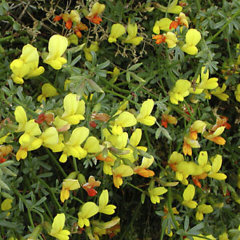
Acmispon rigidus — shrubby deervetch
Shrubby deervetch is a rigid, orange-yellow-flowered shrub of Mojave and Sonoran rocky slopes. Early settlers brewed its leaves and flowers as “Hills tea”, but the plant contains cyanogenic glycosides and should not be treated as a general food.
What makes it interesting: As a drought-tolerant native legume it suits xeriscapes, supports bees and other pollinators and serves as a larval host for desert butterflies. Its roots can also contribute to holding dry, stony ground.
Use with care: Cyanogenic glycosides can release toxic hydrogen cyanide. Historical tea use is not evidence that casual preparation is safe.
View shrubby deervetch in the PFAF database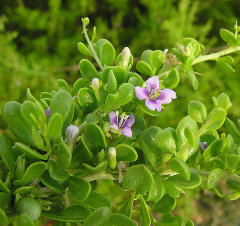
Lycium brevipes — Baja wolfberry
Baja wolfberry is a thorny Sonoran Desert shrub producing soft, juicy berries that were an important seasonal food in extremely arid country. Ripe fruit can be eaten fresh, cooked or dried, while the shrub thrives with very little water once established.
What makes it interesting: Rain triggers vigorous new growth and can transform a severe-looking thorn thicket into a productive fruit crop. Flowers feed native bees; berries feed birds and mammals; dense branches create nesting cover.
Use with care: Confirm identification, negotiate the sharp thorns carefully and eat ripe berries in moderation because large quantities may upset digestion.
View Baja wolfberry in the PFAF database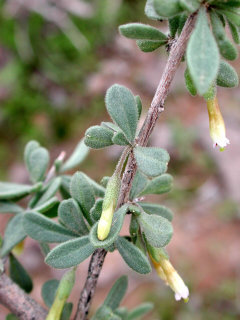
Lycium exsertum — Arizona wolfberry
Arizona wolfberry is one of the most dependable native fruit shrubs of the Sonoran and Chihuahuan deserts. It grows in washes, alluvial flats and rocky scrub, producing sweet, fleshy berries that need little preparation.
What makes it interesting: The plant combines drought survival with genuine food quality. After seasonal rain its new shoots can carry abundant fruit, while the thorny framework protects small wildlife and makes a useful native hedge.
Use with care: Eat only fully ripe, correctly identified berries and use moderation; excessive quantities can cause stomach upset.
View Arizona wolfberry in the PFAF database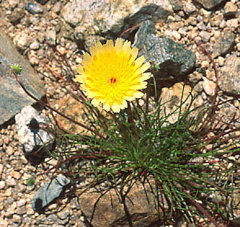
Malacothrix californica — California desert dandelion
This fast annual can be one of the Mojave and Sonoran deserts’ most abundant spring flowers after winter rain. Despite the common name, it is the seed-like cypselae—not the leaves or roots—that have a supported traditional food use. Toasted, they develop a pleasant flavour and can be ground into flour.
What makes it interesting: Seed heads must be gathered before the wind carries them away. The same early bloom that creates a short human harvest also provides timely pollen and nectar for desert insects.
Use with care: Do not assume true-dandelion uses apply. Only the seed is supported as edible; leaves and roots lack adequate evidence.
View California desert dandelion in the PFAF database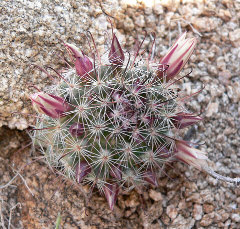
Cochemiea dioica — strawberry cactus
Strawberry cactus is a small pincushion cactus of southern California and Baja California. It produces attractive flowers followed by edible red fruit, but the crop is too small to make the plant an important food.
What makes it interesting: Birds and small mammals eat the fruits and distribute the seed, while native bees visit the flowers. In cultivation, its compact form suits specialist cactus collections and dry rock gardens.
Use with care: Many native cacti are uncommon or legally protected. Never remove wild plants, and do not collect fruit where local protection or population size makes harvesting inappropriate.
View strawberry cactus in the PFAF database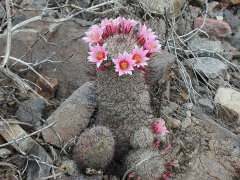
Cochemiea grahamii — Graham’s pincushion cactus
Graham’s pincushion cactus is a familiar small cactus of Arizona, New Mexico and northern Mexico. Rings of pink flowers are followed by bright red edible fruits, historically eaten in small quantities.
What makes it interesting: The ring of flowers emerges from the upper stem as growth progresses, making the plant visually distinctive. Its fruit is more valuable to birds and seed dispersal than as a substantial human harvest.
Use with care: Fruit production is limited and wild plants may be protected. Appreciate natural populations without harvesting them.
View Graham’s pincushion cactus in the PFAF database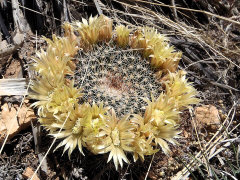
Mammillaria heyderi — little pincushion cactus
Little pincushion cactus sits low among desert grassland, limestone outcrops and gravelly flats from the Southwest into northern Mexico. Its red fruits are edible but sparse, making the species a minor traditional food rather than a practical crop.
What makes it interesting: A plant only about 10 centimetres across may live for decades. That slow investment explains both its resilience and its vulnerability to collection or disturbance.
Use with care: Wild populations may be protected or locally rare. Historical folk or psychoactive claims remain unconfirmed and should not be treated as guidance.
View little pincushion cactus in the PFAF database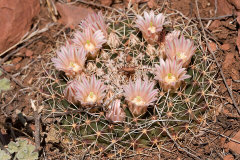
Mammillaria meiacantha — little nipple cactus
Little nipple cactus is another compact desert species with edible red fruits. It grows on rocky slopes and gravelly plains from New Mexico and western Texas into northern Mexico, surviving on excellent drainage and very limited moisture.
What makes it interesting: Pollinating insects use its flowers, while birds and mammals consume the fruits and move seed through the landscape. This small ecological exchange matters more than the plant’s limited food yield.
Use with care: Do not interpret historical ritual associations of related cacti as evidence of safety or pharmacological value. Avoid harvesting protected wild populations.
View little nipple cactus in the PFAF database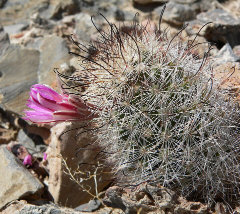
Cochemiea tetrancistra — common fishhook cactus
Common fishhook cactus occupies gravelly bajadas, washes and rocky hillsides across the Mojave and Sonoran deserts. Curved central spines give the plant its name; red fruits are edible but too few to represent a meaningful food source.
What makes it interesting: The hooked spines are an effective identification feature and a formidable defence. Flowers support insects, and fruit consumption by wildlife helps colonise suitable gaps in desert scrub.
Use with care: Spines can cause injury, and many populations are protected. Wild collection is inappropriate even where the fruits have a recorded edible use.
View common fishhook cactus in the PFAF database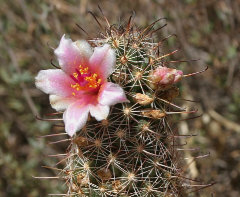
Cochemiea thornberi — Thornber’s fishhook cactus
Thornber’s fishhook cactus is a slow-growing Sonoran Desert species of southern Arizona and Sonora. Hooked spines, colourful flowers and bright red fruit make it distinctive; the fruit is edible fresh but produced only sparingly.
What makes it interesting: The accepted record uses Cochemiea thornberi, while readers may know the older name Mammillaria thornberi. Recording synonyms helps connect modern taxonomy with older field guides and ethnobotanical sources.
Use with care: Conservation takes priority over a tiny fruit harvest. Do not disturb uncommon or protected wild plants.
View Thornber’s fishhook cactus in the PFAF database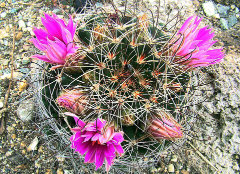
Cochemiea wrightii — Wright’s pincushion cactus
Wright’s pincushion cactus grows through desert grassland and rocky scrub from eastern Arizona to western Texas and northern Mexico. Large pink-to-purple flowers can dwarf the small body of the plant, followed by edible red fruits.
What makes it interesting: It is one of the most ornamental species in this group. The visual investment in a few spectacular flowers makes the cactus valuable to collectors and pollinators even though its fruit yield remains slight.
Use with care: Cultivated, legally sourced plants are the appropriate way to enjoy this slow-growing species. Leave wild fruit and plants to their ecosystem.
View Wright’s pincushion cactus in the PFAF database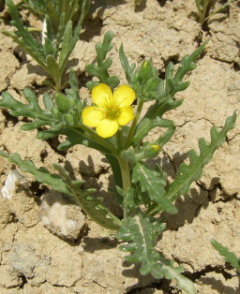
Mentzelia affinis — yellowcomet blazingstar
Yellowcomet blazingstar is a small desert annual with yellow flowers, adhesive foliage and capsules of tiny edible seeds. The Kawaiisu traditionally gathered the seed as a seasonal food, processing it into meal, porridge or seed butter.
What makes it interesting: It is closely associated with creosote-bush scrub and completes its life cycle on winter and spring moisture before extreme summer heat. Rough leaves that cling to clothing explain the group’s “stickleaf” name.
Use with care: Similar blazingstars are difficult to distinguish and some Mentzelia accumulate selenium. Positive species and site identification are essential.
View yellowcomet blazingstar in the PFAF database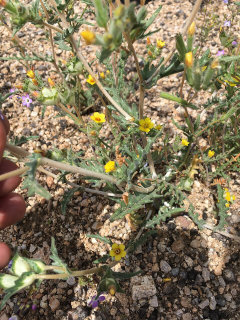
Mentzelia congesta — united blazingstar
United blazingstar is an annual of sagebrush, pinyon-juniper woodland and open pine habitat, especially in California and Nevada. The Kawaiisu harvested its small seeds and ground them into meal.
What makes it interesting: This plant occupies dry middle elevations rather than the hottest desert floor, extending the blazingstar seed-food story into woodland openings and exposed rocky slopes. Flowers also supply pollen to native bees.
Use with care: Small seeds demand considerable work, and close Mentzelia species can be hard to separate. Avoid selenium-rich or contaminated ground.
View united blazingstar in the PFAF database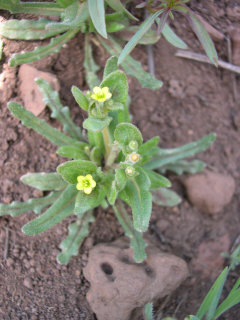
Mentzelia dispersa — bushy blazingstar
Bushy blazingstar ranges widely across western grassland, sagebrush and dry woodland. Washoe, Southern Paiute, Western Shoshone and Kawaiisu peoples roasted and ground its seeds into flour-based foods; one account compares the flavour with peanut butter.
What makes it interesting: Greater sage-grouse eat accessible flowers and leaves, making the plant part of a much larger sagebrush food web. It also colonises disturbed, gravelly ground and supports pollinating insects.
Use with care: Identification and soil conditions matter because some blazingstars accumulate selenium. The tiny seed also requires patient cleaning and processing.
View bushy blazingstar in the PFAF database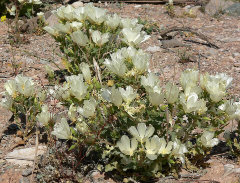
Mentzelia involucrata — whitebract blazingstar
Whitebract blazingstar is October’s standout new seed plant. Upright cup-shaped capsules allow the seeds to be poured out with relatively little cleaning, and field notes describe a distinctive flavour reminiscent of pancakes and eggs. Seeds can be eaten raw, boiled or lightly toasted.
What makes it interesting: Easy harvest is unusual among small-seeded desert annuals. Pale bracts frame the yellow flowers, giving the plant ornamental promise for dry gardens as well as value to spring pollinators.
Use with care: Availability varies sharply with rainfall. Confirm identification and avoid selenium-rich or polluted collection sites; long-term dietary information remains limited.
View whitebract blazingstar in the PFAF database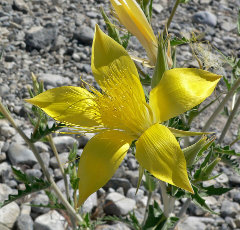
Mentzelia laevicaulis — smoothstem blazingstar
Smoothstem blazingstar is a large perennial rather than a small annual, carrying conspicuous golden flowers above pale stems on rocky Great Basin slopes and woodland margins. Its flat, winged seeds are edible and have a history of Indigenous use, though separating them from dry capsules takes effort.
What makes it interesting: A deep-rooted perennial can persist through unpredictable rainfall and return with a display far larger than most stickleafs. This makes it especially valuable for dryland restoration and naturalistic gardens.
Use with care: Correct identification remains essential, and the possibility of selenium accumulation makes the collection site as important as the species name.
View smoothstem blazingstar in the PFAF databaseA database record is a starting point, not a foraging shortcut
Correct identification, plant part, preparation, conservation status and collection site all matter. October’s records include a tea plant capable of releasing hydrogen cyanide, nightshade-family fruits that should be eaten only when ripe, slow-growing protected cacti and blazingstars that may accumulate selenium. Never consume a wild plant from a name, photograph or rating alone.
What the October updates add
The 23 revised records create useful groups for comparison. Seven wolfberries now show how native desert fruits differ in range, flavour and growth, while three bugleweeds add a wetland contrast. Updates to mallows, medicks and sweetclovers expand the treatment of familiar introduced or naturalised plants, including both their practical uses and their weed or toxicity concerns.
October also strengthens the story around western seed plants. Tarweeds, skeletonplants and the existing white-stem blazingstar record sit alongside five new Mentzelia profiles, making it easier to compare traditional harvesting, seed size, processing effort and ecological value.
Fruit, flowers and conservation
The two wolfberries are the strongest fruit additions this month. Both turn scarce desert water into a genuinely useful crop and shelter wildlife within thorny branches. The cactus records offer a different lesson: an edible fruit can be real yet still be too scarce—and the plant too slow-growing or protected—to justify harvesting.
Among the blazingstars, whitebract blazingstar stands out because its seed is both pleasant and unusually easy to collect. Others require more work but preserve important records of Indigenous food use. Together they demonstrate why yield, processing and conservation belong beside the simple question “is it edible?”
The Southwest Expansion continues
Each addition makes the database better at showing not just what a plant has been used for, but whether that use is practical, safe and responsible today. The Southwest Expansion continues to connect traditional knowledge, field observation, cultivation and ecology across one of North America’s most varied botanical regions.
Explore the linked profiles above for full identification, habitat, cultivation, edible, medicinal, safety and ecological information behind October’s work.