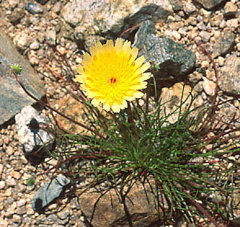
 |
|
Public domain |
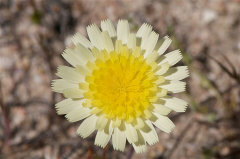 |
| jkirkhart35. Creative Commons Attribution 2.0 |
Translate this page:
Summary
California desert dandelion is one of the most abundant spring wildflowers of the Mojave and Sonoran deserts. Despite its common name, it differs significantly from true dandelions (Taraxacum spp.) in its edible uses. Rather than the roots or leaves, it is the seeds (contained within the cypselae) that have traditionally been gathered as food by Native Americans. The plant blooms early in the year and produces abundant seed heads that can provide a useful seasonal food resource when harvested before they disperse in the wind.
Physical Characteristics

 Malacothrix californica is a ANNUAL growing to 0.6 m (2ft) by 0.3 m (1ft in) at a fast rate.
See above for USDA hardiness. It is hardy to UK zone 9. It is in flower from February to May. The flowers are pollinated by Bees, Insects.
It is noted for attracting wildlife.
Suitable for: light (sandy) and medium (loamy) soils, prefers well-drained soil and can grow in nutritionally poor soil. Suitable pH: mildly acid, neutral and basic (mildly alkaline) soils. It cannot grow in the shade. It prefers dry or moist soil and can tolerate drought.
UK Hardiness Map
US Hardiness Map
Synonyms
Malacothrix californica var. glabrata A.Gray ex D.C.Eaton
Plant Habitats
Edible Uses
California desert dandelion is an overlooked but worthwhile desert food plant. Its toasted cypselae have a pleasant flavor and can be ground into flour, making them a useful seasonal seed crop. Although the roots and leaves resemble true dandelions in flavor, no evidence supports their traditional use as food. For experienced desert foragers, the seeds represent the only recommended edible part and an excellent example of how common names can sometimes be misleading [2-3]. Only the seeds (contained within the cypselae) are reported to be edible. The roots and leaves have not been reported as edible, although they were sampled during the fieldwork described in your source [2-3]. Edibility Rating: 3 out of 5 – A worthwhile native seed crop that is easy to harvest at the right time, although processing is somewhat laborious [2-3]. Taste and Preparation: The edible portion consists of the seeds enclosed within the dry fruits (cypselae). Harvesting is straightforward provided it is done before strong winds disperse the mature seed heads. The fluffy pappus readily separates from the cypselae, making the initial cleaning process relatively easy, although removing the actual seeds from the fruit is more difficult. Fresh cypselae have a pleasant flavor with a slightly gummy texture that clearly suggests food value. Toasting greatly improves both flavor and texture, producing a crisp, brittle food free from bitterness or other unpleasant flavors. The cypselae are also suitable for grinding into flour. Although the roots and leaves were investigated during fieldwork, they are not reported to be edible. The roots were mild but tough and fibrous, while the leaves resembled romaine lettuce with a slight bitter overtone. Cooking produced a green broth and softened the tissues considerably, but without ethnobotanical evidence supporting their use, they should not be regarded as edible [2-3]. Seasonality: California desert dandelion blooms from February to May, with mature cypselae generally available from April through July. Traditional Uses: Native Americans of the Mojave and Sonoran deserts traditionally harvested the seeds for food. They collected, processed, and ground the cypselae into flour. No traditional use of the roots or leaves has been documented [2-3]. Safety: Traditional records support only the seeds as edible. Although the roots and leaves appeared reasonably palatable during field observations, no ethnobotanical evidence confirms their safety, so they should not be consumed. Positive identification is important because other Malacothrix species have not been documented as edible [2-3].
References More on Edible Uses
Medicinal Uses
Plants For A Future can not take any responsibility for any adverse effects from the use of plants. Always seek advice from a professional before using a plant medicinally.
California desert dandelion and its closely related varieties have recorded traditional medicinal uses in Indigenous ethnobotany. Little to no modern clinical or pharmacological research validates its therapeutic properties. Traditional and Ethnobotanical Uses: Blood Medicine: The roots of Malacothrix glabrata—closely intertwined with Malacothrix californica and often classified as its variety (Malacothrix californica var. glabrata) were traditionally prepared and used as a blood medicine by the White Mountain Apache. Antiemetic (Related Species): A close relative within the same genus, Malacothrix sonchoides (sowthistle desert dandelion), was traditionally used by the Navajo as an antiemetic to relieve vomiting. Beyond these historical native remedies, modern science has not thoroughly evaluated California desert dandelion for active chemical compounds, safety, or efficacy. Today, it is valued almost exclusively for its ecological role, acting as a crucial food source for desert wildlife like tortoises and bighorn sheep, and providing vital nectar for native pollinators.
References More on Medicinal Uses
Other Uses
California desert dandelion is well suited to native desert gardens. The bright yellow flowers provide nectar and pollen for native bees and other early-season pollinators. The seeds are also likely consumed by birds and small desert mammals. Its ecological role is acting as a crucial food source for desert wildlife like tortoises and bighorn sheep and providing vital nectar for native pollinators.
Special Uses
References More on Other Uses
Cultivation details
California desert dandelion thrives in full sun and well-drained sandy or gravelly soils. It is highly adapted to arid environments and commonly appears following winter rains. Habitat: This species occurs throughout the Mojave and Sonoran deserts, especially on sandy flats and washes in southern California, southern Nevada, western Arizona, and southwestern Utah. USDA Hardiness Zones: USDA Zones 8–11. Growth Rate: Fast. This annual species germinates after winter rainfall, flowers rapidly, and completes its life cycle before the onset of intense summer heat. Mature Size: Plants range from 4–60 cm (1.5–24 inches) tall, with flower stalks varying widely depending on growing conditions. Cultivation: California desert dandelion suits native desert gardens that receive full sun and excellent drainage. It readily self-seeds under favorable conditions. Identification: California desert dandelion is a stemless annual with milky sap and deeply divided, thread-like basal leaves. Each long, leafless flower stalk bears a single yellow flower head composed entirely of ray florets. The fruits are narrow cylindrical cypselae lacking the long beak characteristic of true dandelions, instead bearing several persistent awn-like and hair-like bristles. This absence of a beak is one of the easiest features distinguishing the genus from Taraxacum. Similar Species: The most similar species is smooth desert dandelion (Malacothrix glabrata), which differs by producing leafy stems with multiple flower heads rather than a single flower arising from a basal rosette. California desert dandelion also resembles true dandelions (Taraxacum spp.), but true dandelions produce distinctly beaked fruits, whereas Malacothrix fruits are not beaked.
References Carbon Farming Information and Carbon Sequestration Information
Temperature Converter
Type a value in the Celsius field to convert the value to Fahrenheit:
Fahrenheit:
Plant Propagation
Seed.
Other Names
If available other names are mentioned here
California desertdandelion, Desert dandelion.
Native Range
US. USA. California, Mexico Northwest.
Weed Potential
Right plant wrong place. We are currently updating this section.
Please note that a plant may be invasive in one area but may not
in your area so it's worth checking.
Low. This native annual readily reseeds itself but is not considered invasive.
Conservation Status
IUCN Red List of Threatened Plants Status : Not listed.
IUCN Red List
Growth: S = slow M = medium F = fast. Soil: L = light (sandy) M = medium H = heavy (clay). pH: A = acid N = neutral B = basic (alkaline). Shade: F = full shade S = semi-shade N = no shade. Moisture: D = dry M = Moist We = wet Wa = water.
Support Plants For A Future
Plants For A Future relies on regular donations to keep our free database and search facilities going, to pay for ongoing research, improvements and enhancements, and to develop and publish new books.
Read more
Choose Currency
Donate in £ GBP
Donate in $ USD
Donate in € EUR
Securely pay via PayPal or Credit/Debit Card without an account.
Expert comment
Author
DC.
Botanical References
Links / References
For a list of references used on this page please go here
Readers comment
| Add a comment |
|
If you have important information about this plant that may help other users please add a comment or link below. Only comments or links that are felt to be directly relevant to a plant will be included. If you think a comment/link or information contained on this page is inaccurate or misleading we would welcome your feedback at [email protected]. If you have questions about a plant please use the Forum on this website as we do not have the resources to answer questions ourselves.
* Please note: the comments by website users are not necessarily those held by PFAF and may give misleading or inaccurate information.
|
Subject : Malacothrix californica
|
|
|
|