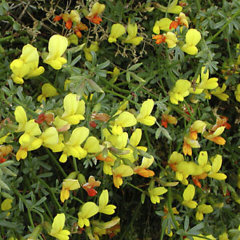
 |
|
Public domain |
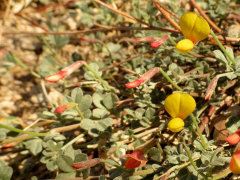 |
| Katja Schulz from Washington, D. C., USA. Creative Commons Attribution 2.0 |
Translate this page:
Summary
Shrubby deervetch is a native perennial shrub of the Mojave and Sonoran Deserts, particularly common in central Arizona. It is recognised by its rigid branching habit and clusters of bright orange-yellow pea-like flowers. Historically, early settlers brewed the leaves and flowers as a herbal tonic known as Hills tea. Although this tea has a pleasant flavour, the plant contains potentially dangerous cyanogenic glycosides, making it unsuitable as a general food plant.
Physical Characteristics

 Acmispon rigidus is a SHRUB growing to 1 m (3ft 3in) by 1 m (3ft 3in) at a medium rate.
See above for USDA hardiness. It is hardy to UK zone 9. It is in flower from February to May. The flowers are pollinated by Bees, Insects.
It is noted for attracting wildlife.
Suitable for: light (sandy) and medium (loamy) soils, prefers well-drained soil and can grow in nutritionally poor soil. Suitable pH: mildly acid, neutral and basic (mildly alkaline) soils. It cannot grow in the shade. It prefers dry or moist soil and can tolerate drought.
UK Hardiness Map
US Hardiness Map
Synonyms
Anisolotus rigidus (Benth.) Rydb. Hosackia rigida Benth. Lotus rigidus (Benth.) Greene. Ottleya rigida (Benth.) D.D.Sokoloff.
Plant Habitats
Edible Uses
Shrubby deervetch is an attractive native desert shrub with historical interest as the source of Hills tea. Its pleasant flavor has led to occasional traditional use, but the presence of potentially toxic cyanogenic glycosides means it is not recommended as a food plant. Today it is best appreciated for its ornamental value, drought tolerance, and importance to native pollinators rather than for its limited and potentially hazardous culinary use [2-3]. Warning: Shrubby deervetch should not be regarded as an edible food plant. The leaves and flowers have traditionally been used only for tea, but several species in this group contain cyanogenic glycosides, compounds that can release hydrogen cyanide. These toxins can cause rapid poisoning through respiratory failure. Traditional preparation involved steeping the leaves and flowers, removing the plant material, and then thoroughly boiling the liquid to drive off volatile toxic compounds. Even with this preparation, the safety of the tea remains uncertain, and routine consumption cannot be recommended [2-3]. Edibility Rating: 1 out of 5 – Primarily a traditional herbal tea plant with significant safety concerns. Do not consider it a food source [2-3]. Taste and Preparation: When prepared as a tea, shrubby deervetch has a pleasant herbal flavor with characteristics reminiscent of clover and vetch, but without the strong perfume-like notes found in many vetches. It often has a gentle sweetness and subtle fruity notes, along with similarities to South African honeybush tea. The leaves generally produce a richer and more balanced infusion than the flowers, while combining both gives the best flavor. The aromatic qualities remain after drying, allowing sprigs to be bundled and stored for later use. Individual leaves are small and sparse, making it easier to harvest entire leafy stems rather than picking leaves one by one [2-3]. Seasonality: Shrubby deervetch flowers from February to May. Young leafy shoots and flowers suitable for tea are available during the spring growing season [2-3]. Traditional Uses: Early settlers brewed the leaves and flowers as a tonic known as Hills tea. While this practice became locally popular, modern understanding of the plant's chemistry suggests considerable caution because of its cyanogenic compounds [2-3]. Safety: Shrubby deervetch contains cyanogenic glycosides, which can release toxic hydrogen cyanide if improperly prepared. These compounds are water-soluble and partly removed through prolonged boiling, but complete safety cannot be guaranteed. For this reason, the plant should not be consumed as a food, and even traditional tea preparations should be approached with caution [2-3].
References More on Edible Uses
Medicinal Uses
Plants For A Future can not take any responsibility for any adverse effects from the use of plants. Always seek advice from a professional before using a plant medicinally.
There are no documented medical uses. Ethnobotanical and pharmacological records for this exact species are marked as unknown. It belongs to a broader genus within the legume family (Fabaceae), where related species have traditional medicinal uses; for example, some Acmispon species (formerly classified under the genus Lotus) have historical records of being used internally and externally as traditional medicine. Related Species, for example, Acmispon wrightii (Wright's deervetch) was historically used by the Navajo and Zuni peoples as a topical poultice for swellings, a gastrointestinal aid for stomachaches, and a cathartic.
References More on Medicinal Uses
Other Uses
A drought-tolerant plant for xeriscaping and erosion control, and a vital larval host plant for native desert butterflies and bees. Shrubby deervetch suits native and drought-tolerant gardens. Its bright orange-yellow spring flowers make it attractive in desert landscapes. The flowers attract many native bees and other pollinating insects. As a native legume, it also contributes to desert ecosystem health and provides habitat and forage for wildlife.
Special Uses
References More on Other Uses
Cultivation details
Shrubby deervetch thrives in dry, sunny locations with well-drained rocky or gravelly soils. It is well adapted to hot desert climates and requires little supplemental water once established. Habitat: This species grows on rocky slopes, desert hillsides, and open shrublands of the Mojave and Sonoran Deserts, particularly at low to middle elevations in central Arizona and neighboring regions. USDA Hardiness Zones: USDA Zones 8–10. Growth Rate: Shrubby deervetch has a moderate growth rate and develops into a compact, woody shrub adapted to arid environments. Mature Size: Plants typically grow 30–110 cm (1–3.5 ft) tall. Cultivation: Shrubby deervetch suits native and drought-tolerant gardens. It prefers full sun and sharply drained soils and requires little maintenance once established. Its bright spring flowers make it attractive in desert landscapes. Identification: Shrubby deervetch is a woody perennial shrub with rigid stems and small compound leaves composed of three to five obovate leaflets. During spring it produces clusters of one to three bright orange-yellow pea-like flowers on long stalks arising from the leaf axils. The straight, flattened seed pods split open when mature. Compared with most other species formerly placed in Lotus, it is noticeably larger and more shrub-like. Similar Species: Shrubby deervetch resembles several other western species of Acmispon and Lotus. It is distinguished by its woody growth habit, rigid stems, relatively large size, rough-haired leaflets, and bright orange-yellow flowers. Many related species also contain cyanogenic glycosides and should not be assumed to be safe for consumption.
References Carbon Farming Information and Carbon Sequestration Information
Temperature Converter
Type a value in the Celsius field to convert the value to Fahrenheit:
Fahrenheit:
The PFAF Bookshop
Plants For A Future have a number of books available in paperback and digital form. Book titles include Edible Plants, Edible Perennials, Edible Trees,Edible Shrubs, Woodland Gardening, and Temperate Food Forest Plants. Our new book is Food Forest Plants For Hotter Conditions (Tropical and Sub-Tropical).
Shop Now
Plant Propagation
Propagation is generally by seed, although fresh seed often benefits from scarification or other treatments commonly used for members of the bean family to improve germination.
Other Names
If available other names are mentioned here
Shrubby deervetch, Desert rock-pea, Hills tea.
Native Range
US. USA. Arizona, California, Mexico Northwest, Nevada, Utah.
Weed Potential
Right plant wrong place. We are currently updating this section.
Please note that a plant may be invasive in one area but may not
in your area so it's worth checking.
Low. Shrubby deervetch is a native desert shrub with no invasive tendencies.
Conservation Status
IUCN Red List of Threatened Plants Status : Not listed.
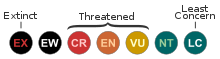
IUCN Red List
Growth: S = slow M = medium F = fast. Soil: L = light (sandy) M = medium H = heavy (clay). pH: A = acid N = neutral B = basic (alkaline). Shade: F = full shade S = semi-shade N = no shade. Moisture: D = dry M = Moist We = wet Wa = water.
Now available:
Food Forest Plants for Mediterranean Conditions
350+ Perennial Plants For Mediterranean and Drier Food Forests and Permaculture Gardens.
[Paperback and eBook]
This is the third in Plants For A Future's series of plant guides for food forests tailored to
specific climate zones. Following volumes on temperate and tropical ecosystems, this book focuses
on species suited to Mediterranean conditions—regions with hot, dry summers and cool, wet winters,
often facing the added challenge of climate change.
Read More
Expert comment
Author
(Benth.) Brouillet
Botanical References
Links / References
For a list of references used on this page please go here
Readers comment
| Add a comment |
|
If you have important information about this plant that may help other users please add a comment or link below. Only comments or links that are felt to be directly relevant to a plant will be included. If you think a comment/link or information contained on this page is inaccurate or misleading we would welcome your feedback at [email protected]. If you have questions about a plant please use the Forum on this website as we do not have the resources to answer questions ourselves.
* Please note: the comments by website users are not necessarily those held by PFAF and may give misleading or inaccurate information.
|
Subject : Acmispon rigidus
|
|
|
|