Translate this page:
Summary
Taxonomic Note: This genus was formerly classified in the family Taxodiaceae. Modern classifications include it within the Cupressaceae. Common juniper, Juniperus communis L., belongs to the cypress family (Cupressaceae) and the genus Juniperus. It is also known as common juniper, ground juniper and dwarf juniper. It is the most widely distributed conifer in the world, occurring across North America, Europe and Asia. Unlike most US southwestern junipers, it is usually a low-growing shrub, although in favorable climates it may occasionally develop into a small tree. Common juniper, is a coniferous evergreen shrub or tree with the largest geographical range of any woody plant. Size is very variable from a small prostrate spreading shrub to large trees. The form Juniperus communis compress for example only grows to 0.8m. The fruit is edible used as a flavouring in sauerkraut, stuffings, vegetable pates etc, and is an essential ingredient of gin. Medicinally it has antiseptic, aromatherapy, aromatic, carminative, diaphoretic, diuretic, rubefacient, stomachic and tonic properties. Many forms of this species are good ground cover plants for sunny situations. Forms to try include 'Depressa Aurea', 'Dumosa', 'Effusa', and 'Repanda'.
Bloom Color: Brown, Yellow. Main Bloom Time: Early spring, Late spring, Mid spring. Form: Oval, Prostrate, Spreading or horizontal, Upright or erect.
Physical Characteristics

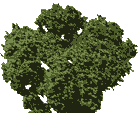 Juniperus communis is an evergreen Shrub growing to 9 m (29ft) by 4 m (13ft) at a slow rate.
See above for USDA hardiness. It is hardy to UK zone 3 and is not frost tender. It is in leaf all year, in flower from May to June, and the seeds ripen in October. The species is dioecious (individual flowers are either male or female, but only one sex is to be found on any one plant so both male and female plants must be grown if seed is required). and is pollinated by Wind. The plant is not self-fertile.
It is noted for attracting wildlife.
Suitable for: light (sandy), medium (loamy) and heavy (clay) soils, prefers well-drained soil and can grow in heavy clay and nutritionally poor soils. Suitable pH: mildly acid, neutral and basic (mildly alkaline) soils and can grow in very acid and very alkaline soils.
It can grow in semi-shade (light woodland) or no shade. It prefers dry or moist soil and can tolerate drought. The plant can tolerate maritime exposure.
UK Hardiness Map
US Hardiness Map
Synonyms
Juniperus albanica. Juniperus argaea. Juniperus compressa. Juniperus kanitzii.
Plant Habitats
Woodland Garden Secondary; Sunny Edge; Dappled Shade; Ground Cover; Cultivated Beds;
Edible Uses
Edible Parts: Fruit Leaves Seed
Edible Uses: Coffee Condiment Tea
Only the mature fleshy seed cones are edible, and then only in small quantities. The young green cones are extremely resinous and unsuitable for eating. Leaves, bark, wood and roots are not edible [2-3]. Mature cones have a pleasant sweetness beneath their resinous flavor. They have traditionally been used to flavor meat, sauerkraut, game, marinades, fermented beverages and spirits. They can also be dried and used as a spice. The first impression is sweet and fruity, but this is quickly overwhelmed by intensely acrid, throat-burning resins. Cooking softens the fruits but has little effect on the resin content [2-3]. Because the cones contain relatively large seeds surrounded by only a modest quantity of edible flesh, they are not especially efficient as a source of calories. The fruits are therefore best viewed as an aromatic flavoring rather than a substantial wild food. Edibility Rating: 2/5. Common juniper receives an overall edibility rating of 2 out of 5. Although the fruits are edible and widely used in traditional cookery, their high resin content severely limits how much can be consumed safely or pleasantly. Their value lies in seasoning foods rather than providing nutrition. Taste, Processing & Culinary Use: Fully mature second-year fruits are distinctly sweet when first tasted. This sweetness is quickly followed by strong resinous, pine-like flavours and a noticeable burning sensation in the throat. The fruits have a mealy texture with three hard seeds occupying much of the interior. The blue outer surface covers pale green flesh rather than juicy pulp. Fresh fruits may be chewed in very small amounts, but they are much better suited to drying and using as a spice. Drying concentrates both the sweetness and the aromatic oils. Crushed dried fruits are widely used to season venison, pork, duck, cabbage Our field observations suggest that reducing the fruits to a syrup produces an intensely sweet flavoring, although the acrid resins remain prominent. The fruits may also be steeped to make tea or infusions, but prolonged boiling extracts additional resins and bitterness. Unlike sweeter wild fruits, common juniper should always be used sparingly [2-3]. Seasonality (Phenology): Common juniper is evergreen and remains recognizable year-round. Flowering usually occurs during spring. The female cones require two years to mature. During the first season they remain green, firm and highly resinous. During the second autumn they become blue-black with a waxy bloom and develop their characteristic sweetness. Unlike many fruits, mature cones often remain attached for another year or longer, allowing harvesting over an extended period. This persistence makes common juniper one of the few reliable wild flavoring plants available throughout much of the winter. Safety & Cautions: Common juniper should be consumed only in small amounts. The fruits contain essential oils and resinous compounds that may irritate the kidneys if consumed frequently or in large quantities. Excessive consumption has been associated with kidney irritation, and medicinal doses should not be used during pregnancy. Individuals with kidney disease should avoid consuming the fruits except under professional supervision. Young green fruits are substantially more resinous than mature ones and should not be eaten. Although culinary use as a seasoning is considered safe, regular consumption of large quantities is not recommended. The needle-like foliage is not edible and should not be consumed. Harvest & Processing: Harvest only fully mature blue-black fruits. Leave green first-year cones to mature for another season. Because mature and immature fruits commonly occur together on the same shrub, careful selection is necessary. Wear gloves when gathering, as the stiff, needle-like leaves can be sharp. You can use fresh fruits immediately or dry them in a warm, well-ventilated location until firm. Once dry, they store well in airtight containers for many months. The fruits may be lightly crushed before cooking to release their aromatic oils. Only a few fruits are normally required to flavor an entire dish [2-3]. Traditional Indigenous Uses: Native peoples of North America occasionally used the fruits as food or flavoring, although the species was generally less important than sweeter southwestern junipers. Throughout Europe, juniper has a much longer documented history as both a medicinal and culinary plant. The dried fruits became an important seasoning for preserved meats because their aromatic oils helped mask strong flavors while contributing antimicrobial properties. Juniper also became a defining flavoring ingredient in gin and numerous traditional herbal preparations. Despite these culinary uses, the fruits have almost never been regarded as a staple food. Nutritional Value: Common juniper fruits contain natural sugars together with volatile oils, terpenes and aromatic resins. Although they provide some carbohydrate, the edible portion surrounding the seeds is relatively small. They are consumed primarily for flavor rather than nutritional value. Their importance lies in aromatic compounds rather than calories. Fruit - raw or cooked[2, 5, 9, 15]. It is usually harvested in the autumn when fully ripe and then dried for later use[12]. A soft, mealy, sweet, resinous flesh[82]. The fruit is often used as a flavouring in sauerkraut, stuffings, vegetable pates etc, and is an essential ingredient of gin[183]. The aromatic fruit is used as a pepper substitute according to one report[183]. An essential oil is sometimes distilled from the fruit to be used as a flavouring[183]. Average yields are around 1%[7]. The cones are about 4 - 8mm in diameter and take 2 - 3 years to mature[82, 200]. Some caution is advised when using the fruit, see the notes above on toxicity. The roasted seed is a coffee substitute[177]. A tea is made by boiling the leaves and stems[161]. A tea made from the berries has a spicy gin-like flavour[183].
References More on Edible Uses
Medicinal Uses
Plants For A Future can not take any responsibility for any adverse effects from the use of plants. Always seek advice from a professional before using a plant medicinally.
Antiseptic Aromatherapy Aromatic Carminative Diaphoretic Diuretic Rubefacient Stomachic
Tonic Urinary
Juniper fruits are commonly used in herbal medicine, as a household remedy, and also in some commercial preparations. They are especially useful in the treatment of digestive disorders plus kidney and bladder problems[4]. The fully ripe fruits are strongly antiseptic, aromatic, carminative, diaphoretic, strongly diuretic, rubefacient, stomachic and tonic[4, 7, 9, 21, 46, 165, 240, 254]. They are used in the treatment of cystitis, digestive problems, chronic arthritis, gout and rheumatic conditions[254]. They can be eaten raw or used in a tea[222], but some caution is advised since large doses can irritate the urinary passage[4]. Externally, it is applied as a diluted essential oil, having a slightly warming effect upon the skin and is thought to promote the removal of waste products from underlying tissues[254]. It is, therefore, helpful when applied to arthritic joints etc[254]. The fruits should not be used internally by pregnant women since this can cause an abortion[9]. The fruits also increase menstrual bleeding so should not be used by women with heavy periods[254]. When made into an ointment, they are applied to exposed wounds and prevent irritation by flies[4]. The essential oil is used in aromatherapy. Its keyword is 'Toxin elimination'[210].
References More on Medicinal Uses
The Bookshop: Edible Plant Books
Our Latest books on Perennial Plants For Food Forests and Permaculture Gardens in paperback or digital formats.
Edible Tropical Plants
Food Forest Plants for Hotter Conditions: 250+ Plants For Tropical Food Forests & Permaculture Gardens.
More
Edible Temperate Plants
Plants for Your Food Forest: 500 Plants for Temperate Food Forests & Permaculture Gardens.
More
More Books
PFAF have eight books available in paperback and digital formats. Browse the shop for more information.
Shop Now
Other Uses
Fibre Fuel Hair Incense Repellent Resin Strewing Tinder
Landscape Uses: Specimen. Agroforestry uses: Junipers can be used as windbreaks or hedges and are often employed in erosion control due to their extensive root systems. They also provide habitat and shelter for wildlife. A decoction of the branches is used as an anti-dandruff shampoo[172]. The essential oil distilled from the fruits is used in perfumes with spicy fragrances[238]. In hot countries the tree yields the resin 'Sandarac' from incisions in the trunk[4, 74]. This is used in the production of a white varnish[74]. The stems were at one time used as a strewing herb to sweeten the smell of rooms[14, 244]. The whole plant can be burnt as an incense and fumigant[66, 102, 146]. It was used during epidemics in the belief that it would purify the air and cleanse it of infection[244]. Fresh or dried juniper branches also make a good insect repellent[102, 172]. Many forms of this species are good ground cover plants for sunny situations[208]. Forms to try include 'Depressa Aurea', 'Dumosa', 'Effusa', and 'Repanda'[197]. 'Prostrata' can also be used[188]. The bark is used as cordage[61] and as a tinder[172]. Wood - strong, hard, fragrant, very durable in contact with the soil and very close-grained, but usually too small to be of much use[82, 229, 244, 245]. It makes an excellent fuel[66]. Wildlife & Ecology: The fruits are eaten by numerous birds, including thrushes, waxwings, and grouse, together with mammals such as foxes and small rodents. Birds are the principal agents of seed dispersal. Dense evergreen foliage provides valuable nesting habitat and winter shelter for birds and small mammals. The shrub is also an important component of alpine and boreal ecosystems where relatively few woody plants occur. Pollinators: Like all junipers, common juniper is wind-pollinated. Male shrubs release large quantities of pollen during spring. Female shrubs receive airborne pollen and subsequently produce the fleshy seed cones. Because male and female cones are usually borne on separate plants, fruit production requires nearby pollen-producing shrubs. The species offers little nectar for insect pollinators. 1. Nectary - Flowers rich in nectar and pollen:
No – Juniper species produce small, inconspicuous flowers that do not produce significant nectar. However, they do release pollen, which can be a food source for some insects, though not in large quantities.
2. Wildlife - Food (Fruit, Seeds, Leaf litter, Shelter, Nesting, Roosting):
Yes – Juniper berries (technically cones) are a food source for many birds and mammals. The dense foliage provides good shelter, and some birds may nest or roost in the branches. Juniper is also used for cover by small wildlife.
3. Invertebrate Shelter (Overwintering sites, Leaf litter, Groundcover):
Yes – Juniper’s rough bark and dense foliage can provide overwintering sites for various invertebrates. The leaf litter from junipers can also serve as habitat for insects and other small creatures.
4. Pest Confuser (Smell):
Yes – The strong aroma of juniper, especially from its berries and leaves, can help deter certain pests. The volatile oils in juniper have natural insect-repellent properties.
Special Uses
Food Forest Ground cover Scented Plants
References More on Other Uses
Cultivation details
Landscape Uses: Specimen. An easily grown plant, it succeeds in hot dry soils and in poor soils. Succeeds in most soils so long as they are well-drained [186], preferring a neutral or slightly alkaline soil. Does well in chalky soils[1]. Grows well in heavy clay soils. Tolerates a pH range from 4 to 8[186]. Succeeds in light woodland but dislikes heavy shade[186]. Established plants are very drought-tolerant [186]. Although the fully dormant plant is cold-tolerant throughout Britain, the young growth in spring can be damaged by late frosts. All parts of the plant are very aromatic[245]. Juniper is a very polymorphic species that has a long history of culinary and medicinal use[244]. It is frequently grown in ornamental and herb gardens; there is a huge range of cultivars with widely diverse habits[11, 81]. At least some forms tolerate maritime exposure[186], there is a thriving colony in an exposed position at Land's End in Cornwall[81]. The fruits take 2 - 3 years to ripen on the plant[11]. Plants are usually very slow-growing, often only a few centimeters a year[186]. Resists honey fungus[88]. Plants are sometimes attacked by a rust, this fungus has an aecidial stage on hawthorn (Crataegus spp.)[1]. Dioecious. Male and female plants must be grown if seed is required. Special Features:
North American native, Fragrant foliage, Inconspicuous flowers or blooms. Juniper berries (the fleshy cones) are typically harvested in late summer to early autumn depending on the species. Junipers produce male cones in spring, while the female cones develop into berries over the summer. Growth rates vary by species, but many Junipers are considered slow to moderate growers, typically reaching maturity in 5 to 15 years, depending on environmental conditions and species. Identification: Common juniper is readily distinguished from all other native southwestern junipers by its sharp needle-like leaves arranged in whorls of three. Each needle bears a conspicuous white stomatal band on the upper surface. Most other western junipers have tiny, overlapping, scale-like leaves instead. The blue-black seed cones measure approximately 6–12 mm across and usually contain three seeds. The shrub's dense habit, stiff, prickly foliage, and aromatic crushed leaves make identification straightforward.
References Carbon Farming Information and Carbon Sequestration Information
Temperature Converter
Type a value in the Celsius field to convert the value to Fahrenheit:
Fahrenheit:
The PFAF Bookshop
Plants For A Future have a number of books available in paperback and digital form. Book titles include Edible Plants, Edible Perennials, Edible Trees,Edible Shrubs, Woodland Gardening, and Temperate Food Forest Plants. Our new book is Food Forest Plants For Hotter Conditions (Tropical and Sub-Tropical).
Shop Now
Plant Propagation
The seed requires a period of cold stratification. The seed has a hard seedcoat and can be very slow to germinate, requiring a cold period followed by a warm period and then another cold spell, each of 2 - 3 months duration[78, 81]. Soaking the seed for 3 - 6 seconds in boiling water may speed up the germination process[11]. The seed is best sown as soon as it is ripe in a cold frame. Some might germinate in the following spring, though most will take another year. Another possibility is to harvest the seed 'green' (when the embryo has fully formed but before the seedcoat has hardened). The seedlings can be potted up into individual pots when they are large enough to handle. Grow on in pots until large enough, then plant out in early summer. When stored dry, the seed can remain viable for several years[1]. Cuttings of mature wood, 5 - 10cm with a heel, September/October in a cold frame. Plant out in the following autumn[1, 78]. Layering in September/October. Takes 12 months[78].
Other Names
If available other names are mentioned here
Aaraar, Abhal, Betar, Borsika, Borsukafenyo, Chichia, Chui, Delinia, Dhup, Enebro, Genievre, Ginepro, Ginevro, Hab-ul-aaraar, Haubera, Haulber, Havusha, Hosha, Jadlovec, Jalovec, Jenever, Jhora, Kadakas, Pama, Petthri, Shur, Vapusha, Wacholder, Zinepro,
Native Range
TEMPERATE ASIA: Azerbaijan, China, Dagestan, Eastern Siberia, Georgia, Hokkaidô, Honshu, Japan, Jilin Sheng, Kamcatskij kraj, Kazakhstan (east), Korea, Kurile Islands, Kyrgyzstan, Russian Federation, Russian Federation, Russian Federation-Eastern Siberia, Russian Federation-Western Siberia, Sakhalin, Tajikistan, Turkey, Western Siberia, Xinjiang Uygur Zizhiqu, Xizang Zizhiqu,Afghanistan. TROPICAL ASIA: Nepal, Pakistan, NORTHERN AMERICA: Canada, Northwest Territories, Yukon, Québec, Nova Scotia, Ontario, Prince Edward Island, New Brunswick, Newfoundland and Labrador, Saskatchewan, Alberta, Manitoba, British Columbia, United States, Alaska, Connecticut, Indiana, Maine, Massachusetts, Michigan, New Hampshire, New York, Ohio, Pennsylvania, Rhode Island, Vermont, Illinois (north & east), Minnesota, North Dakota, South Dakota (northwest), Wisconsin, Colorado, Idaho, Montana, Oregon, Washington, Wyoming, Georgia (north), North Carolina, South Carolina, Virginia, New Mexico, Arizona, California, Nevada, Utah, EUROPE: Denmark, Finland, United Kingdom (U.K.), Ireland, Iceland, Norway, Sweden, Austria, Belgium, Switzerland, Czech Republic, Germany, Hungary, Netherlands, Poland, Slovakia, Russian Federation-European part, European part, Belarus, Estonia, Lithuania, Latvia, Moldova, Ukraine (incl. Krym), Albania, Bulgaria, Bosnia and Herzegovina, Greece, Croatia, Italy (incl. Sardinia, Sicily), Montenegro, Romania, Serbia, Slovenia, Spain, France (incl. Corsica), Portugal, AFRICA: Algeria (north), Morocco.
Weed Potential
Right plant wrong place. We are currently updating this section.
Please note that a plant may be invasive in one area but may not
in your area so it's worth checking.
Common juniper has very low weed potential. It grows slowly, establishes gradually from seed and spreads mainly through bird dispersal. Volunteer seedlings occasionally appear beneath bird perches but are easy to remove. For PFAF purposes, its weediness would be rated approximately 1/5 (very low).
Conservation Status
IUCN Red List of Threatened Plants Status : Juniperus communis is listed as Least Concern.
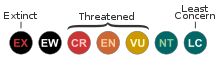
IUCN Red List
| Related Plants
|
| Latin Name | Common Name | Habit | Height | Hardiness | Growth | Soil | Shade | Moisture | Edible | Medicinal | Other |
| Juniperus ashei | Ashe Juniper, Mountain Cedar | Tree | 6.0 |
7-9
| S | LMH | N | DM | 1 | 0 | 2 |
| Juniperus californica | Californian Juniper, Chuperosa | Tree | 4.5 |
7-10
| S | LMH | N | DM | 2 | 1 | 3 |
| Juniperus chinensis | Chinese Juniper, Sargent juniper | Tree | 15.0 |
4-10
| S | LMH | N | DM | 0 | 2 | 3 |
| Juniperus communis nana | Juniper | Shrub | 0.5 |
4-10
| S | LMH | SN | DM | 3 | 3 | 4 |
| Juniperus conferta | Shore Juniper | Shrub | 0.2 |
6-10
| S | LMH | SN | DM | 2 | 0 | 3 |
| Juniperus deppeana | Alligator Juniper | Tree | 18.0 |
6-9
| S | LMH | N | DM | 3 | 0 | 3 |
| Juniperus drupacea | Syrian Juniper | Tree | 15.0 |
6-9
| M | LMH | N | DM | 3 | 0 | |
| Juniperus excelsa | Grecian Juniper | Tree | 20.0 |
5-9
| | LMH | N | DM | 2 | 1 | 3 |
| Juniperus horizontalis | Creeping Juniper, Horizontal Juniper | Shrub | 1.0 |
4-9
| M | LMH | N | DM | 2 | 1 | 3 |
| Juniperus monosperma | One-Seed Juniper | Tree | 8.0 |
5-9
| M | LMH | N | DM | 3 | 2 | 3 |
| Juniperus occidentalis | Western Juniper | Tree | 15.0 |
5-8
| S | LMH | N | DM | 2 | 2 | 3 |
| Juniperus osteosperma | Utah juniper, Desert Juniper | Tree | 8.0 |
3-7
| S | LMH | N | DM | 2 | 2 | 3 |
| Juniperus oxycedrus | Prickly Juniper, Cade juniper | Tree | 15.0 |
8-10
| M | LMH | N | DM | 0 | 1 | 3 |
| Juniperus phoenicea | Phoenician Juniper | Tree | 7.0 |
7-11
| S | LMH | SN | DM | 2 | 2 | 3 |
| Juniperus recurva | Himalayan Juniper | Tree | 12.0 |
6-9
| S | LMH | N | M | 1 | 1 | 1 |
| Juniperus rigida | Temple Juniper, Needle Juniper | Tree | 8.0 |
6-7
| S | LMH | N | DM | 2 | 1 | 3 |
| Juniperus sabina | Savine, Tam Juniper | Shrub | 4.0 |
4-7
| S | LMH | N | DM | 0 | 2 | 4 |
| Juniperus scopulorum | Rocky Mountain Juniper | Tree | 8.0 |
3-8
| S | LMH | N | DM | 2 | 2 | 4 |
| Juniperus silicicola | Southern Redcedar, Juniper, Southern Red Cedar | Tree | 20.0 |
7-10
| S | LMH | N | DM | 2 | 2 | 3 |
| Juniperus squamata | Flaky Juniper | Shrub | 4.0 |
4-7
| S | LMH | N | DM | 0 | 1 | 3 |
| Juniperus tetragona | | Tree | 0.0 |
7-10
| | LMH | N | DM | 2 | 0 | 2 |
| Juniperus virginiana | Pencil Cedar, Eastern redcedar, Southern redcedar, Silver Cedar, Burk Eastern Red Cedar, Silver East | Tree | 20.0 |
3-9
| S | LMH | N | DM | 2 | 2 | 4 |
|
Growth: S = slow M = medium F = fast. Soil: L = light (sandy) M = medium H = heavy (clay). pH: A = acid N = neutral B = basic (alkaline). Shade: F = full shade S = semi-shade N = no shade. Moisture: D = dry M = Moist We = wet Wa = water.
Now available:
Food Forest Plants for Mediterranean Conditions
350+ Perennial Plants For Mediterranean and Drier Food Forests and Permaculture Gardens.
[Paperback and eBook]
This is the third in Plants For A Future's series of plant guides for food forests tailored to
specific climate zones. Following volumes on temperate and tropical ecosystems, this book focuses
on species suited to Mediterranean conditions—regions with hot, dry summers and cool, wet winters,
often facing the added challenge of climate change.
Read More
Expert comment
Author
L.
Botanical References
1117200
Links / References
For a list of references used on this page please go here
Readers comment
| Add a comment |
|
If you have important information about this plant that may help other users please add a comment or link below. Only comments or links that are felt to be directly relevant to a plant will be included. If you think a comment/link or information contained on this page is inaccurate or misleading we would welcome your feedback at [email protected]. If you have questions about a plant please use the Forum on this website as we do not have the resources to answer questions ourselves.
* Please note: the comments by website users are not necessarily those held by PFAF and may give misleading or inaccurate information.
|
Subject : Juniperus communis
|
|
|
|