 |
|
(c) 2010 Ken Fern & Plants For A Future |
 |
| http://fr.wikipedia.org/wiki/Projet:Botanique/Accord_Henry_Brisse |
Translate this page:
Summary
Also sold as upland cress, early yellowrocket is a cool-season, European brassica grown for peppery salad leaves and raab-like bud shoots. It matures quickly in spring, bolts in heat, and can be succession-sown for greens. Naturalized patches occur but it is primarily culinary rather than wild in much of the Southwest. USDA zones: 4–9 (winter annual/biennial). Height/Spread: 20–60 cm × 20–40 cm.
Physical Characteristics

 Barbarea verna is a BIENNIAL growing to 0.3 m (1ft) by 0.3 m (1ft in).
See above for USDA hardiness. It is hardy to UK zone 5 and is not frost tender. It is in flower from May to July, and the seeds ripen from June to August. The species is hermaphrodite (has both male and female organs) and is pollinated by Flies, bees, beetles. The plant is self-fertile.
Suitable for: light (sandy), medium (loamy) and heavy (clay) soils and prefers well-drained soil. Suitable pH: mildly acid, neutral and basic (mildly alkaline) soils. It can grow in semi-shade (light woodland) or no shade. It prefers moist soil.
UK Hardiness Map
US Hardiness Map
Synonyms
B. praecox. (Sm.)R.Br. Campe verna.
Plant Habitats
Woodland Garden Sunny Edge; Dappled Shade; Shady Edge; not Deep Shade; North Wall. By.
Edible Uses
Edible Parts: Leaves Oil Seed
Edible Uses: Oil
Best parts: young leaves and raab. Window: late winter–spring. Rating: 3.5/5.Young leaves - raw, cooked or used as a seasoning[1, 2, 33, 37, 52]. A hot, spicy watercress flavour, they are delicious in salads[183, 244]. Leaves can be obtained throughout the year if autumn-sown plants are given a light protection in winter[1]. An edible oil is obtained from the seed[46, 52, 61, 183]. The seed can be sprouted and added to salads etc[183]. Taste, Processing & Kitchen Notes: Raw flavor: cress-like pepper with pleasant brassica sweetness when grown cool and irrigated evenly. Heat/drought ramps up pungency and bitterness. For mild results, cut at 10–15 cm rosette stage. Light blanching or quick sauté with fat/acid balances bite. Bud clusters compact and tasty [2-3]. Seasonality (Phenology): Sow: late summer–fall (overwinter rosettes) or very early spring. Harvest greens: late winter–spring. Flower/bolt: late spring; edible raab window is short. Seed: early summer.
References More on Edible Uses
Medicinal Uses
Plants For A Future can not take any responsibility for any adverse effects from the use of plants. Always seek advice from a professional before using a plant medicinally.
None known
References More on Medicinal Uses
The Bookshop: Edible Plant Books
Our Latest books on Perennial Plants For Food Forests and Permaculture Gardens in paperback or digital formats.
Edible Tropical Plants
Food Forest Plants for Hotter Conditions: 250+ Plants For Tropical Food Forests & Permaculture Gardens.
More
Edible Temperate Plants
Plants for Your Food Forest: 500 Plants for Temperate Food Forests & Permaculture Gardens.
More
More Books
PFAF have eight books available in paperback and digital formats. Browse the shop for more information.
Shop Now
Other Uses
Oil
Ecology & Wildlife: Early bloom for pollinators; greens host brassica herbivores supporting predatory beneficials.
Special Uses
Food Forest
References More on Other Uses
Cultivation details
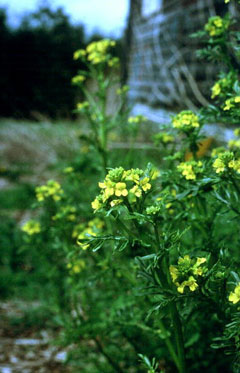
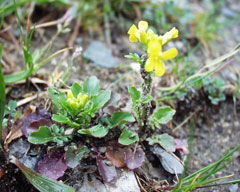
Identification & Habit: Annual/biennial; smooth, glabrous foliage. Basal leaves with more numerous lobes than the other species (diagnostic note); upper leaves lobed and partly clasping. Bright yellow 4-petaled flowers in racemes; elongating siliques ascending to appressed; short beak. Habit is tidier and often shorter than B. vulgaris. Succeeds in sun or shade in a moist well-drained soil,[200] growing well on a north facing wall[33, 52]. The summer crop is best if it is given some shade whilst the winter crop succeeds in sunny positions[1, 200]. Land cress is often cultivated as a salad plant, when it is usually treated as an annual[46]. It can supply leaves all year round from successional sowings[1]. In hot weather plants soon run to seed unless they are kept shaded and moist[183]. The leaves taste much hotter in the summer[K]. Plants usually self-sow freely when growing in a suitable position[K]. Seasonality (Phenology): Sow: late summer–fall (overwinter rosettes) or very early spring. Harvest greens: late winter–spring. Flower/bolt: late spring; edible raab window is short. Seed: early summer. Growing Conditions: Full sun to light shade in warming climates; cool, moist, fertile loam (pH 6.0–7.5). Regular moisture keeps leaves tender; mulch to hold cool soil. Habitat & Range: Native to Europe/West Asia; cultivated widely; naturalized in temperate North America in damp field edges, gardens, and waste ground. Size & Landscape Performance: Compact clumps 20–60 cm; fine in kitchen beds, spring pots, or under fruit trees as a cool-season understory. Succession-sow every 2–3 weeks in cool periods. Thin to 10–15 cm. Harvest by cut-and-come-again or whole rosettes. Fertilize lightly (too much N = harshness). Shade cloth can extend the harvest as temps climb. Cultivar/Selection Notes: Sold as Upland Cress/Creasy Greens; several market strains exist (broad-leaf vs. narrow-leaf), all similar culinarily. Look-Alikes & Confusion Risks: Other cresses (Cardamine, Lepidium), watercress (Nasturtium officinale), and wild mustards. Confirm glabrous plant, lobed basal leaves with multiple pairs, and yellow flowers (not white like many cresses). Traditional/Indigenous Use Summary: Primarily a European kitchen green (salads and spring potherb) adopted in North American gardens; limited indigenous North American ethnobotanical record.
References Carbon Farming Information and Carbon Sequestration Information
Temperature Converter
Type a value in the Celsius field to convert the value to Fahrenheit:
Fahrenheit:
The PFAF Bookshop
Plants For A Future have a number of books available in paperback and digital form. Book titles include Edible Plants, Edible Perennials, Edible Trees,Edible Shrubs, Woodland Gardening, and Temperate Food Forest Plants. Our new book is Food Forest Plants For Hotter Conditions (Tropical and Sub-Tropical).
Shop Now
Plant Propagation
Seed - sow spring to September in situ at 3-weekly intervals to provide a succession of leaves. Germination usually takes place within 2 - 3 weeks.
Other Names
If available other names are mentioned here
Early yellowrocket (Barbarea verna)
Native Range
TEMPERATE ASIA: Turkey (southwest) EUROPE: Croatia, Italy (incl. Sardinia), Slovenia, Spain, France (incl. Corsica), Portugal
Weed Potential
Right plant wrong place. We are currently updating this section.
Please note that a plant may be invasive in one area but may not
in your area so it's worth checking.
Low–moderate; in gardens it can self-sow, but it’s easy to manage. Less aggressive than B. vulgaris.
Conservation Status
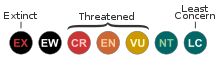
IUCN Red List of Threatened Plants Status :
IUCN Red List
Growth: S = slow M = medium F = fast. Soil: L = light (sandy) M = medium H = heavy (clay). pH: A = acid N = neutral B = basic (alkaline). Shade: F = full shade S = semi-shade N = no shade. Moisture: D = dry M = Moist We = wet Wa = water.
Now available:
Food Forest Plants for Mediterranean Conditions
350+ Perennial Plants For Mediterranean and Drier Food Forests and Permaculture Gardens.
[Paperback and eBook]
This is the third in Plants For A Future's series of plant guides for food forests tailored to
specific climate zones. Following volumes on temperate and tropical ecosystems, this book focuses
on species suited to Mediterranean conditions—regions with hot, dry summers and cool, wet winters,
often facing the added challenge of climate change.
Read More
Expert comment
Author
(Mill.)Asch.
Botanical References
200
Links / References
For a list of references used on this page please go here
Readers comment
© 2010, Plants For A Future. Plants For A Future is a charitable company limited by guarantee, registered in England and Wales. Charity No. 1057719, Company No. 3204567.