Translate this page:
Summary
Vitis × doaniana Munson ex Viala is an accepted hybrid. The native range of this hybrid is S. Oklahoma to N. Central Texas. It is a liana (a long-stemmed, woody vine that is rooted in the ground and climbs up trees to reach sunlight in the canopy, often forming hanging networks. Common in tropical forests, they are not a specific plant family but a growth form that uses, but does not parasitize, host trees for support). The hybrid formula is V. acerifolia × V. mustangensis.
Physical Characteristics

 Vitis_x_doaniana is a deciduous Climber growing to 10 m (32ft 10in). It is in flower from June to July, and the seeds ripen from September to October. The species is hermaphrodite (has both male and female organs) and is pollinated by Insects.
Suitable for: light (sandy), medium (loamy) and heavy (clay) soils and prefers well-drained soil. Suitable pH: mildly acid, neutral and basic (mildly alkaline) soils. It can grow in semi-shade (light woodland) or no shade. It prefers dry or moist soil.
UK Hardiness Map
US Hardiness Map
Synonyms
Plant Habitats
Edible Uses
Fruit - raw or dried for winter use[177]. It makes an excellent wine[274]. The fruit is quite small but is carried in bunches and so is easy to harvest[K]. Young leaves are wrapped around other foods and then baked, they impart a pleasant flavour. Young tendrils - raw or cooked.
References More on Edible Uses
Medicinal Uses
Plants For A Future can not take any responsibility for any adverse effects from the use of plants. Always seek advice from a professional before using a plant medicinally.
None known
References More on Medicinal Uses
Other Uses
A yellow dye is obtained from the fresh or dried leaves.
Special Uses
References More on Other Uses
Cultivation details
Prefers a deep rich moist well-drained moderately fertile loam[1, 200]. Grows best in a calcareous soil[200]. Succeeds in sun or partial shade though a warm sunny position is required for the fruit to ripen[200]. Plants climb by means of tendrils[182]. Any pruning should be carried out in winter when the plants are dormant otherwise they bleed profusely[182, 200]. Closely related to V. mustangensis[11]. This species is a hybrid, Vitis acerifolia x Vitis mustangensis[274]. Is this species no more than a synonym for V. acerifolia?[200]. Plants in this genus are notably susceptible to honey fungus[200].
References Carbon Farming Information and Carbon Sequestration Information
Temperature Converter
Type a value in the Celsius field to convert the value to Fahrenheit:
Fahrenheit:
Plant Propagation
Seed - best sown in a cold frame as soon as it is ripe[K]. Six weeks cold stratification improves the germination rate, and so stored seed is best sown in a cold frame as soon as it is obtained. Germination should take place in the first spring, but sometimes takes another 12 months. Prick out the seedlings into individual pots when they are large enough to handle and grow them on in a cold frame for their first winter. Plant out in early summer. Cuttings of mature wood of the current seasons growth, December/January in a frame. These cuttings can be of wood 15 - 30cm long or they can be of short sections of the stem about 5cm long with just one bud at the top of the section. In this case a thin, narrow strip of the bark about 3cm long is removed from the bottom half of the side of the stem. This will encourage callusing and the formation of roots. Due to the size of these cuttings they need to be kept in a more protected environment than the longer cuttings. Layering.
Other Names
If available other names are mentioned here
Native Range
NORTHERN AMERICA: United States (Oklahoma (south), Colorado (southeast), Texas)
Weed Potential
Right plant wrong place. We are currently updating this section.
Please note that a plant may be invasive in one area but may not
in your area so it's worth checking.
Conservation Status
IUCN Red List of Threatened Plants Status :
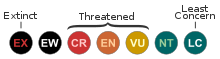
IUCN Red List
Growth: S = slow M = medium F = fast. Soil: L = light (sandy) M = medium H = heavy (clay). pH: A = acid N = neutral B = basic (alkaline). Shade: F = full shade S = semi-shade N = no shade. Moisture: D = dry M = Moist We = wet Wa = water.
Support Plants For A Future
Plants For A Future relies on regular donations to keep our free database and search facilities going, to pay for ongoing research, improvements and enhancements, and to develop and publish new books.
Read more
Choose Currency
Donate in £ GBP
Donate in $ USD
Donate in € EUR
Securely pay via PayPal or Credit/Debit Card without an account.
Expert comment
Author
Munson.
Botanical References
11
Links / References
For a list of references used on this page please go here
Readers comment