 |
|
flickr.com/people/51035743246@N01 |
 |
|
Translate this page:
Summary
Physical Characteristics

 Vicia_villosa is a PERENNIAL CLIMBER growing to 1.8 m (6ft). It is in flower from June to September. The species is hermaphrodite (has both male and female organs) and is pollinated by Bees. The plant is self-fertile.
It can fix Nitrogen.
Suitable for: light (sandy), medium (loamy) and heavy (clay) soils and prefers well-drained soil. Suitable pH: mildly acid, neutral and basic (mildly alkaline) soils. It can grow in semi-shade (light woodland) or no shade. It prefers moist soil.
UK Hardiness Map
US Hardiness Map
Synonyms
Plant Habitats
Edible Uses
Seed[2]. No more details are given. Used as a vegetable[177]. No more details are given.
References More on Edible Uses
Medicinal Uses
Plants For A Future can not take any responsibility for any adverse effects from the use of plants. Always seek advice from a professional before using a plant medicinally.
None known
References More on Medicinal Uses
Other Uses
Used as a spring or autumn sown green manure. The seed can be sown in September to overwinter, or as late as October for a greenhouse green manure[87].
Special Uses
References More on Other Uses
Cultivation details
Succeeds in any well-drained soil in a sunny position if the soil is reliably moist throughout the growing season, otherwise it is best grown in semi-shade[200]. Cultivated for its edible seed in N. and C. Europe[2]. This species is not very deep rooting[87]. This species has a symbiotic relationship with certain soil bacteria, these bacteria form nodules on the roots and fix atmospheric nitrogen. Some of this nitrogen is utilized by the growing plant but some can also be used by other plants growing nearby[200].
References Carbon Farming Information and Carbon Sequestration Information
Temperature Converter
Type a value in the Celsius field to convert the value to Fahrenheit:
Fahrenheit:
Plant Propagation
Pre-soak the seed for 24 hours in warm water and then sow in situ in spring or autumn.
Other Names
If available other names are mentioned here
Native Range
TEMPERATE ASIA: Afghanistan, Cyprus, Iran, Iraq, Israel, Lebanon, Syria, Turkey, Azerbaijan, Georgia, Russian Federation (Checheno-Ingushetia, Dagestan, Krasnodar, Stavropol), Kazakhstan, Kyrgyzstan, Tajikistan, Turkmenistan, Uzbekistan EUROPE: Czechoslovakia, Austria, Switzerland, Germany, Hungary, Poland, Belarus, Estonia, Lithuania, Latvia, Moldova, Russian Federation (Cuvašskaja Respublika, Kalmykija, Respublika, Mordovija, Respublika, Tatarstan, Belgorod, Bryansk, Kaliningrad, Kursk, Lipeckaja oblast, Orel, Rostov, Saratov, Smolensk, Tambov, Tula, Ulyanovsk, Volgogradskaja oblast, Voronezh, Yaroslavl), Ukraine (incl. Krym), Former Yugoslavia, Albania, Bulgaria, Greece (incl. Crete), Italy (incl. Sardinia, Sicily), Romania, Spain (incl. Baleares), France (incl. Corsica), Portugal AFRICA: Spain (Canarias), Algeria, Egypt, Libya, Morocco, Tunisia
Weed Potential
Right plant wrong place. We are currently updating this section.
Please note that a plant may be invasive in one area but may not
in your area so it's worth checking.
Conservation Status
IUCN Red List of Threatened Plants Status :
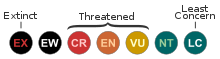
IUCN Red List
Growth: S = slow M = medium F = fast. Soil: L = light (sandy) M = medium H = heavy (clay). pH: A = acid N = neutral B = basic (alkaline). Shade: F = full shade S = semi-shade N = no shade. Moisture: D = dry M = Moist We = wet Wa = water.
Support Plants For A Future
Plants For A Future relies on regular donations to keep our free database and search facilities going, to pay for ongoing research, improvements and enhancements, and to develop and publish new books.
Read more
Choose Currency
Donate in £ GBP
Donate in $ USD
Donate in € EUR
Securely pay via PayPal or Credit/Debit Card without an account.
Expert comment
Author
Roth.
Botanical References
50
Links / References
For a list of references used on this page please go here
Readers comment
© 2010, Plants For A Future. Plants For A Future is a charitable company limited by guarantee, registered in England and Wales. Charity No. 1057719, Company No. 3204567.