 |
|
commons.wikimedia.org/wiki/User:Magnus_Manske |
 |
|
Translate this page:
Summary
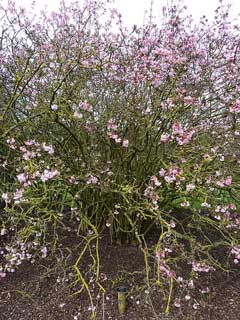
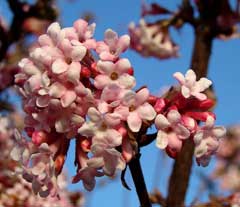
Viburnum × bodnantense Aberc. ex Stearn is an artificial hybrid shrub. The hybrid formula of this artificial cross is V. fragrans × V. grandiflorum. Viburnum × bodnantense is commonly known as Bodnant Viburnum. A very popular cultivar of this deciduous shrub is 'Dawn' (often called Pink Dawn Viburnum), known for its highly fragrant, pink winter flowers that bloom on bare branches. It is a favored shrub for winter color and fragrance.
Physical Characteristics

 Viburnum_x_bodnantense is a deciduous Shrub growing to 3 m (9ft) by 2.5 m (8ft).
See above for USDA hardiness. It is hardy to UK zone 7. It is in flower from January to March. The species is hermaphrodite (has both male and female organs) and is pollinated by Insects. The plant is not self-fertile.
Suitable for: light (sandy), medium (loamy) and heavy (clay) soils. Suitable pH: mildly acid, neutral and basic (mildly alkaline) soils. It can grow in semi-shade (light woodland) or no shade. It prefers moist soil.
UK Hardiness Map
US Hardiness Map
Synonyms
Plant Habitats
Edible Uses
Fruit - raw or cooked. A sweet flavour, though not borne very freely[K]. The fruit is fairly large, it can be up to 20mm in diameter and contains a single large seed[K].
References More on Edible Uses
Medicinal Uses
Plants For A Future can not take any responsibility for any adverse effects from the use of plants. Always seek advice from a professional before using a plant medicinally.
None known
References More on Medicinal Uses
The Bookshop: Edible Plant Books
Our Latest books on Perennial Plants For Food Forests and Permaculture Gardens in paperback or digital formats.

Edible Tropical Plants
Food Forest Plants for Hotter Conditions: 250+ Plants For Tropical Food Forests & Permaculture Gardens.
More

Edible Temperate Plants
Plants for Your Food Forest: 500 Plants for Temperate Food Forests & Permaculture Gardens.
More

More Books
PFAF have eight books available in paperback and digital formats. Browse the shop for more information.
Shop Now
Other Uses
References More on Other Uses
Cultivation details
An easily grown plant, it succeeds in most soils but is ill-adapted for poor soils and for dry situations[1]. It prefers a deep rich loamy soil in sun or semi-shade[11, 200]. Grows well in light woodland[K]. Requires shelter from north and east winds[200]. The deliciously scented flowers are produced in winter but can withstand temperatures down to between -12 and -20°c if the plant is in a sheltered position with no early morning sun[11, 200]. The plant itself is hardy to about -20°c[200]. A very ornamental plant, there are many named varieties[200]. This species is a hybrid of garden origin, V. farreri x V. grandiflorum. It is more vigorous than either species and also has larger flowers[219]. Since it is a hybrid, it might not set seed or even produce fruit. It is, however, worth experimenting with growing this species close to either of its parents to see if this improves the ability to set fruit in Britain[K]. Self incompatible, there must be at least 2 genetically distinct plants growing if fruit is wanted. Even then, fruit is rarely seen in Britain. Hand pollination may improve the fruit yield as might siting the plants so that they get the maximum protection from severe winter weather.
References Carbon Farming Information and Carbon Sequestration Information
Temperature Converter
Type a value in the Celsius field to convert the value to Fahrenheit:
Fahrenheit:
The PFAF Bookshop
Plants For A Future have a number of books available in paperback and digital form. Book titles include Edible Plants, Edible Perennials, Edible Trees,Edible Shrubs, Woodland Gardening, and Temperate Food Forest Plants. Our new book is Food Forest Plants For Hotter Conditions (Tropical and Sub-Tropical).
Shop Now
Plant Propagation
Seed - this species is a hybrid and will not breed true from seed, if seedlings are required then the seed is best sown in a cold frame as soon as it is ripe. Germination can be slow, sometimes taking more than 18 months. If the seed is harvested 'green' (when it has fully developed but before it has fully ripened) and sown immediately in a cold frame, it should germinate in the spring[80]. Stored seed will require 2 months warm then 3 months cold stratification and can still take 18 months to germinate[113]. Prick out the seedlings into individual pots when they are large enough to handle and grow them on in a cold frame or greenhouse. Plant out into their permanent positions in late spring or early summer of the following year. Cuttings of soft-wood, early summer in a frame[200]. Pot up into individual pots once they start to root and plant them out in late spring or early summer of the following year. Cuttings of half-ripe wood, 5 - 8 cm long with a heel if possible, July/August in a frame[78, 113]. Plant them into individual pots as soon as they start to root. These cuttings can be difficult to overwinter, it is best to keep them in a greenhouse or cold frame until the following spring before planting them out[113]. Cuttings of mature wood, winter in a frame. They should root in early spring - pot them up when large enough to handle and plant them out in the summer if sufficient new growth is made, otherwise keep them in a cold frame for the next winter and then plant them out in the spring. Layering of current seasons growth in July/August. Takes 15 months[78].
Other Names
If available other names are mentioned here
Native Range
This is an artificial hybrid.
Weed Potential
Right plant wrong place. We are currently updating this section.
Please note that a plant may be invasive in one area but may not in your area so it's worth checking.
Conservation Status
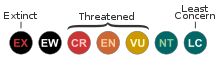
IUCN Red List of Threatened Plants Status :
Growth: S = slow M = medium F = fast. Soil: L = light (sandy) M = medium H = heavy (clay). pH: A = acid N = neutral B = basic (alkaline). Shade: F = full shade S = semi-shade N = no shade. Moisture: D = dry M = Moist We = wet Wa = water.
Now available:
Food Forest Plants for Mediterranean Conditions
350+ Perennial Plants For Mediterranean and Drier Food Forests and Permaculture Gardens.
[Paperback and eBook]
This is the third in Plants For A Future's series of plant guides for food forests tailored to
specific climate zones. Following volumes on temperate and tropical ecosystems, this book focuses
on species suited to Mediterranean conditions—regions with hot, dry summers and cool, wet winters,
often facing the added challenge of climate change.
Read More
Expert comment
Author
Stearn.
Botanical References
200
Links / References
For a list of references used on this page please go here
Readers comment
| Add a comment |
|
If you have important information about this plant that may help other users please add a comment or link below. Only comments or links that are felt to be directly relevant to a plant will be included. If you think a comment/link or information contained on this page is inaccurate or misleading we would welcome your feedback at [email protected]. If you have questions about a plant please use the Forum on this website as we do not have the resources to answer questions ourselves.
* Please note: the comments by website users are not necessarily those held by PFAF and may give misleading or inaccurate information.
|
Subject : Viburnum_x_bodnantense
|
|
|
|