 |
|
commons.wikimedia.org/wiki/User:Djlayton4 |
 |
| USDA Forest Service |
Translate this page:
Summary
Physical Characteristics

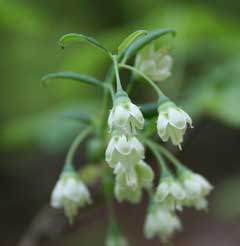
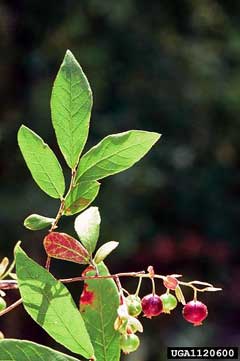
 Vaccinium_stamineum is a deciduous Shrub growing to 3 m (9ft 10in).
See above for USDA hardiness. It is hardy to UK zone 5. It is in flower from May to June. The species is hermaphrodite (has both male and female organs) and is pollinated by Insects.
Suitable for: light (sandy) and medium (loamy) soils and prefers well-drained soil. Suitable pH: mildly acid soils and can grow in very acid soils.
It can grow in semi-shade (light woodland) or no shade. It prefers dry or moist soil.
UK Hardiness Map
US Hardiness Map
Synonyms
V. candicans.
Plant Habitats
Edible Uses
Fruit - raw or cooked. Unpalatable[200]. The quality varies from shrub to shrub[183]. When cooked and served cold they are considered to be delicious with a flavour suggesting gooseberry and cranberry sauce with the slightly bitter aftertaste of grapefruit marmalade[183]. The fruit is about 10mm in diameter[200].
References More on Edible Uses
Medicinal Uses
Plants For A Future can not take any responsibility for any adverse effects from the use of plants. Always seek advice from a professional before using a plant medicinally.
None known
References More on Medicinal Uses
The Bookshop: Edible Plant Books
Our Latest books on Perennial Plants For Food Forests and Permaculture Gardens in paperback or digital formats.
Edible Tropical Plants
Food Forest Plants for Hotter Conditions: 250+ Plants For Tropical Food Forests & Permaculture Gardens.
More
Edible Temperate Plants
Plants for Your Food Forest: 500 Plants for Temperate Food Forests & Permaculture Gardens.
More
More Books
PFAF have eight books available in paperback and digital formats. Browse the shop for more information.
Shop Now
Other Uses
References More on Other Uses
Cultivation details
Requires a moist but freely-draining lime free soil, preferring one that is rich in peat or a light loamy soil with added leaf-mould[11, 200]. Prefers a very acid soil with a pH in the range of 4.5 to 6, plants soon become chlorotic when lime is present. Succeeds in full sun or light shade though it fruits better in a sunny position[200]. Another report says that it prefers a position in partial shade[184]. Requires shelter from strong winds[200]. Plants are hardy to about -25°c[184]. Dislikes root disturbance, plants are best grown in pots until being planted out in their permanent positions[200]. A polymorphic species, the plants are very variable in leaf shape. It is closely related to V. neglectum[11]. Plants in this genus are notably resistant to honey fungus[200].
References Carbon Farming Information and Carbon Sequestration Information
Temperature Converter
Type a value in the Celsius field to convert the value to Fahrenheit:
Fahrenheit:
The PFAF Bookshop
Plants For A Future have a number of books available in paperback and digital form. Book titles include Edible Plants, Edible Perennials, Edible Trees,Edible Shrubs, Woodland Gardening, and Temperate Food Forest Plants. Our new book is Food Forest Plants For Hotter Conditions (Tropical and Sub-Tropical).
Shop Now
Plant Propagation
Seed - sow late winter in a greenhouse in a lime-free potting mix and only just cover the seed[78]. Stored seed might require a period of up to 3 months cold stratification[113]. Another report says that it is best to sow the seed in a greenhouse as soon as it is ripe[200]. Once they are about 5cm tall, prick the seedlings out into individual pots and grow them on in a lightly shaded position in the greenhouse for at least their first winter. Plant them out into their permanent positions in late spring or early summer, after the last expected frosts. Cuttings of half-ripe wood, 5 - 8cm with a heel, August in a frame[78]. Slow and difficult. Layering in late summer or early autumn[78]. Another report says that spring is the best time to layer[200]. Takes 18 months[78]. Division of suckers in spring or early autumn[113].
Other Names
If available other names are mentioned here
Native Range
NORTHERN AMERICA: Canada (Ontario (southeast)), United States (Indiana (south), Massachusetts, New Jersey, New York, Ohio, Pennsylvania, Rhode Island, West Virginia, Connecticut, Kansas (southeast), Missouri, Illinois, Oklahoma, Alabama, Arkansas, Delaware, District of Columbia, Florida, Georgia, Kentucky, Louisiana, Maryland, North Carolina, South Carolina, Virginia, Mississippi, Tennessee, Texas), Mexico (Nuevo León, San Luis Potosí, Hidalgo, Oaxaca).
Weed Potential
Right plant wrong place. We are currently updating this section.
Please note that a plant may be invasive in one area but may not in your area so it's worth checking.
Conservation Status
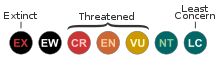
IUCN Red List of Threatened Plants Status :
Growth: S = slow M = medium F = fast. Soil: L = light (sandy) M = medium H = heavy (clay). pH: A = acid N = neutral B = basic (alkaline). Shade: F = full shade S = semi-shade N = no shade. Moisture: D = dry M = Moist We = wet Wa = water.
Now available:
Food Forest Plants for Mediterranean Conditions
350+ Perennial Plants For Mediterranean and Drier Food Forests and Permaculture Gardens.
[Paperback and eBook]
This is the third in Plants For A Future's series of plant guides for food forests tailored to
specific climate zones. Following volumes on temperate and tropical ecosystems, this book focuses
on species suited to Mediterranean conditions—regions with hot, dry summers and cool, wet winters,
often facing the added challenge of climate change.
Read More
Expert comment
Author
L.
Botanical References
43
Links / References
For a list of references used on this page please go here
Readers comment
| Add a comment |
|
If you have important information about this plant that may help other users please add a comment or link below. Only comments or links that are felt to be directly relevant to a plant will be included. If you think a comment/link or information contained on this page is inaccurate or misleading we would welcome your feedback at [email protected]. If you have questions about a plant please use the Forum on this website as we do not have the resources to answer questions ourselves.
* Please note: the comments by website users are not necessarily those held by PFAF and may give misleading or inaccurate information.
|
Subject : Vaccinium_stamineum
|
|
|
|