 |
|
(c) 2010 Ken Fern & Plants For A Future |
 |
| (c) 2010 Ken Fern & Plants For A Future |
Translate this page:
Summary
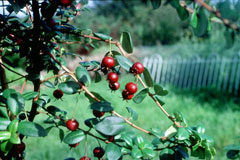
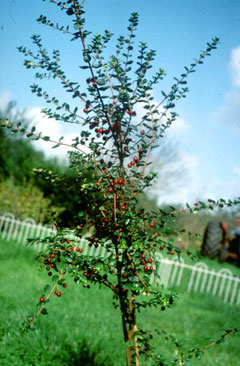
Ugni molinae is an evergreen Shrub growing to 2 m (6ft) commonly known as Chilean guava, strawberry myrtle, Ugniberry, or New Zealand cranberry. An excellent ornamental plant with a beautiful strawberry aroma. Often grown as a low growing hedge or a container specimen. It was a favourite fruit of Queen Victoria having been introduced to the UK in 1844. The fruit has an absolutely delicious flavour, it is very aromatic and tastes of wild strawberries. The fruit is about 15mm in diameter and is freely borne even on small plants. The fruit is used to make jam, Kuchen cake and the dessert murta con membrillo. Leaves are a tea substitute. The roasted seeds are a coffee substitute. It is used to make the traditional liqueur Murtado in Chile. Myrtus ugni Molina is a synonym of Ugni molinae Turcz.
Physical Characteristics

 Ugni is an evergreen Shrub growing to 2 m (6ft) by 1 m (3ft 3in) at a medium rate.
See above for USDA hardiness. It is hardy to UK zone 8 and is frost tender. It is in leaf all year, in flower from May to July, and the seeds ripen from August to October. The species is hermaphrodite (has both male and female organs) and is pollinated by Bees. The plant is self-fertile.
It is noted for attracting wildlife.
Suitable for: light (sandy), medium (loamy) and heavy (clay) soils and prefers well-drained soil. Suitable pH: mildly acid, neutral and basic (mildly alkaline) soils. It cannot grow in the shade. It prefers dry or moist soil and can tolerate drought. The plant can tolerates strong winds but not maritime exposure.
UK Hardiness Map
US Hardiness Map
Synonyms
Eugenia ugni. Ugni molinae. Myrtus ugni
Plant Habitats
Edible Uses
Fruit - raw or cooked[2, 3]. An absolutely delicious flavour, it is very aromatic and tastes of wild strawberries[11, 15, K]. The fruit is about 15mm in diameter[196] and is freely borne even on small plants[K]. Leaves are a tea substitute[177, 183]. The roasted seeds are a coffee substitute[183].
References More on Edible Uses
Medicinal Uses
Plants For A Future can not take any responsibility for any adverse effects from the use of plants. Always seek advice from a professional before using a plant medicinally.
None known
References More on Medicinal Uses
The Bookshop: Edible Plant Books
Our Latest books on Perennial Plants For Food Forests and Permaculture Gardens in paperback or digital formats.
Edible Tropical Plants
Food Forest Plants for Hotter Conditions: 250+ Plants For Tropical Food Forests & Permaculture Gardens.
More
Edible Temperate Plants
Plants for Your Food Forest: 500 Plants for Temperate Food Forests & Permaculture Gardens.
More
More Books
PFAF have eight books available in paperback and digital formats. Browse the shop for more information.
Shop Now
Other Uses
Agroforestry uses: Chilean guava can be used as a hedge or border plant due to its dense foliage and attractive flowers. It can also contribute to biodiversity by providing food and habitat for wildlife. Tolerant of trimming, it can be grown as a small hedge in the milder parts of Britain[11]. 1. Nectary - Flowers rich in nectar and pollen:
Yes – The small, fragrant flowers of Chilean guava produce nectar and pollen, attracting pollinators like bees.
2. Wildlife - Food (Fruit, Seeds, Leaf litter, Shelter, Nesting, Roosting):
Yes – The edible fruits of Chilean guava are consumed by various wildlife, including birds and small mammals. The shrub also provides shelter with its dense foliage, which may be used for nesting or roosting.
3. Invertebrate Shelter (Overwintering sites, Leaf litter, Groundcover):
Yes – The plant can provide shelter for invertebrates through leaf litter and groundcover, supporting beneficial insects and their habitats.
4. Pest Confuser (Smell):
No – Chilean guava is not known for having a strong scent that confuses pests.
Special Uses
References More on Other Uses
Cultivation details
Succeeds in any reasonably good soil including[1] dry ones. Prefers a moderately fertile well-drained loam in a sunny position[11, 200]. Fairly tolerant of maritime exposure[K]. Established plants are drought resistant[196]. A very ornamental plant[1], it is only hardy in the milder parts of Britain[3], tolerating temperatures down to about -10°c when fully dormant[184]. The young growth in spring can be damaged by late frosts. Plants grow and fruit very well in Cornwall, indeed, in the past it has been cultivated commercially for its fruit there[11, 59] (it was one of Queen Victoria's favourite fruits), but is now normally only grown as an ornamental plant. This is a much underused plant that highly merits cultivation on a commercial scale for its fruit[K]. Flowers and fruits well even when the plants are young[11, 166]. Plants in this genus are notably resistant to honey fungus[200]. Chilean guava is self-fertile, meaning it can produce fruit without needing another plant for pollination. The fruit is typically harvested in late summer to early autumn, around late February to April (Southern Hemisphere), depending on the climate and specific variety.
Chilean guava usually flowers in late spring to early summer, producing small, white to pink flowers that are quite fragrant. Chilean guava is a relatively slow-growing shrub, reaching maturity in about 3 to 4 years, but it can live for many years, often producing fruit annually.
References Carbon Farming Information and Carbon Sequestration Information
Temperature Converter
Type a value in the Celsius field to convert the value to Fahrenheit:
Fahrenheit:
The PFAF Bookshop
Plants For A Future have a number of books available in paperback and digital form. Book titles include Edible Plants, Edible Perennials, Edible Trees,Edible Shrubs, Woodland Gardening, and Temperate Food Forest Plants. Our new book is Food Forest Plants For Hotter Conditions (Tropical and Sub-Tropical).
Shop Now
Plant Propagation
Pre-soak the seed for 24 hours in warm water and then sow it in late winter in a greenhouse. Prick out the seedlings into individual pots as soon as they are large enough to handle and grow them on in the greenhouse for at least their first winter. Plant them out into their permanent positions in late spring or early summer, after the last expected frosts[K]. Cuttings of half-ripe wood, 7 - 10cm with a heel, July/August in a frame. Pot up in the autumn and overwinter in a cold frame. Plant out in late spring. High percentage[78]. Cuttings of mature wood of the current seasons growth, 7 - 12cm with a heel, November in a shaded and frost free frame. Plant out in late spring or early autumn. High percentage[78]. Layering.
Other Names
If available other names are mentioned here
Chilean cranberry, Chilean guava myrtle, Cranberry, Guava myrtle, Muria, Murta, New Zealand cranberry, Strawberry myrtle, Tazziberry, Temo, Ugni,
Native Range
SOUTHERN AMERICA: Argentina, Chubut, Chile,
Weed Potential
Right plant wrong place. We are currently updating this section.
Please note that a plant may be invasive in one area but may not
in your area so it's worth checking.
Conservation Status
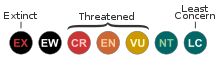
IUCN Red List of Threatened Plants Status :
IUCN Red List
Growth: S = slow M = medium F = fast. Soil: L = light (sandy) M = medium H = heavy (clay). pH: A = acid N = neutral B = basic (alkaline). Shade: F = full shade S = semi-shade N = no shade. Moisture: D = dry M = Moist We = wet Wa = water.
Now available:
Food Forest Plants for Mediterranean Conditions
350+ Perennial Plants For Mediterranean and Drier Food Forests and Permaculture Gardens.
[Paperback and eBook]
This is the third in Plants For A Future's series of plant guides for food forests tailored to
specific climate zones. Following volumes on temperate and tropical ecosystems, this book focuses
on species suited to Mediterranean conditions—regions with hot, dry summers and cool, wet winters,
often facing the added challenge of climate change.
Read More
Expert comment
Author
Turcz.
Botanical References
11200
Links / References
For a list of references used on this page please go here
Readers comment
| Add a comment |
|
If you have important information about this plant that may help other users please add a comment or link below. Only comments or links that are felt to be directly relevant to a plant will be included. If you think a comment/link or information contained on this page is inaccurate or misleading we would welcome your feedback at [email protected]. If you have questions about a plant please use the Forum on this website as we do not have the resources to answer questions ourselves.
* Please note: the comments by website users are not necessarily those held by PFAF and may give misleading or inaccurate information.
|
|