 |
|
Matt Lavin from Bozeman, Montana, USA wikimedia.org |
 |
| Patrick Alexander from Las Cruces, NM Creative Commons Zero, Public Domain Dedication |
Translate this page:
Summary
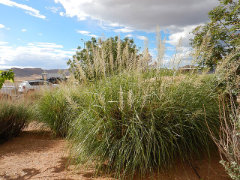
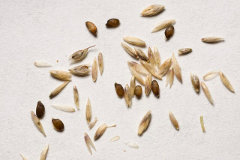
Big sacaton produces abundant, sand-like grains that were a staple food for Native peoples of the Southwest. The grains are easy to collect, nutritious, and versatile in cooking, especially when boiled into porridges or broths. Although it is not a major modern food crop, its ecological and cultural value make it an important traditional resource in desert and semi-desert regions. Sporobolus wrightii is an evergreen, perennial grass that forms dense clumps up to 90cm in diameter. It is a coarse, upright plant with culms 90 - 250cm tall[277 , 1050 ]. The plant is often used in revegetation and soil stabilization projects in southwestern N. America.
Physical Characteristics

 Sporobolus wrightii is an evergreen Perennial growing to 1.5 m (5ft) by 1.5 m (5ft).
See above for USDA hardiness. It is hardy to UK zone 7 and is not frost tender. The flowers are pollinated by Wind.
Suitable for: light (sandy), medium (loamy) and heavy (clay) soils. Suitable pH: neutral and basic (mildly alkaline) soils and can grow in very alkaline and saline soils.
It cannot grow in the shade. It prefers moist or wet soil.
UK Hardiness Map
US Hardiness Map
Synonyms
Homotypic Synonyms: S. airoides var. wrightii (Scribn.) Gould. Heterotypic Synonyms: Bauchea karwinskyi E.Fourn. Epicampes crassiculmis Piper. S. altissimus Vasey ex Brandegee. S. altissimus var. minor Vasey. S. eminens J.Presl. S. expansus Scribn. S. schaffneri Mez. Vilfa eminens (J.Presl) Steud.
Plant Habitats
Edible Uses
The grains of big sacaton are edible and were a valued food source for Native Americans, much like those of the closely related alkali sacaton (S. airoides), to which this plant is nearly identical. The tiny, sand-like seeds are nutritious, pleasantly flavored, and easy to harvest and process. They were cooked into mushes or porridges, or ground into flour. Boiling quickly softens the grains and produces a rich, golden-brown broth or hearty porridge. Toasting adds flavor but doesn’t soften the seeds as effectively. The grains ripen in late summer to autumn, often lingering into early winter, though most fall earlier [2-3]. As with all grasses, only healthy, mold-free grains should be gathered, since infected seeds may harbor toxic molds such as ergot (Claviceps species). Cooking does not remove ergot toxins, so careful selection is essential. A few grasses in the region also contain cyanogenic glycosides, which boiling can reduce [2-3]. Big sacaton is a large perennial bunchgrass, growing 1–2 m tall and thriving in arid and semi-arid habitats such as dry washes and floodplains across the southwestern United States. Its impressive size and high seed yields made it one of the most important wild grasses for traditional food use [2-3].
References More on Edible Uses
Medicinal Uses
Plants For A Future can not take any responsibility for any adverse effects from the use of plants. Always seek advice from a professional before using a plant medicinally.
None known
References More on Medicinal Uses
The Bookshop: Edible Plant Books
Our Latest books on Perennial Plants For Food Forests and Permaculture Gardens in paperback or digital formats.
Edible Tropical Plants
Food Forest Plants for Hotter Conditions: 250+ Plants For Tropical Food Forests & Permaculture Gardens.
More
Edible Temperate Plants
Plants for Your Food Forest: 500 Plants for Temperate Food Forests & Permaculture Gardens.
More
More Books
PFAF have eight books available in paperback and digital formats. Browse the shop for more information.
Shop Now
Other Uses
Agroforestry Uses: Big sacaton may be used in pure stands or as part of a rangeland seeding mix for highly alkaline soils. It is useful for revegetating saline soils throughout the Southwest of N. America. It performs well as a grass hedge terrace or windstrip for erosion control. It helps stabilize watershed structures, stream banks and flood plain areas. Big sacaton is also useful for wildlife cover[277 ]. The plant is important for impeding erosion in areas where flash floods occur[1050 ].
Special Uses
References More on Other Uses
Cultivation details
The plant is found in the wild primarily on heavier soils in lowland or wetland sites. It is tolerant of highly alkaline and saline soil and can tolerate poorly drained soils and seasonally flooded areas. It is also found in open areas such as rocky slopes, plateaus, and mesas[277 ]. It generally grows on sand, sandy loam, silty clay loam, and saline soils[1050 ]. Plants are top-killed by fire, they usually regrow freely from the roots unless the fire has been hot enough to damage them[1050 ]. USDA Hardiness Zone: 6–9. Weed Potential: Big sacaton is not generally considered an invasive weed; instead, it is valued for erosion control, rangeland restoration, and forage production. Its dense root systems help stabilize soil in dry landscapes.
References Carbon Farming Information and Carbon Sequestration Information
Temperature Converter
Type a value in the Celsius field to convert the value to Fahrenheit:
Fahrenheit:
The PFAF Bookshop
Plants For A Future have a number of books available in paperback and digital form. Book titles include Edible Plants, Edible Perennials, Edible Trees,Edible Shrubs, Woodland Gardening, and Temperate Food Forest Plants. Our new book is Food Forest Plants For Hotter Conditions (Tropical and Sub-Tropical).
Shop Now
Plant Propagation
Seed - sow spring in a greenhouse and only just cover the seed. Germination should take place within 2 weeks. Prick out the seedlings into individual pots when they are large enough to handle and plant them out in the summer if they have grown sufficiently. Otherwise, grow them on in a greenhouse for their first winter and plant them out in late spring of the following year. Division in spring. Larger divisions can be planted directly into their permanent positions. We have found it best to pot up the smaller divisions and grow them in a lightly shaded position in a cold frame, planting them out once they are well established in the summer.
Other Names
If available other names are mentioned here
Big Sacaton (Sporobolus wrightii Munro ex Scribn. = Sporobolus airoides (Torr.) Torr. var. wrightii (Munro ex Scribn.) Gould)
Native Range
Native to: Arizona, California, Mexico Central, Mexico Northeast, Mexico Northwest, New Mexico, Oklahoma, South Carolina, Texas, Utah. Introduced into: Egypt.
Weed Potential
Right plant wrong place. We are currently updating this section.
Please note that a plant may be invasive in one area but may not in your area so it's worth checking.
Big sacaton is not generally considered an invasive weed; instead, it is valued for erosion control, rangeland restoration, and forage production. Its dense root systems help stabilize soil in dry landscapes.
Conservation Status
IUCN Red List of Threatened Plants Status : Not available

Growth: S = slow M = medium F = fast. Soil: L = light (sandy) M = medium H = heavy (clay). pH: A = acid N = neutral B = basic (alkaline). Shade: F = full shade S = semi-shade N = no shade. Moisture: D = dry M = Moist We = wet Wa = water.
Now available:
Food Forest Plants for Mediterranean Conditions
350+ Perennial Plants For Mediterranean and Drier Food Forests and Permaculture Gardens.
[Paperback and eBook]
This is the third in Plants For A Future's series of plant guides for food forests tailored to
specific climate zones. Following volumes on temperate and tropical ecosystems, this book focuses
on species suited to Mediterranean conditions—regions with hot, dry summers and cool, wet winters,
often facing the added challenge of climate change.
Read More
Expert comment
Author
Scribn.
Botanical References
Links / References
For a list of references used on this page please go here
A special thanks to Ken Fern for some of the information used on this page.
Readers comment
| Add a comment |
|
If you have important information about this plant that may help other users please add a comment or link below. Only comments or links that are felt to be directly relevant to a plant will be included. If you think a comment/link or information contained on this page is inaccurate or misleading we would welcome your feedback at [email protected]. If you have questions about a plant please use the Forum on this website as we do not have the resources to answer questions ourselves.
* Please note: the comments by website users are not necessarily those held by PFAF and may give misleading or inaccurate information.
|
Subject : Sporobolus wrightii
|
|
|
|