 |
|
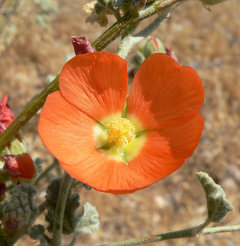
Stan Shebs Creative Commons Attribution-Share Alike 3.0 |
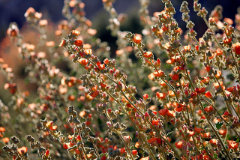 |
| Joshua Tree National Park Public domain |
Translate this page:
Summary
Taxonomic Note: This genus was formerly classified in the family Tiliaceae. Modern classifications include it within the Malvaceae.
Sphaeralcea ambigua is an erect, herbaceous perennial plant producing a cluster of stems from a woody rootstock; it can grow 50 - 100cm tall[200 , 270 ]. The plant is harvested from the wild for local use as a medicine and source of materials. It is sometimes grown as an ornamental in gardens[200 ]. Desert globemallow is abundant and visually striking, but its food value is minimal. Seeds are bitter and impractical, while flowers are mildly pleasant but slimy. With safety concerns due to irritating hairs, desert globemallow is better appreciated as a medicinal or ornamental native plant than as a reliable food source. Sphaeralcea species are somewhat difficult to identify. The species boundaries are not always sharp because there is frequent hybridization, polyploidy, and morphological variation in response to environmental conditions, particularly rainfall. Plants growing in Arizona are particularly difficult to identify[270 ].
Physical Characteristics

 Sphaeralcea ambigua is a PERENNIAL growing to 0.7 m (2ft 4in) by 0.5 m (1ft 8in).
See above for USDA hardiness. It is hardy to UK zone 7 and is not frost tender. The flowers are pollinated by Bees.
Suitable for: light (sandy), medium (loamy) and heavy (clay) soils and prefers well-drained soil. Suitable pH: mildly acid, neutral and basic (mildly alkaline) soils. It cannot grow in the shade. It prefers dry or moist soil.
UK Hardiness Map
US Hardiness Map
Synonyms
Accepted Infraspecifics: S. ambigua subsp. ambigua. S. ambigua subsp. monticola Kearney. S. ambigua var. rosacea (Munz & I.M.Johnst.) Kearney. S. ambigua var. rugosa (Kearney) Kearney. S. ambigua var. versicolor (Kearney) Kearney.
Plant Habitats
Edible Uses
Desert globemallow is a showy perennial of the arid Southwest, widely recognized for its globe-shaped flowers in shades of orange, pink, or purple. While historical references suggest that Native Americans sometimes ate the seeds, immature fruits, or chewed the mucilaginous stems, globemallows are best considered a marginal or questionable wild food [2-3]. The seeds and immature fruits were reportedly eaten by the Hopi and Pueblo peoples, and archaeological evidence suggests seeds were occasionally gathered. However, the seeds have a bitter, unpleasant flavor, difficult-to-remove shells, and the dust from processing can irritate the eyes and lungs. Cooking does little to improve them, so they are not a practical food source [2-3].The flowers, though rarely mentioned as edible, are the most promising part. Their petals, stamens, and pistils are free of irritating hairs and provide a fleeting sweetness and splash of color to salads. The texture, however, is slimy due to high mucilage content. Gathering a usable supply requires effort, since stalks and sepals must be discarded to avoid irritation [2-3].
References More on Edible Uses
Medicinal Uses
Plants For A Future can not take any responsibility for any adverse effects from the use of plants. Always seek advice from a professional before using a plant medicinally.
A decoction of the root is used to treat an upset stomach[257 ]. An infusion of the root is taken as a means of birth control[257 ]. A poultice of the mashed root is used to treat swollen feet[257 ]. A decoction of the root, or the whole plant, is used as an emetic and in the treatment of venereal diseases[257 ]. A poultice of the wilted plant is applied to rheumatic and swollen areas[257 ]. A decoction of the leaves is used in the treatment of colds[257 ]. A decoction of the leaves is used as an eye wash[257 ]. Sphaeralcea species are good sources of mucilage in the form of mucopolysaccharide starches. This has been shown to stimulate macrophage activity and help promote healing and resistance, especially in the skin, upper intestinal tract, urinary tract and lungs[1152 ]. The whole plant is demulcent and emollient[1152 ]. Taken internally, it can be used to soothe sore throats and irritations along the digestive tract, urinary tract etc. Applied externally, it can be used to soothe and promote healing of cuts, burns, wounds etc[1152 ].
References More on Medicinal Uses
The Bookshop: Edible Plant Books
Our Latest books on Perennial Plants For Food Forests and Permaculture Gardens in paperback or digital formats.

Edible Tropical Plants
Food Forest Plants for Hotter Conditions: 250+ Plants For Tropical Food Forests & Permaculture Gardens.
More

Edible Temperate Plants
Plants for Your Food Forest: 500 Plants for Temperate Food Forests & Permaculture Gardens.
More

More Books
PFAF have eight books available in paperback and digital formats. Browse the shop for more information.
Shop Now
Other Uses
The plant is a rich source of mucilage. An infusion is often used as a hair rinse after shampooing, when it is said to give the hair body. A strong infusion will curl the hair if it is not rinsed out[1152 ]. The whole plant is boiled, then added to red clay (liquid only?) and used to make cups[257 ].
Special Uses
References More on Other Uses
Cultivation details
Sphaeralcea species from western N. America are generally species of warm, dry and very freely draining habitats. It grows primarily in the desert or dry shrubland biome. They are often tolerant of very low winter temperatures but, like many species with downy leaves, they are not very tolerant of winter wet and will often fail to overwinter in mild but wet winter areas[200 ]. Species in this genus generally require a warm, sunny position in a moderately fertile, freely-draining soil[200 ]. USDA Hardiness Zone: 6–9 (adapted to hot, dry desert climates). Weed Potential: Desert globemallow is not generally considered invasive, but it is abundant and widespread in the desert Southwest. Its ability to thrive in disturbed soils and spread readily makes it a persistent native rather than a problem weed.
References Carbon Farming Information and Carbon Sequestration Information
Temperature Converter
Type a value in the Celsius field to convert the value to Fahrenheit:
Fahrenheit:
The PFAF Bookshop
Plants For A Future have a number of books available in paperback and digital form. Book titles include Edible Plants, Edible Perennials, Edible Trees,Edible Shrubs, Woodland Gardening, and Temperate Food Forest Plants. Our new book is Food Forest Plants For Hotter Conditions (Tropical and Sub-Tropical).
Shop Now
Plant Propagation
Seed - it has a hard seed coat and benefits from either autumn sowing or scarification of stored seed[277 ]. This can usually be done by pouring a small amount of nearly boiling water on the seeds (being careful not to cook them!) and then soaking them for 12 - 24 hours in warm water. By this time they should have imbibed moisture and swollen - if they have not, then carefully make a nick in the seedcoat (being careful not to damage the embryo) and soak for a further 12 hours before sowing. Softwood cuttings in a frame in early summer[200 ]. Division[200 ].
Other Names
If available other names are mentioned here
Desert Globemallow
Native Range
Native to: Arizona, California, Mexico Northwest, Nevada, Utah.
Weed Potential
Right plant wrong place. We are currently updating this section.
Please note that a plant may be invasive in one area but may not in your area so it's worth checking.
Desert globemallow is not generally considered invasive, but it is abundant and widespread in the desert Southwest. Its ability to thrive in disturbed soils and spread readily makes it a persistent native rather than a problem weed.
Conservation Status
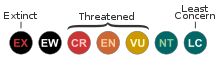
IUCN Red List of Threatened Plants Status : Not available
Growth: S = slow M = medium F = fast. Soil: L = light (sandy) M = medium H = heavy (clay). pH: A = acid N = neutral B = basic (alkaline). Shade: F = full shade S = semi-shade N = no shade. Moisture: D = dry M = Moist We = wet Wa = water.
Now available:
Food Forest Plants for Mediterranean Conditions
350+ Perennial Plants For Mediterranean and Drier Food Forests and Permaculture Gardens.
[Paperback and eBook]
This is the third in Plants For A Future's series of plant guides for food forests tailored to
specific climate zones. Following volumes on temperate and tropical ecosystems, this book focuses
on species suited to Mediterranean conditions—regions with hot, dry summers and cool, wet winters,
often facing the added challenge of climate change.
Read More
Expert comment
Author
A. Gray
Botanical References
Links / References
For a list of references used on this page please go here
A special thanks to Ken Fern for some of the information used on this page.
Readers comment
| Add a comment |
|
If you have important information about this plant that may help other users please add a comment or link below. Only comments or links that are felt to be directly relevant to a plant will be included. If you think a comment/link or information contained on this page is inaccurate or misleading we would welcome your feedback at [email protected]. If you have questions about a plant please use the Forum on this website as we do not have the resources to answer questions ourselves.
* Please note: the comments by website users are not necessarily those held by PFAF and may give misleading or inaccurate information.
|
Subject : Sphaeralcea ambigua
|
|
|
|