 |
|
Public domain |
 |
| Krzysztof Ziarnek, Kenraiz Creative Commons Attribution-Share Alike 4.0 |
Translate this page:
Summary
American threesquare is a smaller, triangular-stemmed bulrush found throughout wet lowlands of the Americas. Though edible, it is nutritionally modest and yields limited food value compared with larger bulrushes. USDA Zones 5–10; height 0.5–1.5 m.
Physical Characteristics

 Schoenoplectus americanus is an evergreen Perennial growing to 1 m (3ft 3in) by 0.5 m (1ft 8in) at a medium rate.
See above for USDA hardiness. It is hardy to UK zone 6 and is not frost tender. The flowers are pollinated by Wind.
It is noted for attracting wildlife.
Suitable for: light (sandy) and medium (loamy) soils and can grow in nutritionally poor soil. Suitable pH: neutral and basic (mildly alkaline) soils and can grow in very alkaline and saline soils.
It cannot grow in the shade. It prefers wet soil and can grow in water.
UK Hardiness Map
US Hardiness Map
Synonyms
Homotypic Synonyms: Heleophylax americanus (Pers.) Schinz & Thell., Scirpus americanus Pers.
Plant Habitats
Edible Uses
Edible Uses & Rating: Edible rhizomes, stem bases, shoots, and seeds—but all are small and low-yielding. Seeds are best utilized [2-3]. Rating: 2/5. Taste, Processing & Kitchen Notes: Shoots and stems have mild grassy flavor; rhizomes are tough and stringy; seeds can be toasted for a wheat-like flavor. Best used in soups or as flour extender [2-3].. Seasonality (Phenology): Growth in spring–summer; seed maturation in late summer. Rhizomes harvestable year-round. Traditional/Indigenous Use Summary: Utilized for weaving and seed harvesting; limited food role compared to tule (Schoenoplectus acutus) [2-3]. Edibility Summary: Low caloric value; Rating: 2/5, seeds only worth collection.
References More on Edible Uses
Medicinal Uses
Plants For A Future can not take any responsibility for any adverse effects from the use of plants. Always seek advice from a professional before using a plant medicinally.
None Known
References More on Medicinal Uses
The Bookshop: Edible Plant Books
Our Latest books on Perennial Plants For Food Forests and Permaculture Gardens in paperback or digital formats.
Edible Tropical Plants
Food Forest Plants for Hotter Conditions: 250+ Plants For Tropical Food Forests & Permaculture Gardens.
More
Edible Temperate Plants
Plants for Your Food Forest: 500 Plants for Temperate Food Forests & Permaculture Gardens.
More
More Books
PFAF have eight books available in paperback and digital formats. Browse the shop for more information.
Shop Now
Other Uses
Excellent for soil stabilization. Ecology & Wildlife: Seeds eaten by ducks and rails; dense mats shelter amphibians.
Special Uses
References More on Other Uses
Cultivation details
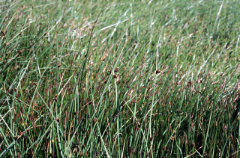
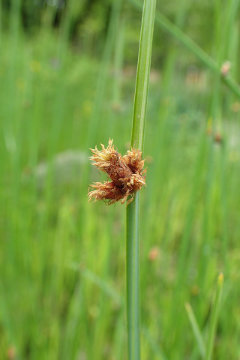
Identification & Habit: Perennial sedge with sharply triangular stems, no leaves, and small, compact clusters of brown spikelets near the tip. Rhizomes are slender and wiry. Growing Conditions: Prefers shallow water margins or saturated soils, full sun. Moderately tolerant of salinity. Habitat & Range: Coastal and inland wetlands throughout the Americas; common in the Southwest’s saline and freshwater marshes. Size & Landscape Performance: Shorter and finer than tule (Schoenoplectus acutus); excellent for soil stabilization. Schoenoplectus americanus (American threesquare): A sedge-like bulrush: reduced, bristly flowers, no nectar, no attractants. It is predominantly wind-pollinated, with some potential selfing. Insect visits occur but are biologically minor.
References Carbon Farming Information and Carbon Sequestration Information
Temperature Converter
Type a value in the Celsius field to convert the value to Fahrenheit:
Fahrenheit:
The PFAF Bookshop
Plants For A Future have a number of books available in paperback and digital form. Book titles include Edible Plants, Edible Perennials, Edible Trees,Edible Shrubs, Woodland Gardening, and Temperate Food Forest Plants. Our new book is Food Forest Plants For Hotter Conditions (Tropical and Sub-Tropical).
Shop Now
Plant Propagation
Propagate by rhizome division or seed. Rhizomes should be planted horizontally 5–10 cm deep. Seeds require cold-moist stratification and germinate best in shallow water or saturated media.
Other Names
If available other names are mentioned here
Schoenoplectus americanus (American Threesquare)
Native Range
US. USA. Alabama, Alaska, Argentina Northeast, Argentina Northwest, Argentina South, Arizona, Belize, Bermuda, Bolivia, British Columbia, California, Chile Central, Chile North, Colorado, Connecticut, Costa Rica, Cuba, Delaware, Dominican Republic, Florida, Georgia, Guatemala, Idaho, Illinois, Jamaica, Kansas, Leeward Is., Louisiana, Maine, Maryland, Massachusetts, Mexico Central, Mexico Gulf, Mexico Northeast, Mexico Northwest, Mexico Southeast, Mexico Southwest, Michigan, Mississippi, Missouri, Netherlands Antilles, Nevada, New Hampshire, New Jersey, New Mexico, New York, New Zealand North, New Zealand South, Nicaragua, North Carolina, Nova Scotia, Oklahoma, Oregon, Peru, Puerto Rico, Rhode I., South Carolina, Texas, Uruguay, Utah, Venezuela, Vermont, Virginia, Washington, Wyoming
Weed Potential
Right plant wrong place. We are currently updating this section.
Please note that a plant may be invasive in one area but may not in your area so it's worth checking.
None Known
Conservation Status
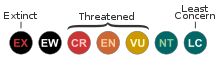
IUCN Red List of Threatened Plants Status : Schoenoplectus americanus is listed as Least Concern.
Growth: S = slow M = medium F = fast. Soil: L = light (sandy) M = medium H = heavy (clay). pH: A = acid N = neutral B = basic (alkaline). Shade: F = full shade S = semi-shade N = no shade. Moisture: D = dry M = Moist We = wet Wa = water.
Now available:
Food Forest Plants for Mediterranean Conditions
350+ Perennial Plants For Mediterranean and Drier Food Forests and Permaculture Gardens.
[Paperback and eBook]
This is the third in Plants For A Future's series of plant guides for food forests tailored to
specific climate zones. Following volumes on temperate and tropical ecosystems, this book focuses
on species suited to Mediterranean conditions—regions with hot, dry summers and cool, wet winters,
often facing the added challenge of climate change.
Read More
Expert comment
Author
(Pers.) Volkart
Botanical References
Links / References
For a list of references used on this page please go here
Readers comment
| Add a comment |
|
If you have important information about this plant that may help other users please add a comment or link below. Only comments or links that are felt to be directly relevant to a plant will be included. If you think a comment/link or information contained on this page is inaccurate or misleading we would welcome your feedback at [email protected]. If you have questions about a plant please use the Forum on this website as we do not have the resources to answer questions ourselves.
* Please note: the comments by website users are not necessarily those held by PFAF and may give misleading or inaccurate information.
|
Subject : Schoenoplectus americanus
|
|
|
|