 |
|
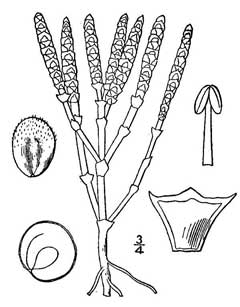
USDA-NRCS PLANTS Database / Britton, N.L., and A. Brown. 1913. An illustrated flora of the northern United States, Canada and the British Possessions. 3 vols. Charles Scribner's Sons, New York. Vol. 2 |
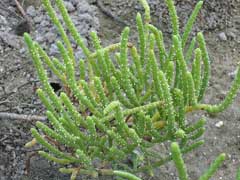 |
| www.flickr.com/photos/annaarmitage |
Translate this page:
Summary
Taxonomic Note: This genus was formerly classified in the family Chenopodiaceae. Modern classifications include it within the Amaranthaceae.
A salt-tolerant annual of tidal flats and marshes, dwarf saltwort is both ecologically important and agriculturally promising. Its edible stems and oil-rich seeds have been valued traditionally and are now being studied for sustainable farming in saline environments. Dwarf saltwort offers crisp edible stems and nutrient-rich seeds. While the salt content limits raw consumption, it has significant potential as a cultivated food plant under saline irrigation systems.
Physical Characteristics

 Salicornia bigelovii is a ANNUAL growing to 0.3 m (1ft).
See above for USDA hardiness. It is hardy to UK zone 8. It is in flower from August to September, and the seeds ripen from September to October. The species is hermaphrodite (has both male and female organs) and is pollinated by Wind.
Suitable for: light (sandy), medium (loamy) and heavy (clay) soils. Suitable pH: mildly acid, neutral and basic (mildly alkaline) soils and can grow in saline soils.
It cannot grow in the shade. It prefers moist soil.
UK Hardiness Map
US Hardiness Map
Synonyms
S. mucronata Bigelow, non Lag. S. depressa Standl.
Plant Habitats
Cultivated Beds;
Edible Uses
Edible Parts: Leaves Oil Oil
Edible Uses: Oil Oil
Young stems and seeds are edible, but both are extremely salty. Fresh stems can be eaten raw or cooked as a crunchy, saline vegetable, similar to samphire. They can also be pickled. Seeds are oily and nutritious and have attracted interest as a potential crop for saline agriculture. The seeds yield an edible oil comparable to safflower or sunflower, though in the wild, collecting sufficient quantities is difficult. Because of their salt content, both stems and seeds should be consumed in moderation. [2-3].Young leaves and stems - cooked or pickled[105, 172, 177]. The raw seed is inedible due to the presence of saponins, though these remain in the seed-meal when the oil is extracted[252]. The seed contains about 30% of an edible oil and 35% protein[252]. The oil is highly polyunsaturated and similar to safflower oil (Carthamnus tinctorius) in fatty-acid composition[252]. It has a pleasant nut-like flavour and a texture similar to olive oil[252].
References More on Edible Uses
Medicinal Uses
Plants For A Future can not take any responsibility for any adverse effects from the use of plants. Always seek advice from a professional before using a plant medicinally.
None known
References More on Medicinal Uses
The Bookshop: Edible Plant Books
Our Latest books on Perennial Plants For Food Forests and Permaculture Gardens in paperback or digital formats.
Edible Tropical Plants
Food Forest Plants for Hotter Conditions: 250+ Plants For Tropical Food Forests & Permaculture Gardens.
More
Edible Temperate Plants
Plants for Your Food Forest: 500 Plants for Temperate Food Forests & Permaculture Gardens.
More
More Books
PFAF have eight books available in paperback and digital formats. Browse the shop for more information.
Shop Now
Other Uses
Oil Oil
The seed contains about 30% oil[252]. Experimental crop in saline agriculture (notably in Mexico and the Middle East). Oil-rich seeds are being explored for biodiesel and food oil production. Traditional use of ashes for soap and glass. Provides habitat for shorebirds in coastal wetlands.
Special Uses
References More on Other Uses
Cultivation details
Native to coastal salt marshes and tidal flats of the Gulf of Mexico and Pacific coasts. Often found in hypersaline environments unsuitable for most plants. Growth & Ecology: Annual halophyte adapted to tidal flooding and extreme salinity. Its tolerance of salt and capacity for oil-rich seed production make it of interest for sustainable agriculture. It can be cultivated under irrigation with seawater in saline soils. Requires full sun and moist to wet conditions.Recent research has shown this plant to have excellent potential as a commercial crop in arid and desert regions near the sea. It needs irrigation, which can be sustainably provided by using seawater. 10–40 cm tall, bushy and sprawling. USDA zones 8–11; frost-sensitive annual.
References Carbon Farming Information and Carbon Sequestration Information
Temperature Converter
Type a value in the Celsius field to convert the value to Fahrenheit:
Fahrenheit:
The PFAF Bookshop
Plants For A Future have a number of books available in paperback and digital form. Book titles include Edible Plants, Edible Perennials, Edible Trees,Edible Shrubs, Woodland Gardening, and Temperate Food Forest Plants. Our new book is Food Forest Plants For Hotter Conditions (Tropical and Sub-Tropical).
Shop Now
Plant Propagation
Seed - we have no information for this species but suggest sowing the seed in situ as soon as it is ripe if this is possible, otherwise sow in spring.
Other Names
If available other names are mentioned here
Dwarf saltwort. Salicornia depressa Standl.
Native Range
NORTHERN AMERICA: Canada (Nova Scotia), United States (Connecticut (south), Maine (southeast), Massachusetts (east), New Jersey (east), New York (southeast), Rhode Island, Alabama (south), Delaware, Florida, Georgia (southeast), Louisiana (south), Maryland (east), Mississippi (south), North Carolina (east), South Carolina, Virginia (east), Texas, California (southwest)), Mexico (Baja California (Norte) (west), Yucatán) SOUTHERN AMERICA: Hispaniola, Anguilla, Netherlands Antilles (South St. Martin), Bahamas, Cuba, Guadeloupe (North St. Martin), United States (Puerto Rico)
Weed Potential
Right plant wrong place. We are currently updating this section.
Please note that a plant may be invasive in one area but may not in your area so it's worth checking.
Low – restricted to saline soils, unlikely to invade non-saline habitats.
Conservation Status
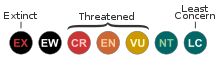
IUCN Red List of Threatened Plants Status :
Growth: S = slow M = medium F = fast. Soil: L = light (sandy) M = medium H = heavy (clay). pH: A = acid N = neutral B = basic (alkaline). Shade: F = full shade S = semi-shade N = no shade. Moisture: D = dry M = Moist We = wet Wa = water.
Now available:
Food Forest Plants for Mediterranean Conditions
350+ Perennial Plants For Mediterranean and Drier Food Forests and Permaculture Gardens.
[Paperback and eBook]
This is the third in Plants For A Future's series of plant guides for food forests tailored to
specific climate zones. Following volumes on temperate and tropical ecosystems, this book focuses
on species suited to Mediterranean conditions—regions with hot, dry summers and cool, wet winters,
often facing the added challenge of climate change.
Read More
Expert comment
Author
Torr.
Botanical References
43235270
Links / References
For a list of references used on this page please go here
Readers comment