 |
|
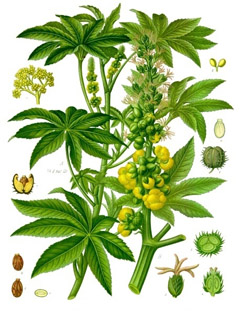
http://commons.wikimedia.org/wiki/File:Koeh-257.jpg |
 |
|
Translate this page:
Summary
Bloom Color: Red. Main Bloom Time: Early fall, Late summer, Mid summer. Form: Upright or erect.
Physical Characteristics

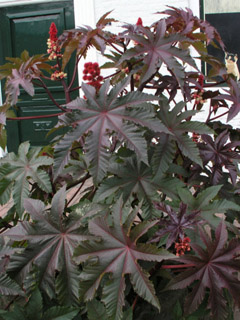
 Ricinus is an evergreen Shrub growing to 1.5 m (5ft) by 1 m (3ft 3in) at a fast rate.
See above for USDA hardiness. It is hardy to UK zone 9 and is frost tender. It is in leaf all year, in flower from July to September, and the seeds ripen from September to November. The species is monoecious (individual flowers are either male or female, but both sexes can be found on the same plant) and is pollinated by Wind. The plant is self-fertile.
Suitable for: light (sandy), medium (loamy) and heavy (clay) soils, prefers well-drained soil and can grow in heavy clay soil. Suitable pH: mildly acid, neutral and basic (mildly alkaline) soils. It cannot grow in the shade. It prefers moist soil.
UK Hardiness Map
US Hardiness Map
Synonyms
Cataputia major. Cataputia minor. Ricinus africanus. Croton spinosus.
Plant Habitats
Edible Uses
The seed contains 35 - 55% of an edible oil, used in cooking[2, 171]. The seed is a rich source of phosphorus, 90% of which is in the phytic form[218]. Some caution should be observed, see the notes above on toxicity
References More on Edible Uses
Medicinal Uses
Plants For A Future can not take any responsibility for any adverse effects from the use of plants. Always seek advice from a professional before using a plant medicinally.
The oil from the seed is a very well-known laxative that has been widely used for over 2,000 years[222]. It is considered to be fast, safe and gentle, prompting a bowel movement in 3 - 5 hours, and is recommended for both the very young and the aged[4, 254]. It is so effective that it is regularly used to clear the digestive tract in cases of poisoning[254]. It should not be used in cases of chronic constipation, where it might deal with the symptoms but does not treat the cause[4]. The flavour is somewhat unpleasant, however, and it can cause nausea in some people[4]. The oil has a remarkable antidandruff effect[7]. The oil is well-tolerated by the skin and so is sometimes used as a vehicle for medicinal and cosmetic preparations[254]. Castor oil congeals to a gel-mass when the alcoholic solution is distilled in the presence of sodium salts of higher fatty acids[240]. This gel is useful in the treatment of non-inflammatory skin diseases and is a good protective in cases of occupational eczema and dermatitis[240]. The seed is anthelmintic, cathartic, emollient, laxative, purgative[4, 7, 21]. It is rubbed on the temple to treat headache[218] and is also powdered and applied to abscesses and various skin infections[218]. The seed is used in Tibetan medicine, where it is considered to have an acrid, bitter and sweet taste with a heating potency[241]. It is used in the treatment of indigestion and as a purgative[241]. A decoction of the leaves and roots is antitussive, discutient and expectorant[218]. The leaves are used as a poultice to relieve headaches and treat boils[240].
References More on Medicinal Uses
The Bookshop: Edible Plant Books
Our Latest books on Perennial Plants For Food Forests and Permaculture Gardens in paperback or digital formats.
Edible Tropical Plants
Food Forest Plants for Hotter Conditions: 250+ Plants For Tropical Food Forests & Permaculture Gardens.
More
Edible Temperate Plants
Plants for Your Food Forest: 500 Plants for Temperate Food Forests & Permaculture Gardens.
More
More Books
PFAF have eight books available in paperback and digital formats. Browse the shop for more information.
Shop Now
Other Uses
The seed contains 35 - 55% of a drying oil. As well as being used in cooking, it is an ingredient of soaps, polishes, flypapers, paints and varnishes[2, 4, 7, 14, 57]. It is also used as a lubricant and for lighting and as an ingredient in fuels for precision engines[7, 17, 100]. The oil is used in coating fabrics and other protective coverings, in the manufacture of high-grade lubricants, transparent typewriter and printing inks, in textile dyeing (when converted into sulfonated Castor Oil or Turkey-Red Oil, for dyeing cotton fabrics with alizarine) and in the production of 'Rilson', a polyamide nylon-type fibre[269]. The dehydrated oil is an excellent drying agent which compares favorably with tung oil and is used in paints and varnishes[269]. The hydrogenated oil is utilized in the manufacture of waxes, polishes, carbon paper, candles and crayons[269]. A fibre for making ropes is obtained from the stems[7]. The growing plant is said to repel flies and mosquitoes[7, 14, 18, 20, 171, 201]. When grown in the garden it is said to rid it of moles and nibbling insects[14, 20, 201]. The leaves have insecticidal properties[171]. Cellulose from the stems is used for making cardboard, paper etc[61, 171].
Special Uses
References More on Other Uses
Cultivation details
Landscape Uses:Border, Container, Foundation, Massing, Seashore, Specimen, Woodland garden. Prefers a well-drained moisture retentive clay or sandy loam in full sun[14, 200]. Requires a rich soil and daytime temperatures above 20°c for the seedlings to grow well[260], though the seed may fail to set if temperatures rise above 38°C for an extended period[269]. The plant requires 140 - 180 days of warm temperatures in the growing season in order to produce good crops of seed, and is readily killed by frost[269]. The plant is reported to tolerate an annual precipitation in the range of 20 to 429cm, an annual temperature in the range of 7.0 to 27.8°C and a pH of 4.5 to 8.3[269]. The castor-oil plant is a fast-growing shrub in the wild, reaching up to 12 metres in height, though it is much smaller when cultivated in the temperate zone[188, 260]. A very ornamental plant[1], although it is not winter hardy in Britain, it can be grown outdoors as an annual bedding plant for sub-tropical displays, and can flower and produce fruit in its first year in warm summers[1, 4]. It has been known to ripen a crop of seeds as far north as Christiana in Norway[4]. Providing the plants water needs are met, yields of around 1 tonne per hectare have been achieved, with exceptional cases of up t 5 tonnes per hectare[269]. It has a long history of cultivation as an oil-bearing and medicinal plant, having been grown in ancient Egypt[238]. It is still widely cultivated for its seed in tropical and sub-tropical zones[1, 61]. There are many named varieties, some developed for ornamental use and others for oil production[4, 269]. Plants may need support in exposed areas[188]. Special Features:
Attractive foliage, Not North American native, All or parts of this plant are poisonous.
References Carbon Farming Information and Carbon Sequestration Information
Temperature Converter
Type a value in the Celsius field to convert the value to Fahrenheit:
Fahrenheit:
The PFAF Bookshop
Plants For A Future have a number of books available in paperback and digital form. Book titles include Edible Plants, Edible Perennials, Edible Trees,Edible Shrubs, Woodland Gardening, and Temperate Food Forest Plants. Our new book is Food Forest Plants For Hotter Conditions (Tropical and Sub-Tropical).
Shop Now
Plant Propagation
Seed - sow early spring in a warm greenhouse in individual pots. When they are large enough to handle, prick the seedlings out into individual pots and plant them out after the last expected frosts[1]. The seeds retain their viability for 2 - 3 years[269].
Other Names
If available other names are mentioned here
Native Range
Coming Soon
Weed Potential
Right plant wrong place. We are currently updating this section.
Please note that a plant may be invasive in one area but may not in your area so it's worth checking.
Conservation Status
IUCN Red List of Threatened Plants Status :

Growth: S = slow M = medium F = fast. Soil: L = light (sandy) M = medium H = heavy (clay). pH: A = acid N = neutral B = basic (alkaline). Shade: F = full shade S = semi-shade N = no shade. Moisture: D = dry M = Moist We = wet Wa = water.
Now available:
Food Forest Plants for Mediterranean Conditions
350+ Perennial Plants For Mediterranean and Drier Food Forests and Permaculture Gardens.
[Paperback and eBook]
This is the third in Plants For A Future's series of plant guides for food forests tailored to
specific climate zones. Following volumes on temperate and tropical ecosystems, this book focuses
on species suited to Mediterranean conditions—regions with hot, dry summers and cool, wet winters,
often facing the added challenge of climate change.
Read More
Expert comment
Author
L.
Botanical References
200
Links / References
For a list of references used on this page please go here
Readers comment
| Add a comment |
|
If you have important information about this plant that may help other users please add a comment or link below. Only comments or links that are felt to be directly relevant to a plant will be included. If you think a comment/link or information contained on this page is inaccurate or misleading we would welcome your feedback at [email protected]. If you have questions about a plant please use the Forum on this website as we do not have the resources to answer questions ourselves.
* Please note: the comments by website users are not necessarily those held by PFAF and may give misleading or inaccurate information.
To leave a comment please Register or login here All comments need to be approved so will not appear immediately.
|
|