 |
|
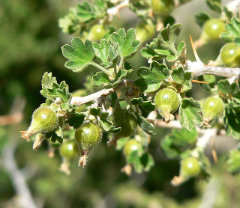
Stan Shebs Creative Commons Attribution-Share Alike 3.0 |
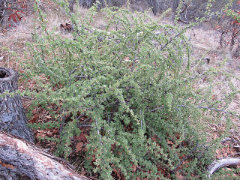 |
| Ian.macky Creative Commons Attribution-Share Alike 4.0 |
Translate this page:
Summary
Ribes velutinum is a spiny, deciduous shrub with spreading, densely and intricately branched stems; it can grow 50 - 200cm tall[270 ]. The plant is harvested from the wild for local use as a food. Velvet gooseberry (Ribes velutinum) is a Great Basin native (USDA 5–8) producing palatable, mildly sweet but seedy, velvety berries that are edible fresh or dried and not considered weedy.
Physical Characteristics

 Ribes velutinum is a deciduous Shrub growing to 1.2 m (4ft) by 1 m (3ft 3in) at a fast rate.
See above for USDA hardiness. It is hardy to UK zone 6 and is not frost tender. The flowers are pollinated by Insects.
It is noted for attracting wildlife.
Suitable for: light (sandy), medium (loamy) and heavy (clay) soils and prefers well-drained soil. Suitable pH: mildly acid, neutral and basic (mildly alkaline) soils. It can grow in semi-shade (light woodland) or no shade. It prefers moist soil.
UK Hardiness Map
US Hardiness Map
Synonyms
Grossularia velutina (Greene) Coville & Britton. R. gooddingii M.Peck.
Plant Habitats
Edible Uses
Fruit - raw or cooked. Palatable[270 ]. The yellow, becoming purple or dark reddish, globose fruit is 4 - 9mm in diameter[270 ]. Velvet gooseberry (Ribes velutinum) produces reddish-purple berries covered with fine velvety hairs. The berries are palatable and mildly sweet, with few off-flavors. The hairs are soft and not a major problem when eating, though they can make the berries less pleasant than smooth-skinned species. The fruit is less juicy than some currants, and seeds are numerous, but they are soft and chewable. Overall, the berries are usable fresh or dried, though they are not as flavorful as the very best Ribes. Velvet gooseberry thrives in Great Basin habitats and typically bears its yellow flowers from March to June, with fruits ripening from August to October [2-3].
References More on Edible Uses
Medicinal Uses
Plants For A Future can not take any responsibility for any adverse effects from the use of plants. Always seek advice from a professional before using a plant medicinally.
None known
References More on Medicinal Uses
The Bookshop: Edible Plant Books
Our Latest books on Perennial Plants For Food Forests and Permaculture Gardens in paperback or digital formats.
Edible Tropical Plants
Food Forest Plants for Hotter Conditions: 250+ Plants For Tropical Food Forests & Permaculture Gardens.
More
Edible Temperate Plants
Plants for Your Food Forest: 500 Plants for Temperate Food Forests & Permaculture Gardens.
More
More Books
PFAF have eight books available in paperback and digital formats. Browse the shop for more information.
Shop Now
Other Uses
References More on Other Uses
Cultivation details
Species in this genus are generally easy to grow, preferring a position in sun (where they fruit best) or moderate shade and succeeding in most moist but well-drained soils of at least moderate fertility[11 ]. This species is likely to require a very sunny position if grown in cool summer regions[11 ]. White pine blister rust, caused by the pathogen Cronartium ribicola, is a fungal disease that is native to Asia but has spread via human activity to many other regions, where it has become more virulent. It has a complex life-cycle that requires both currants (Ribes species) and white pines (Pinus species of the section Strobus) for the disease to spread. Whilst Ribes species can generally live with the disease (it has an annual life-cycle and infects the leaves only) Pinus species can be devastated by it (it becomes perennial and spreads through the tree). Young pines are far more susceptible than mature trees. In America the growing of certain Ribes species is banned in some areas in order to protect plantations of white pine species. Plants in this genus tend to be notably susceptible to honey fungus[200 ]. The leaves of Ribes velutinum are thick and leathery[270 ]. USDA Hardiness & Weed Potential: Velvet gooseberry is native to the western United States and grows mainly in the Great Basin at mid- to high elevations. It is suited to USDA Hardiness Zones 5–8. It is a native shrub and not considered invasive.
References Carbon Farming Information and Carbon Sequestration Information
Temperature Converter
Type a value in the Celsius field to convert the value to Fahrenheit:
Fahrenheit:
The PFAF Bookshop
Plants For A Future have a number of books available in paperback and digital form. Book titles include Edible Plants, Edible Perennials, Edible Trees,Edible Shrubs, Woodland Gardening, and Temperate Food Forest Plants. Our new book is Food Forest Plants For Hotter Conditions (Tropical and Sub-Tropical).
Shop Now
Plant Propagation
Seed - best sown as soon as it is ripe in the autumn in a cold frame. Stored seed requires 3 months of cold stratification at 0 - 9°c and should be sown as early in the year as possible[113, 164 ]. Under normal storage conditions, the seed can remain viable for 17 years or more. Prick out the seedlings into individual pots when they are large enough to handle and grow them on in a cold frame for their first winter, planting them out in late spring of the following year. Cuttings of half-ripe wood, mid summer in a frame[113 ]. Cuttings of mature wood of the current year's growth, preferably with a heel of the previous year's growth, late autumn to late winter in a cold frame or sheltered bed outdoors[78, 200 ].
Other Names
If available other names are mentioned here
Velvet gooseberry (Ribes velutinum)
Native Range
Native to: Arizona, California, Idaho, Montana, Nevada, Oregon, Utah, Washington.
Weed Potential
Right plant wrong place. We are currently updating this section.
Please note that a plant may be invasive in one area but may not in your area so it's worth checking.
It is a native shrub and not considered invasive.
Conservation Status
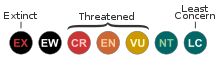
IUCN Red List of Threatened Plants Status : Not available
| Related Plants
|
| Latin Name | Common Name | Habit | Height | Hardiness | Growth | Soil | Shade | Moisture | Edible | Medicinal | Other |
| Embelia ribes | False black pepper, White-flowered Embelia | Climber | 15.0 |
10-12
| F | LMH | S | M | 3 | 4 | 2 |
| Rheum ribes | | Perennial | 1.5 |
5-9
| | MH | SN | DM | 2 | 0 | |
| Ribes aciculare | | Shrub | 1.0 |
3-7
| | LMH | SN | M | 3 | 0 | |
| Ribes alpinum | Alpine Currant | Shrub | 1.2 |
2-7
| M | LMH | SN | M | 3 | 0 | 4 |
| Ribes altissimum | | Shrub | 3.0 |
5-9
| | LMH | SN | M | 3 | 0 | |
| Ribes ambiguum | | Shrub | 0.6 |
5-9
| | LMH | SN | M | 2 | 0 | |
| Ribes americanum | American Blackcurrant | Shrub | 1.8 |
-
| | LMH | SN | M | 2 | 1 | |
| Ribes aureum | Golden Currant | Shrub | 2.4 |
3-8
| F | LMH | SN | DM | 4 | 1 | 2 |
| Ribes bracteosum | Stink Currant | Shrub | 2.5 |
6-9
| | LMH | N | M | 2 | 1 | |
| Ribes burejense | Bureja gooseberry, | Shrub | 1.0 |
4-8
| | LMH | SN | M | 4 | 0 | 0 |
| Ribes californicum | Hillside Gooseberry | Shrub | 0.0 |
6-9
| | LMH | N | M | 2 | 0 | |
| Ribes cereum | Wax Currant | Shrub | 1.8 |
4-8
| | LMH | N | DM | 2 | 1 | |
| Ribes curvatum | Granite gooseberry | Shrub | 1.0 |
6-9
| | LMH | SN | M | 3 | 0 | |
| Ribes cynosbati | Dogberry, Eastern prickly gooseberry | Shrub | 1.5 |
0-0
| | LMH | SN | M | 3 | 1 | 0 |
| Ribes diacanthum | Siberian currant | Shrub | 1.8 |
0-0
| | LMH | SN | M | 2 | 0 | |
| Ribes distans | | Shrub | 0.6 |
4-8
| | LMH | SN | M | 2 | 0 | |
| Ribes divaricatum | Coastal Black Gooseberry, Spreading gooseberry, Parish's gooseberry, Straggly gooseberry | Shrub | 2.7 |
4-8
| | LMH | SN | M | 4 | 1 | 2 |
| Ribes fasciculatum | | Shrub | 1.5 |
4-8
| | LMH | SN | M | 1 | 0 | |
| Ribes fragrans | | Shrub | 0.6 |
3-7
| | LMH | SN | M | 3 | 0 | |
| Ribes gayanum | | Shrub | 1.5 |
7-10
| | LMH | SN | M | 3 | 0 | |
| Ribes glaciale | | Shrub | 3.0 |
-
| | LMH | SN | M | 2 | 0 | |
| Ribes glandulosum | Skunk Currant | Shrub | 0.4 |
-
| | LMH | SN | M | 2 | 1 | 3 |
| Ribes griffithii | | Shrub | 2.5 |
-
| | LMH | SN | M | 2 | 0 | |
| Ribes himalense | | Shrub | 2.0 |
5-9
| | LMH | SN | M | 3 | 1 | |
| Ribes hirtellum | Currant-Gooseberry, Hairystem gooseberry | Shrub | 1.0 |
4-8
| | LMH | N | M | 3 | 0 | 0 |
| Ribes horridum | | Shrub | 1.5 |
-
| | LMH | SN | M | 3 | 0 | |
| Ribes hudsonianum | Hudson Bay Currant, Northern black currant, Western black currant | Shrub | 1.0 |
0-0
| | LMH | SN | M | 2 | 1 | |
| Ribes inebrians | Whisky Currant | Shrub | 2.0 |
4-8
| | LMH | SN | M | 2 | 1 | |
| Ribes inerme | Whitestem Gooseberry, Klamath gooseberry | Shrub | 2.0 |
5-9
| | LMH | SN | M | 2 | 0 | |
| Ribes irriguum | Idaho Gooseberry | Shrub | 3.0 |
-
| | LMH | SN | M | 2 | 1 | |
|
|
Growth: S = slow M = medium F = fast. Soil: L = light (sandy) M = medium H = heavy (clay). pH: A = acid N = neutral B = basic (alkaline). Shade: F = full shade S = semi-shade N = no shade. Moisture: D = dry M = Moist We = wet Wa = water.
Now available:
Food Forest Plants for Mediterranean Conditions
350+ Perennial Plants For Mediterranean and Drier Food Forests and Permaculture Gardens.
[Paperback and eBook]
This is the third in Plants For A Future's series of plant guides for food forests tailored to
specific climate zones. Following volumes on temperate and tropical ecosystems, this book focuses
on species suited to Mediterranean conditions—regions with hot, dry summers and cool, wet winters,
often facing the added challenge of climate change.
Read More
Expert comment
Author
Greene
Botanical References
Links / References
For a list of references used on this page please go here
A special thanks to Ken Fern for some of the information used on this page.
Readers comment
| Add a comment |
|
If you have important information about this plant that may help other users please add a comment or link below. Only comments or links that are felt to be directly relevant to a plant will be included. If you think a comment/link or information contained on this page is inaccurate or misleading we would welcome your feedback at [email protected]. If you have questions about a plant please use the Forum on this website as we do not have the resources to answer questions ourselves.
* Please note: the comments by website users are not necessarily those held by PFAF and may give misleading or inaccurate information.
|
Subject : Ribes velutinum
|
|
|
|