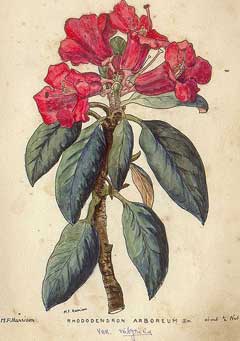
 |
|
http://commons.wikimedia.org/wiki/File:Rhododendron_arboreum.jpg |
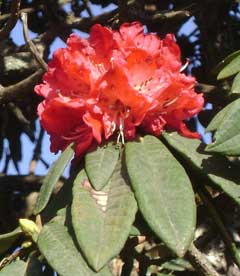 |
| http://commons.wikimedia.org/wiki/User:Marcus334 |
Translate this page:
Summary
Physical Characteristics

 Rhododendron_arboreum is an evergreen Shrub growing to 12 m (39ft) by 3 m (9ft).
See above for USDA hardiness. It is hardy to UK zone 7. It is in leaf all year, in flower from April to May. The species is hermaphrodite (has both male and female organs) and is pollinated by Insects.
Suitable for: light (sandy) and medium (loamy) soils and prefers well-drained soil. Suitable pH: mildly acid soils and can grow in very acid soils.
It can grow in semi-shade (light woodland) or no shade. It prefers moist soil.
UK Hardiness Map
US Hardiness Map
Synonyms
Plant Habitats
Edible Uses
The tender leaves are used as a cooked vegetable[105, 158, 183]. Caution is advised, see the notes above on toxicity. Flowers - raw or cooked[272]. A sweet-sour taste, they are said to make a good sub-acid jelly[183]. Th flowers are sometimes simply pickled by adding salt and chili[272]. Caution is advised, large quantities can cause intoxication[2, 183].
References More on Edible Uses
Medicinal Uses
Plants For A Future can not take any responsibility for any adverse effects from the use of plants. Always seek advice from a professional before using a plant medicinally.
The young leaves are astringent and poultice[158]. They are made into a pasteand then applied to the forehead in the treatment of headaches[240, 272]. The juice of the bark is used in the treatment of coughs, diarrhoea and dysentery[272]. A decoction of the flowers is used to check a tendency to vomit, especially if there is also a loss of appetite[272]. The juice of the flowers is used in the treatment of menstrual disorders[272]. The petals are eaten to assist the removal of any animal bones that have become stuck in the throat[262].
References More on Medicinal Uses
Other Uses
The juice of the leaves is spread over cots and beds to get rid of bed lice[272]. Wood - soft, even grained, seasons badly. Used in turnery, it can also be used to make charcoal and for fuel[51, 158]. Th wood is much employed in Nepal where it is used for making household implements, building small houses and fences[272]. Planks of the wood are carved to make boxes, cupboards and other furniture[272]. It is a very good fuel, burning well with a long-lasting heat - overcollection of the wod for fuel, and also for making charcoal, has become a cause for conservation concern[272].
Special Uses
References More on Other Uses
Cultivation details
Succeeds in most humus rich lime free soils except those of a dry arid nature or heavy or clayey[1]. Prefers a peaty or well-drained sandy loam[1]. Succeeds in sun or shade, the warmer the climate the more shade a plant requires[200]. Requires a pH between 4.5 and 5.5[200]. Hardy to between -10 and -15°c, the pink flowered form is hardier than the red[184]. Succeeds in a woodland though, because of its surface-rooting habit[200], it does not compete well with surface-rooting trees[1]. Plants need to be kept well weeded, they dislike other plants growing over or into their root system, in particular they grow badly with ground cover plants, herbaceous plants and heathers[200]. There are many named varieties selected for their ornamental value[200]. Plants form a root ball and are very tolerant of being transplanted, even when quite large, so long as the root ball is kept intact[200]. This plant is the national flower of Nepal[51]. The flowers are sold in local markets and used as offerings to the Gods and Godesses[272]. A very ornamental plant[1], it is not very hardy outdoors in much of Britain, but grows well in the milder areas of the country[1]. Plants in this genus are notably susceptible to honey fungus[200].
References Carbon Farming Information and Carbon Sequestration Information
Temperature Converter
Type a value in the Celsius field to convert the value to Fahrenheit:
Fahrenheit:
Plant Propagation
Seed - best sown in a greenhouse as soon as it is ripe in the autumn and given artificial light. Alternatively sow the seed in a lightly shaded part of the warm greenhouse in late winter or in a cold greenhouse in April. Surface-sow the seed and do not allow the compost to become dry[200]. Pot up the seedlings when they are large enough to handle and grow on in a greenhouse for at least the first winter. Layering in late July. Takes 15 - 24 months[78]. Cuttings of half-ripe wood, August in a frame. Difficult[78].
Other Names
If available other names are mentioned here
Native Range
TEMPERATE ASIA: China (Guangxi Zhuangzu Zizhiqu, Xizang Zizhiqu, Yunnan Sheng) TROPICAL ASIA: Bhutan, India (Sikkim, Himachal Pradesh, Jammu and Kashmir, Uttar Pradesh, West Bengal (north), Arunachal Pradesh), Nepal Bhutan, India (Sikkim, Assam, Himachal Pradesh, Jammu and Kashmir, Manipur, Meghalaya, Tamil Nadu, Uttar Pradesh, West Bengal (north), Arunachal Pradesh), Sri Lanka, Nepal, Myanmar (north), Thailand
Weed Potential
Right plant wrong place. We are currently updating this section.
Please note that a plant may be invasive in one area but may not
in your area so it's worth checking.
Conservation Status
IUCN Red List of Threatened Plants Status :
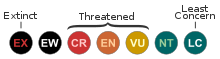
IUCN Red List
Growth: S = slow M = medium F = fast. Soil: L = light (sandy) M = medium H = heavy (clay). pH: A = acid N = neutral B = basic (alkaline). Shade: F = full shade S = semi-shade N = no shade. Moisture: D = dry M = Moist We = wet Wa = water.
Support Plants For A Future
Plants For A Future relies on regular donations to keep our free database and search facilities going, to pay for ongoing research, improvements and enhancements, and to develop and publish new books.
Read more
Choose Currency
Donate in £ GBP
Donate in $ USD
Donate in € EUR
Securely pay via PayPal or Credit/Debit Card without an account.
Expert comment
Author
Sm.
Botanical References
1151200
Links / References
For a list of references used on this page please go here
Readers comment