 |
|
edibleplants.org |
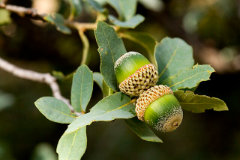 |
| Patrick Alexander from Las Cruces, NM Creative Commons Zero, Public Domain Dedication |
Translate this page:
Summary
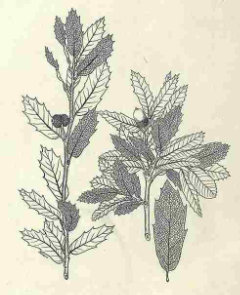
Quercus grisea is a deciduous or semi-evergreen large, multi-stemmed shrub or medium-sized, usually single-stemmed tree; it can grow up to 10 metres tall, exceptionally to 20 metres with a bole 180cm in diameter[270 , 1050 , 1212 ]. Shrubby forms growing in difficult situations can be less than 45cm tall, often spreading at the roots to form a thicket[1050 ]. The plant is harvested from the wild for local use of its wood, and probably also as a food and a medicine. It is sometimes grown as an ornamental. Gray oak (Quercus grisea) is a native Southwestern tree producing large but tannic acorns that become good food after leaching; it grows in USDA Zones 7–10 and is not weedy.
Physical Characteristics

 Quercus grisea is a deciduous Tree growing to 6 m (19ft) by 6 m (19ft).
See above for USDA hardiness. It is hardy to UK zone 8 and is not frost tender. The flowers are pollinated by Wind.
It is noted for attracting wildlife.
Suitable for: light (sandy), medium (loamy) and heavy (clay) soils, prefers well-drained soil and can grow in nutritionally poor soil. Suitable pH: mildly acid, neutral and basic (mildly alkaline) soils and can grow in very acid soils.
It cannot grow in the shade. It prefers dry or moist soil and can tolerate drought.
UK Hardiness Map
US Hardiness Map
Synonyms
Homotypic Synonyms: Q. undulata var. grisea (Liebm.) Engelm.
Plant Habitats
Edible Uses
The light brown, ovoid to narrowly ovoid or ellipsoid seed is 12 - 18mm long and 8 - 12mm wide[270 ]. Although no direct reference of edibility has been seen, this species belongs to the white oak subgenus, where the seeds are generally low in tannins and are often eaten[1050 ]. The seed is usually cooked before eating, though it can also be eaten raw. It can be eaten whole, though it is more commonly dried, then ground into a powder and used as a thickening in stews etc or mixed with cereals for making bread. In some species, especially many of those classified as 'white oaks', the seeds are low in tannins and have a more or less sweet and agreeable flavour. The seed of most species, however, have a very bitter flavour, due especially to the presence of tannins. In these species there are various processes that can remove or at least reduce the amount of these bitter substances (although other water-soluble substances, including some minerals, will also be removed). Tannins are water-soluble and therefore the easiest way to remove or reduce tannin levels is by soaking in water. A few different methods are listed:- A traditional method of preparing the seed was to bury it in boggy ground overwinter and allow the wet soil to gradually leach the tannins. The germinating seed was dug up in the spring when it would have lost most of its astringency and bitterness. Another method was to wrap the seeds in a cloth bag and place them in a stream for several weeks. Drying the seed and grinding it to a powder before soaking speeds up the process. The fastest method is to use hot water, by cooking the powder and changing the water several times until the cooking water is no longer bitter. Alternatively, you can use cold water (which is reported to produce the best quality flour). In this case, you soak the powdered seed in cold water for 12 - 24 hours then discard the water. Repeat this process for a number of times until the soak water is no longer bitter. The roasted seed of many Quercus species has been used as a coffee substitute. Gray oak (Quercus grisea), a member of the beech family (Fagaceae), is a hardy southwestern native that produces edible acorns. Like all oaks, its acorns contain high levels of tannins when raw, which can cause digestive upset and must be leached out before the nuts are safe to eat. The acorns of gray oak are relatively large and of good quality, though still somewhat astringent when fresh. Once shelled, coarsely ground, and leached with repeated changes of water, the nutmeats become palatable and lend themselves well to cooking. The nuts are whitish inside with dark-brown shells, and after processing they are well suited for making breads, pancakes, or porridge. Roasting the leached nutmeat brings out a more nutty, pleasant flavor while driving off moisture, making them suitable for long-term storage. The harvest typically occurs toward the end of summer into autumn, when acorns mature, although timing can vary with elevation and rainfall. While they require effort to process, gray oak acorns are a reliable and worthwhile wild food resource [2-3].
References More on Edible Uses
Medicinal Uses
Plants For A Future can not take any responsibility for any adverse effects from the use of plants. Always seek advice from a professional before using a plant medicinally.
Quercus (oak) species are used in the traditional medicine of many cultures, being valued especially for their tannins. Various parts of the plant can be used, most frequently it is the leaves, bark, seeds, seed cups or the galls that are produced as a result of insect damage. A decoction or infusion is astringent, antibacterial, antifungal, antiseptic, styptic and haemostatic. It is taken internally to treat conditions such as acute diarrhea, dysentery and haemorrhages. Externally, it is used as a mouthwash to treat toothache or gum problems and is applied topically as a wash on cuts, burns, various skin problems, haemorrhoids and oral, genital and anal mucosa inflammation[4 ]. Extracts of the plant can be added to ointments and used for the healing of cuts[4 , 1231 ].
References More on Medicinal Uses
The Bookshop: Edible Plant Books
Our Latest books on Perennial Plants For Food Forests and Permaculture Gardens in paperback or digital formats.
Edible Tropical Plants
Food Forest Plants for Hotter Conditions: 250+ Plants For Tropical Food Forests & Permaculture Gardens.
More
Edible Temperate Plants
Plants for Your Food Forest: 500 Plants for Temperate Food Forests & Permaculture Gardens.
More
More Books
PFAF have eight books available in paperback and digital formats. Browse the shop for more information.
Shop Now
Other Uses
The leaves of most species in this genus are more or less rich in tannins. A mulch of the partially decayed leaves can be placed around vulnerable plants in order to repel slugs, snails, grubs etc, and these will in time break down to add humus and nutrients to the soil. Fresh leaves should be used with caution, however, since as these decay they utilize some of the nitrogen in the soil and thus can inhibit plant growth[20 , K ].. Oak galls are excrescences that are sometimes produced in great numbers on the tree and are caused by the activity of the larvae of different insects. The insects live inside these galls, obtaining their nutrient therein. When the insect pupates and leaves, the gall can be used as a rich source of tannin, that can also be used as a dyestuff and is also used by many cultures to make ink[4 , 331 ]. The bark of oak trees is also usually rich in tannins and can be used as a dyestuff and for waterproofing rope[331 , K ]. The wood is hard and heavy. Because of its usually small dimensions it has little commercial value, though it is used as fence posts and, when larger sizes become available, it is used to make furniture[1050 ] The wood is used for fuel[1050 ].
Special Uses
References More on Other Uses
Cultivation details
Quercus grisea occurs in semiarid climates with mild winters, hot summers, and dry springs[1050 ]. It is a fairly cold-hardy tree, tolerating temperatures down to around -20°c when dormant. It grows best in areas with hot summers, however. In areas with cooler summers, such as the maritime regions of the temperate zone, it often grows poorly, failing to properly ripen its wood and suffering frost damage over the winter[11, 200 ]. Requires a sunny position[112 ]. It prefers an acidic soil, though it can tolerate a pH of 6.9[1212 ]. It is found in the wild on shallow, rocky soils with textures that range from clays to sandy loams. The soils often are derived from igneous or dolomitic parent materials[1050 ]. The tree resprouts from the base if cut down or top-killed by fire[1050 ]. The tree has a low-growing form in open savannahs, reaching tree size when growing in mesic canyons[1050 ]. Numerous hybrids between Quercus grisea and other white oaks, including Quercus gambelii , Quercus mohriana , Quercus arizonica , and numerous species in northern Mexico, have been reported. In the Hueco and Quitman mountains of trans-Pecos Texas, putative hybrids of Quercus grisea × Quercus turbinella Greene occur[270 ]. USDA Hardiness & Weed Potential: Gray oak thrives in the mountains of Arizona and New Mexico and extends south into Mexico. It is well adapted to the arid and semi-arid environments of the Southwest and is generally found at USDA Hardiness Zones 7–10. As a native species, it is not considered weedy or invasive.
References Carbon Farming Information and Carbon Sequestration Information
Temperature Converter
Type a value in the Celsius field to convert the value to Fahrenheit:
Fahrenheit:
The PFAF Bookshop
Plants For A Future have a number of books available in paperback and digital form. Book titles include Edible Plants, Edible Perennials, Edible Trees,Edible Shrubs, Woodland Gardening, and Temperate Food Forest Plants. Our new book is Food Forest Plants For Hotter Conditions (Tropical and Sub-Tropical).
Shop Now
Plant Propagation
Seed - it quickly loses viability if it is allowed to dry out. It can be stored moist and cool overwinter but is best sown as soon as it is ripe in an outdoor seed bed, though it must be protected from mice, squirrels etc. Small quantities of seed can be sown in deep pots in a cold frame. Plants produce a deep taproot and need to be planted out into their permanent positions as soon as possible, in fact seed sown in situ will produce the best trees[11 ]. Trees should not be left in a nursery bed for more than 2 growing seasons without being moved or they will transplant very badly.
Other Names
If available other names are mentioned here
Gray oak (Quercus grisea)
Native Range
Native to: Arizona, Colorado, Mexico Gulf, Mexico Northeast, Mexico Northwest, Mexico Southwest, New Mexico, Texas.
Weed Potential
Right plant wrong place. We are currently updating this section.
Please note that a plant may be invasive in one area but may not in your area so it's worth checking.
As a native species, it is not considered weedy or invasive.
Conservation Status
IUCN Red List of Threatened Plants Status : Least Concern.

| Related Plants
|
| Latin Name | Common Name | Habit | Height | Hardiness | Growth | Soil | Shade | Moisture | Edible | Medicinal | Other |
| Quercus × schuettei | Schuette's oak | Tree | 18.0 |
4-8
| F | MH | N | MWe | 3 | 0 | 3 |
| Quercus acuta | Japanese Evergreen Oak | Tree | 25.0 |
6-9
| M | MH | SN | M | 2 | 2 | 2 |
| Quercus acutissima | Sawthorn Oak | Tree | 5.0 |
5-9
| M | MH | SN | M | 2 | 2 | 3 |
| Quercus agrifolia | Encina, California live oak, Coast Live Oak | Tree | 15.0 |
8-11
| S | MH | SN | M | 3 | 2 | 2 |
| Quercus alba | White Oak, Hybrid oak | Tree | 20.0 |
3-9
| S | MH | SN | DM | 3 | 2 | 4 |
| Quercus aliena | Oriental White Oak | Tree | 20.0 |
4-8
| | MH | SN | M | 2 | 2 | 2 |
| Quercus arizonica | Arizona White Oak | Tree | 8.0 |
7-10
| S | LMH | N | DM | 2 | 2 | 2 |
| Quercus aucheri | Boz-Pirnal Oak | Shrub | 5.0 |
7-10
| S | MH | SN | DM | 4 | 2 | 2 |
| Quercus bicolor | Swamp White Oak | Tree | 25.0 |
4-8
| M | MH | SN | MWe | 4 | 2 | 3 |
| Quercus brantii | Barro, Brant's oak | Tree | 8.0 |
7-9
| F | LMH | N | DM | 3 | 2 | 3 |
| Quercus cerris | Turkey Oak, European turkey oak | Tree | 35.0 |
5-9
| F | MH | SN | M | 3 | 2 | 2 |
| Quercus chrysolepis | Live Oak, Canyon live oak | Tree | 25.0 |
8-11
| S | MH | SN | M | 2 | 2 | 2 |
| Quercus coccifera | Kermes Oak | Shrub | 4.0 |
5-9
| | MH | SN | M | 3 | 2 | 3 |
| Quercus coccinea | Scarlet Oak | Tree | 25.0 |
4-8
| M | MH | SN | M | 2 | 2 | 3 |
| Quercus dentata | Japanese Emperor Oak, Daimyo oak | Tree | 20.0 |
4-8
| F | MH | SN | M | 2 | 2 | 2 |
| Quercus douglasii | Blue Oak | Tree | 12.0 |
8-11
| S | MH | SN | DM | 3 | 2 | 4 |
| Quercus durata | California Scrub Oak, Leather oak | Shrub | 4.0 |
7-10
| | MH | SN | M | 2 | 2 | 2 |
| Quercus ellipsoidalis | Northern Pin Oak | Tree | 20.0 |
4-6
| M | MH | SN | M | 2 | 2 | 3 |
| Quercus emoryi | Black Oak, Emory oak | Tree | 12.0 |
6-9
| S | MH | SN | M | 3 | 2 | 3 |
| Quercus engelmannii | Evergreen Oak, Engelmann oak, Mesa Oak | Tree | 10.0 |
8-11
| M | MH | SN | M | 2 | 2 | 3 |
| Quercus falcata | Southern Red Oak, Cherrybark Oak, Spanish Oak, Southern Red Oak | Tree | 25.0 |
7-9
| M | MH | SN | M | 1 | 2 | 2 |
| Quercus floribunda | | Tree | 0.0 |
-
| | MH | SN | M | 2 | 2 | 3 |
| Quercus frainetto | Hungarian Oak, Italian Oak, Forest Green Oak | Tree | 30.0 |
5-8
| F | MH | SN | M | 4 | 2 | 2 |
| Quercus fruticosa | Gall Oak, Lusitanian Oak | Shrub | 2.0 |
7-10
| | MH | N | M | 3 | 2 | 2 |
| Quercus gambelii | Shin Oak, Gambel oak, Rocky Mountain White Oak | Shrub | 4.5 |
4-8
| S | MH | SN | DM | 3 | 2 | 3 |
| Quercus garryana | Oregon White Oak, Garry Oak | Tree | 18.0 |
7-9
| S | MH | SN | M | 2 | 2 | 3 |
| Quercus glauca | Ring-cup oak , Ring Cupped Oak, Blue Japanese Oak | Tree | 15.0 |
8-9
| S | MH | SN | M | 3 | 2 | 3 |
| Quercus hispanica | | Tree | 20.0 |
6-9
| | MH | SN | M | 3 | 2 | 3 |
| Quercus hypoleucoides | Silverleaf Oak | Tree | 8.0 |
7-10
| S | LMH | N | M | 1 | 2 | 2 |
|
|
Growth: S = slow M = medium F = fast. Soil: L = light (sandy) M = medium H = heavy (clay). pH: A = acid N = neutral B = basic (alkaline). Shade: F = full shade S = semi-shade N = no shade. Moisture: D = dry M = Moist We = wet Wa = water.
Now available:
Food Forest Plants for Mediterranean Conditions
350+ Perennial Plants For Mediterranean and Drier Food Forests and Permaculture Gardens.
[Paperback and eBook]
This is the third in Plants For A Future's series of plant guides for food forests tailored to
specific climate zones. Following volumes on temperate and tropical ecosystems, this book focuses
on species suited to Mediterranean conditions—regions with hot, dry summers and cool, wet winters,
often facing the added challenge of climate change.
Read More
Expert comment
Author
Liebm.
Botanical References
Links / References
For a list of references used on this page please go here
A special thanks to Ken Fern for some of the information used on this page.
Readers comment
| Add a comment |
|
If you have important information about this plant that may help other users please add a comment or link below. Only comments or links that are felt to be directly relevant to a plant will be included. If you think a comment/link or information contained on this page is inaccurate or misleading we would welcome your feedback at [email protected]. If you have questions about a plant please use the Forum on this website as we do not have the resources to answer questions ourselves.
* Please note: the comments by website users are not necessarily those held by PFAF and may give misleading or inaccurate information.
|
|