 |
|
edibleplants.org |
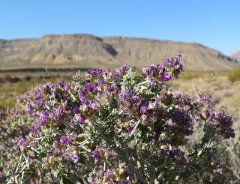 |
| Stan Shebs Creative Commons Attribution-Share Alike 3.0 |
Translate this page:
Summary
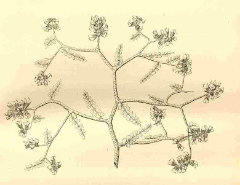
Psorothamnus polydenius is a much-branched, spiny deciduous shrub usually growing 40 - 100cm tall, occasionally to 150cm. Older stems are leafless[1359 ]. Nevada smokebush (Psorothamnus polydenius) produces edible seeds, but only in very small, unreliable quantities. Its greater value lies in its fragrant flowers, traditionally used in tobacco mixtures. USDA Zones 8–10; native, not invasive.
Physical Characteristics

 Psorothamnus polydenius is a SHRUB growing to 1 m (3ft 3in) by 1 m (3ft 3in).
See above for USDA hardiness. It is hardy to UK zone 9 and is frost tender. The flowers are pollinated by Insects.
It can fix Nitrogen.
Suitable for: light (sandy) and medium (loamy) soils, prefers well-drained soil and can grow in nutritionally poor soil. Suitable pH: mildly acid, neutral and basic (mildly alkaline) soils and can grow in very alkaline soils.
It cannot grow in the shade. It prefers dry or moist soil and can tolerate drought.
UK Hardiness Map
US Hardiness Map
Synonyms
Homotypic Synonyms: Dalea polydenia Torr. Parosela polydenia (Torr.) A.Heller. Accepted Infraspecifics: P. polydenius var. jonesii Barneby. P. polydenius var. polydenius.
Plant Habitats
Edible Uses
Nevada smokebush (Psorothamnus polydenius), also known as Nevada dalea, is a desert shrub native to the arid Southwest. Its seeds are reported to be edible, though, as with Emory’s dyebush, production is unreliable. During field observations, seed yields were meager or vanished quickly, making them of little practical value to foragers. This scarcity likely reflects the plant’s dependence on favorable rainfall for reproduction. While the seeds are technically edible, there are no records of them being a significant food source for Native Americans. Instead, the fragrant flowers of Nevada smokebush were more culturally important—they were added to tobacco mixtures, lending an aromatic quality to ceremonial and practical use. No other edible parts of this species are reported [2-3].
References More on Edible Uses
Medicinal Uses
Plants For A Future can not take any responsibility for any adverse effects from the use of plants. Always seek advice from a professional before using a plant medicinally.
The plant is antirheumatic, antiseptic, astringent, diuretic. A decoction of the stems and plant tops is used to treat a variety of complaints including muscular pain, stomach aches, coughs, colds and influenza, TB, kidney problems, venereal diseases[257 ]. The stem is chewed as a treatment for toothaches and facial neuralgia[257 ]. A strong infusion of the plant isused to treat diarrhoea[257 ]. The dried or crushed, fresh stems are applied to sores[257 ]. A decoction of the stems is used as a wash to treat smallpox, measles etc[257 ]. A hot decoction of the plant is used as a wash to relieve rheumatism[257 ].
References More on Medicinal Uses
The Bookshop: Edible Plant Books
Our Latest books on Perennial Plants For Food Forests and Permaculture Gardens in paperback or digital formats.
Edible Tropical Plants
Food Forest Plants for Hotter Conditions: 250+ Plants For Tropical Food Forests & Permaculture Gardens.
More
Edible Temperate Plants
Plants for Your Food Forest: 500 Plants for Temperate Food Forests & Permaculture Gardens.
More
More Books
PFAF have eight books available in paperback and digital formats. Browse the shop for more information.
Shop Now
Other Uses
Nevada smokebush (Psorothamnus polydenius) produces edible seeds, but only in very small, unreliable quantities. Its greater value lies in its fragrant flowers, traditionally used in tobacco mixtures [2-3].
Special Uses
References More on Other Uses
Cultivation details
Sandy and gravelly, often alkaline flats and low hills, commonly associated with Chenopods, sometimes on dunes; at elevations from 880 - 2,250 metres[1359 ]. The plant often forms colonies but is seldom crowded into thickets[1359 ]. USDA Hardiness Zones: Best suited to Zones 8–10, thriving in desert habitats. Weed/Invasiveness: A US native desert shrub; not considered invasive and tends to remain localized due to its limited seed production.
References Carbon Farming Information and Carbon Sequestration Information
Temperature Converter
Type a value in the Celsius field to convert the value to Fahrenheit:
Fahrenheit:
The PFAF Bookshop
Plants For A Future have a number of books available in paperback and digital form. Book titles include Edible Plants, Edible Perennials, Edible Trees,Edible Shrubs, Woodland Gardening, and Temperate Food Forest Plants. Our new book is Food Forest Plants For Hotter Conditions (Tropical and Sub-Tropical).
Shop Now
Plant Propagation
Like many species within the family Fabaceae, once they have ripened and dried the seeds of this species may benefit from scarification before sowing in order to speed up and improve germination. This can usually be done by pouring a small amount of nearly boiling water on the seeds (being careful not to cook them!) and then soaking them for 12 - 24 hours in warm water. By this time they should have imbibed moisture and swollen - if they have not, then carefully make a nick in the seedcoat (being careful not to damage the embryo) and soak for a further 12 hours before sowing[K ].
Other Names
If available other names are mentioned here
Nevada smokebush or Nevada dalea
Native Range
Native to: California, Nevada, Utah.
Weed Potential
Right plant wrong place. We are currently updating this section.
Please note that a plant may be invasive in one area but may not in your area so it's worth checking.
A native desert shrub; not considered invasive and tends to remain localized due to its limited seed production.
Conservation Status
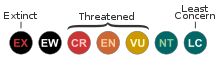
IUCN Red List of Threatened Plants Status : Not available
Growth: S = slow M = medium F = fast. Soil: L = light (sandy) M = medium H = heavy (clay). pH: A = acid N = neutral B = basic (alkaline). Shade: F = full shade S = semi-shade N = no shade. Moisture: D = dry M = Moist We = wet Wa = water.
Now available:
Food Forest Plants for Mediterranean Conditions
350+ Perennial Plants For Mediterranean and Drier Food Forests and Permaculture Gardens.
[Paperback and eBook]
This is the third in Plants For A Future's series of plant guides for food forests tailored to
specific climate zones. Following volumes on temperate and tropical ecosystems, this book focuses
on species suited to Mediterranean conditions—regions with hot, dry summers and cool, wet winters,
often facing the added challenge of climate change.
Read More
Expert comment
Author
(Torr. ex S.Watson) Rydb.
Botanical References
Links / References
For a list of references used on this page please go here
A special thanks to Ken Fern for some of the information used on this page.
Readers comment
| Add a comment |
|
If you have important information about this plant that may help other users please add a comment or link below. Only comments or links that are felt to be directly relevant to a plant will be included. If you think a comment/link or information contained on this page is inaccurate or misleading we would welcome your feedback at [email protected]. If you have questions about a plant please use the Forum on this website as we do not have the resources to answer questions ourselves.
* Please note: the comments by website users are not necessarily those held by PFAF and may give misleading or inaccurate information.
|
Subject : Psorothamnus polydenius
|
|
|
|