 |
|
FeasterCecile wikipedia.org |
 |
|
Translate this page:
Summary
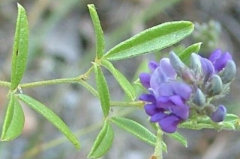
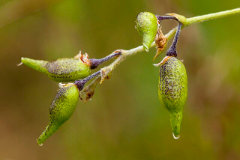
Pediomelum tenuiflorum is a much-branched, erect or ascending, herbaceous perennial plant usually growing 40 - 60cm tall, though sometimes reaching 120cm[274 ]. The plant is harvested from the wild for local use as a food, medicine and source of materials. The plant is classified as 'Least Concern' in the IUCN Red List of Threatened Species(2013)[338 ]. The name of this species has undergone various changes, and various authors are likely to treat any one of the three following taxon as correct. We are treating it as Pediomelum tenuiflorum (Pursh) A.N.Egan & Reveal, following Egan A.N. & Reveal J. in A New Combination in Pediomelum and a New Genus, Ladeania, from Western North America (Fabaceae, Psoraleeae), Novon 19; 310-314, 2009. However, Grimes, J. W. in A revision of the New World Species of the Psoraleeae (Leguminosae: Papilionoideae) Mem. New York Bot. Gard. 61:29, 1990 placed the species in Psoralidium as Psoralidium tenuiflorum (Pursh) Rydb., whilst various other treatments retain this species in Psoralea as Psoralea tenuiflora Pursh.
Physical Characteristics

 Psoralidium tenuiflorum is a PERENNIAL growing to 1 m (3ft 3in) by 0.2 m (0ft 8in) at a fast rate.
See above for USDA hardiness. It is hardy to UK zone 8 and is not frost tender. The flowers are pollinated by Insects.
It is noted for attracting wildlife.
Suitable for: light (sandy), medium (loamy) and heavy (clay) soils, prefers well-drained soil and can grow in nutritionally poor soil. Suitable pH: mildly acid, neutral and basic (mildly alkaline) soils. It cannot grow in the shade. It prefers dry or moist soil and can tolerate drought.
UK Hardiness Map
US Hardiness Map
Synonyms
Lotodes floribundum (Nutt. ex Torr. & A.Gray) Kuntze. Lotodes tenuiflorum (Pursh) Kuntze. Psoralea floribunda Nutt. ex Torr. & A.Gray. Psoralea tenuiflora Pursh Psoralidium floribundum (Nutt. ex Torr. & A.Gray) Rydb. Psoralidium tenuiflorum (Pursh) Rydb.
Plant Habitats
Edible Uses
Root - raw or cooked[105 , 161 , 1438 ]. It can also be dried, ground into a powder and used in soups or with cereals for making bread etc[61 ]. One report says that this species does not have a tuberous root[235 ]. The plant (part not specified) is used as an ingredient of an intoxicant beverage made from mescal (Agave species)[257 ]. The slimflower scurfpea (Psoralidium tenuiflorum) is a perennial member of the bean family native to central and western North America. The only part reported to be edible is the root. These roots are white with brown skins, which can be peeled to slightly improve the flavor. Although small—typically 4–7 mm thick and 70–120 mm long—they are surprisingly sweet and aromatic, with a flavor combining notes of potato, licorice, and a characteristic scurfpea sweetness. The woody texture does not soften with cooking, yet the roots impart a distinctive and hearty flavor when simmered as a broth or used as a base in soups and stews. They can also be gnawed despite their firmness. Because of their small size and limited availability, slimflower scurfpea roots were not a major food resource for Native Americans, though they remain a fine example of a traditional wild plant food [2-3].
References More on Edible Uses
Medicinal Uses
Plants For A Future can not take any responsibility for any adverse effects from the use of plants. Always seek advice from a professional before using a plant medicinally.
A compound decoction of the roots is used as a treatment for TB[257 ]. An infusion of the roots is taken to relieve headaches[257 ]. An infusion of the plant is drunk, or the leaves are smoked, as a treatment for influenza[257 ].
References More on Medicinal Uses
The Bookshop: Edible Plant Books
Our Latest books on Perennial Plants For Food Forests and Permaculture Gardens in paperback or digital formats.
Edible Tropical Plants
Food Forest Plants for Hotter Conditions: 250+ Plants For Tropical Food Forests & Permaculture Gardens.
More
Edible Temperate Plants
Plants for Your Food Forest: 500 Plants for Temperate Food Forests & Permaculture Gardens.
More
More Books
PFAF have eight books available in paperback and digital formats. Browse the shop for more information.
Shop Now
Other Uses
The plant is a good soil stabilizer in sandy soils in its natural environment[200 , 1309 ]. Other Uses: A smudge made from plant stems can be used as a fumigant to repel mosquitoes[257 ]. The plant tops can be fashioned into garlands for use as hats to protect from the sun on hot days[257 ].
Special Uses
References More on Other Uses
Cultivation details
Succeeds in an ordinary garden soil[1 ]. Requires a well-drained soil in a sunny position[200 ]. Plants are very intolerant of root disturbance, they are best planted out into their permanent positions whilst still small[200 ]. This species has a symbiotic relationship with certain soil bacteria, these bacteria form nodules on the roots and fix atmospheric nitrogen. Some of this nitrogen is utilized by the growing plant but some can also be used by other plants growing nearby[200 ]. This species is adapted to dry, open habitats across its native range, and based on its distribution, it is likely suited to USDA Hardiness Zones 6–9. It is not known to be invasive or aggressive, and does not show weedy tendencies outside its natural environments.
References Carbon Farming Information and Carbon Sequestration Information
Temperature Converter
Type a value in the Celsius field to convert the value to Fahrenheit:
Fahrenheit:
The PFAF Bookshop
Plants For A Future have a number of books available in paperback and digital form. Book titles include Edible Plants, Edible Perennials, Edible Trees,Edible Shrubs, Woodland Gardening, and Temperate Food Forest Plants. Our new book is Food Forest Plants For Hotter Conditions (Tropical and Sub-Tropical).
Shop Now
Plant Propagation
Pre-soak the seed for 24 hours in warm water and then sow in early to mid-spring in a greenhouse. To avoid root disturbance, either sow the seed in individual pots or pot up the young seedlings as soon as possible. Grow them in the pots until planted out in their final positions. It is usually impossible to transplant this species without fatal damage to the root[200 ]. Division in spring. With great care since the plant resents root disturbance. It is virtually impossible to divide this species successfully[200 ].
Other Names
If available other names are mentioned here
Slimflower scurfpea
Native Range
Native to: Arizona, Colorado, Illinois, Iowa, Kentucky, Mexico Northeast, Mexico Northwest, Minnesota, Mississippi, Missouri, Montana, New Mexico, North Dakota, Ohio, Texas, Utah, West Virginia, Wyoming.
Weed Potential
Right plant wrong place. We are currently updating this section.
Please note that a plant may be invasive in one area but may not in your area so it's worth checking.
It is not known to be invasive or aggressive, and does not show weedy tendencies outside its natural environments.
Conservation Status
IUCN Red List of Threatened Plants Status : Least Concern

Growth: S = slow M = medium F = fast. Soil: L = light (sandy) M = medium H = heavy (clay). pH: A = acid N = neutral B = basic (alkaline). Shade: F = full shade S = semi-shade N = no shade. Moisture: D = dry M = Moist We = wet Wa = water.
Now available:
Food Forest Plants for Mediterranean Conditions
350+ Perennial Plants For Mediterranean and Drier Food Forests and Permaculture Gardens.
[Paperback and eBook]
This is the third in Plants For A Future's series of plant guides for food forests tailored to
specific climate zones. Following volumes on temperate and tropical ecosystems, this book focuses
on species suited to Mediterranean conditions—regions with hot, dry summers and cool, wet winters,
often facing the added challenge of climate change.
Read More
Expert comment
Author
(Pursh) A.N.Egan & Reveal
Botanical References
Links / References
For a list of references used on this page please go here
A special thanks to Ken Fern for some of the information used on this page.
Readers comment
| Add a comment |
|
If you have important information about this plant that may help other users please add a comment or link below. Only comments or links that are felt to be directly relevant to a plant will be included. If you think a comment/link or information contained on this page is inaccurate or misleading we would welcome your feedback at [email protected]. If you have questions about a plant please use the Forum on this website as we do not have the resources to answer questions ourselves.
* Please note: the comments by website users are not necessarily those held by PFAF and may give misleading or inaccurate information.
|
Subject : Psoralidium tenuiflorum
|
|
|
|