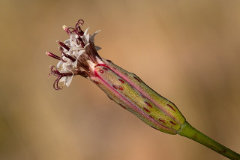
 |
|
Patrick Alexander from Las Cruces, NM Creative Commons Zero, Public Domain Dedication |
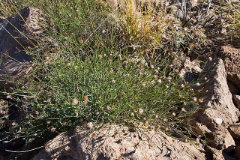 |
| Patrick Alexander from Las Cruces, NM Creative Commons Zero, Public Domain Dedication |
Translate this page:
Summary
Porophyllum gracile is an erect to sub-erect, little to much-branched, perennial plant with stems that can become more or less woody and persist; it can grow 20 - 70cm tall[270, 1169 ]. The plant is harvested from the wild for local use as a medicine. Deerweed has edible leaves—aromatic, unique in flavor, and free of harsh overtones—but is best used sparingly. It thrives in USDA Zones 7–10 and is not invasive.
Physical Characteristics

 Porophyllum gracile is a PERENNIAL growing to 0.4 m (1ft 4in) by 0.4 m (1ft 4in).
See above for USDA hardiness. It is hardy to UK zone 8 and is not frost tender. The flowers are pollinated by Insects.
Suitable for: light (sandy), medium (loamy) and heavy (clay) soils, prefers well-drained soil and can grow in nutritionally poor soil. Suitable pH: mildly acid, neutral and basic (mildly alkaline) soils. It cannot grow in the shade. It prefers dry or moist soil and can tolerate drought.
UK Hardiness Map
US Hardiness Map
Synonyms
P. caesium Greene. P. caesium Casar. P. cedrense Rose & Standl. P. confertum Greene. P. confertum var. ochroleucum I.M.Johnst. P. junciforme Greene. P. leucospermum Greene. P. nodosum M.E.Jones. P. ochroleucum Rydb. P. pinifolium Rydb. P. putidum A.Nelson. P. vaseyi Greene.
Plant Habitats
Edible Uses
Deerweed (Porophyllum gracile), a native member of the sunflower family (Asteraceae), is primarily recognized for its medicinal uses, and references to its edibility are limited. While other Porophyllum species—such as P. ruderale and P. punctatum—are cultivated in Mexico as flavorful seasonings or vegetables, deerweed appears in forage contexts only in moderation. The leaves of deerweed are edible, whether fresh or cooked, and despite their unusual flavor, they introduce a unique aromatic note to dishes. Describing the taste is challenging—it defies straightforward comparison to familiar greens. Common descriptors include pungent, skunk-like, pineapple-like, marigold-like, musty, fruity, fishy, and malodorous; in effect, all seem valid, though none fully capture its complexity. The flavor aligns with the aroma but is a little milder, and importantly, it’s free of harsh bitterness, making the leaves suitable for soups or salads. When boiled, the leaves yield a deep red-orange-brown dye and retain their soft texture; by contrast, the flower heads (specifically phyllaries and developing pappi) and older stems remain tough. Gathering is somewhat tedious but generally possible year-round, with new growth most prevalent in spring. Leaves may drop in drought, but typically regrow after rainfall [2-3].
References More on Edible Uses
Medicinal Uses
Plants For A Future can not take any responsibility for any adverse effects from the use of plants. Always seek advice from a professional before using a plant medicinally.
A root decoction (occasionally the stems and leaves), is used as a regulator of delayed menstruation[257, 1169 ]. The plant is used in the treatment of intestinal disorders[1169 ]. A decoction of the pounded plant is taken to relieve the aches of rheumatic joints and other pains[257 ]. A decoction of the pounded plant is applied as a liniment to the body and used as a wash on sores[257 ]. Leaves, stems, or roots are generally heated in water to make a strong tea which is taken internally or applied externally[1169 ]..
References More on Medicinal Uses
The Bookshop: Edible Plant Books
Our Latest books on Perennial Plants For Food Forests and Permaculture Gardens in paperback or digital formats.
Edible Tropical Plants
Food Forest Plants for Hotter Conditions: 250+ Plants For Tropical Food Forests & Permaculture Gardens.
More
Edible Temperate Plants
Plants for Your Food Forest: 500 Plants for Temperate Food Forests & Permaculture Gardens.
More
More Books
PFAF have eight books available in paperback and digital formats. Browse the shop for more information.
Shop Now
Other Uses
References More on Other Uses
Cultivation details
Porophyllum gracile is one of the most variable species of the genus. It occupies the widest range of ecological habitats for a member of the section Hunteria and probably for the genus. In addition, it occurs in not only the driest areas (rainfall of less than 130mm a year) but also the coldest areas occupied by a species of Porophyllum[1169 ]. Grows best in a sunny position in a well-drained soil. The aromatic oils, which are contained largely in the pores or glands that are especially plentiful on the leaves, produce a strong odour when the foliage is bruised, broken, or heated. Cures, real or fancied, that are attributed to various species of Porophyllum are probably largely due to either the soothing properties of the oils or the imagination by the patient that anything that is so odoriferous must be beneficial[1169 ]. Deerweed is well adapted to arid and semi-arid climates across its native southwestern U.S. range. Based on its ecological preferences, it aligns with USDA Hardiness Zones 7–10, where mild winters and hot summers are the norm. It is a native species and is not considered invasive; it coexists well within its natural habitat without aggressive spreading behavior.
References Carbon Farming Information and Carbon Sequestration Information
Temperature Converter
Type a value in the Celsius field to convert the value to Fahrenheit:
Fahrenheit:
The PFAF Bookshop
Plants For A Future have a number of books available in paperback and digital form. Book titles include Edible Plants, Edible Perennials, Edible Trees,Edible Shrubs, Woodland Gardening, and Temperate Food Forest Plants. Our new book is Food Forest Plants For Hotter Conditions (Tropical and Sub-Tropical).
Shop Now
Plant Propagation
Seed
Other Names
If available other names are mentioned here
Deerweed (Porophyllum gracile)
Native Range
Native to: Arizona, California, Mexico Northeast, Mexico Northwest, New Mexico, Texas.
Weed Potential
Right plant wrong place. We are currently updating this section.
Please note that a plant may be invasive in one area but may not in your area so it's worth checking.
It is a native species and is not considered invasive; it coexists well within its natural habitat without aggressive spreading behavior.
Conservation Status
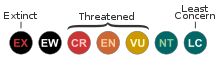
IUCN Red List of Threatened Plants Status : Not available
Growth: S = slow M = medium F = fast. Soil: L = light (sandy) M = medium H = heavy (clay). pH: A = acid N = neutral B = basic (alkaline). Shade: F = full shade S = semi-shade N = no shade. Moisture: D = dry M = Moist We = wet Wa = water.
Now available:
Food Forest Plants for Mediterranean Conditions
350+ Perennial Plants For Mediterranean and Drier Food Forests and Permaculture Gardens.
[Paperback and eBook]
This is the third in Plants For A Future's series of plant guides for food forests tailored to
specific climate zones. Following volumes on temperate and tropical ecosystems, this book focuses
on species suited to Mediterranean conditions—regions with hot, dry summers and cool, wet winters,
often facing the added challenge of climate change.
Read More
Expert comment
Author
Benth.
Botanical References
Links / References
For a list of references used on this page please go here
A special thanks to Ken Fern for some of the information used on this page.
Readers comment
| Add a comment |
|
If you have important information about this plant that may help other users please add a comment or link below. Only comments or links that are felt to be directly relevant to a plant will be included. If you think a comment/link or information contained on this page is inaccurate or misleading we would welcome your feedback at [email protected]. If you have questions about a plant please use the Forum on this website as we do not have the resources to answer questions ourselves.
* Please note: the comments by website users are not necessarily those held by PFAF and may give misleading or inaccurate information.
|
Subject : Porophyllum gracile
|
|
|
|