 |
|
http://commons.wikimedia.org/wiki/User:KENPEI |
 |
| http://commons.wikimedia.org/wiki/User:Gothika |
Translate this page:
Summary
Physical Characteristics

 Pelargonium_crispum is an evergreen Shrub growing to 0.7 m (2ft 4in) by 0.3 m (1ft).
See above for USDA hardiness. It is hardy to UK zone 9 and is frost tender. It is in leaf all year, in flower from May to August. The species is hermaphrodite (has both male and female organs).
Suitable for: light (sandy) and medium (loamy) soils and prefers well-drained soil. Suitable pH: mildly acid, neutral and basic (mildly alkaline) soils. It can grow in semi-shade (light woodland) or no shade. It prefers dry or moist soil.
UK Hardiness Map
US Hardiness Map
Synonyms
Plant Habitats
Edible Uses
The leaves have a pleasant lemon aroma[238]. They are crushed and used to flavour soups, fruit dishes, jellies, sorbets, ice-cream, cakes etc[183, 238]. Cake pans can be lined with the leaves and the pastry will be infused with their essence[183]. An infusion of the leaves is used as a tea[238].
References More on Edible Uses
Medicinal Uses
Plants For A Future can not take any responsibility for any adverse effects from the use of plants. Always seek advice from a professional before using a plant medicinally.
All parts of the plant are astringent[4]. It can be harvested as required and used fresh[238].
References More on Medicinal Uses
Other Uses
An essential oil is obtained from the leaves and young shoots. Strawberry and citral-scented[46], it is used in perfumery and soap making[61]. The leaves are dried for pot-pourri and for making herb pillows[238].
Special Uses
References More on Other Uses
Cultivation details
Requires a light well-drained neutral to alkaline soil in a sunny position[188, 200]. Plants are tolerant of some shade[238]. In order to maintain their native habit, plants require fairly dry conditions in a very sunny position[260]. Plants are not very cold-hardy in Britain, tolerating temperatures down to about -3°c[260]. They generally require greenhouse protection but might succeed outdoors when grown in a very sheltered warm spot in the mildest parts of the country[1]. They can also be grown in containers that are placed outdoors in the summer and then brought into the greenhouse or conservatory for the winter[238]. The plants need to be kept fairly dry in the winter[200]. The bruised leaves release a strong lemon scent, rather like lemon verbena[245]. Very tolerant of pruning, they can be cut right down to the base in the autumn when bringing them back indoors, or in the spring to encourage lots of fresh growth[238]. A number of named varieties have been selected for their ornamental and/or culinary value[183, 238].
References Carbon Farming Information and Carbon Sequestration Information
Temperature Converter
Type a value in the Celsius field to convert the value to Fahrenheit:
Fahrenheit:
Plant Propagation
Seed - best sown as soon as it is ripe in a greenhouse. Stored seed should be sown in early spring in a greenhouse. The seed germinates best with a minimum temperature of 13°c, germination usually taking place within 2 weeks though it sometimes takes some months[200]. Prick out the seedlings into individual pots when they are large enough to handle and grow them on in the greenhouse for at least their first winter. If trying them outdoors, plant them out in early summer and consider giving them extra protection during the winter. Cuttings succeed at almost any time in the growing season but early summer is the best time in order for the new plant to become established before winter.
Other Names
If available other names are mentioned here
Native Range
AFRICA: South Africa (Cape Province (southwest))
Weed Potential
Right plant wrong place. We are currently updating this section.
Please note that a plant may be invasive in one area but may not
in your area so it's worth checking.
Conservation Status
IUCN Red List of Threatened Plants Status :
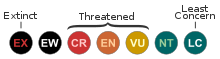
IUCN Red List
Growth: S = slow M = medium F = fast. Soil: L = light (sandy) M = medium H = heavy (clay). pH: A = acid N = neutral B = basic (alkaline). Shade: F = full shade S = semi-shade N = no shade. Moisture: D = dry M = Moist We = wet Wa = water.
Support Plants For A Future
Plants For A Future relies on regular donations to keep our free database and search facilities going, to pay for ongoing research, improvements and enhancements, and to develop and publish new books.
Read more
Choose Currency
Donate in £ GBP
Donate in $ USD
Donate in € EUR
Securely pay via PayPal or Credit/Debit Card without an account.
Expert comment
Author
(P.J.Bergius.)L'Hér.
Botanical References
200
Links / References
For a list of references used on this page please go here
Readers comment