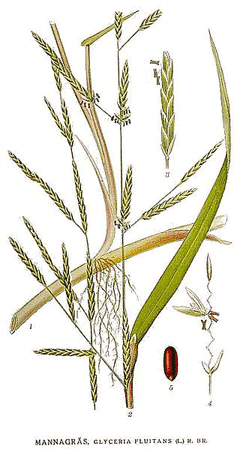
 |
|
http://commons.wikimedia.org/wiki/File:450_Glyceria_fluitans.jpg |
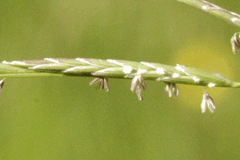 |
| http://www.commanster.eu/commanster.html |
Translate this page:
Summary
Physical Characteristics

 Panicularia fluitans is a PERENNIAL growing to 0.5 m (1ft 8in) by 0.5 m (1ft 8in).
See above for USDA hardiness. It is hardy to UK zone 5 and is not frost tender. It is in flower from May to August. The species is hermaphrodite (has both male and female organs) and is pollinated by Wind.
Suitable for: light (sandy), medium (loamy) and heavy (clay) soils. Suitable pH: mildly acid, neutral and basic (mildly alkaline) soils and can grow in very acid and very alkaline soils.
It cannot grow in the shade. It prefers wet soil and can grow in water.
UK Hardiness Map
US Hardiness Map
Synonyms
Panicularia fluitans
Plant Habitats
Edible Uses
Seed - raw or cooked[43, 57, 100]. A sweetish taste, the seed was considered a delicacy in some parts of Europe and was an article of commerce until well into the 20th century[183]. A flour from the seed is said to make a bread little inferior to wheat bread, the flour can also be used as a thickener in soups etc when it imparts a sweet delicate flavour[183]. Unfortunately, the seed is very small and therefore the plant is relatively unproductive[K].
References More on Edible Uses
Medicinal Uses
Plants For A Future can not take any responsibility for any adverse effects from the use of plants. Always seek advice from a professional before using a plant medicinally.
None known
References More on Medicinal Uses
Other Uses
The leaves have been burnt as an incense[257].
Special Uses
References More on Other Uses
Cultivation details
Succeeds in most soils, so long as they are wet, and in shallow water[115]. Dislikes shade. This plant is occasionally cultivated for its edible seed[115], it is not very large and is somewhat fiddly to harvest but is considered to be an epicure's food[183].
References Carbon Farming Information and Carbon Sequestration Information
Temperature Converter
Type a value in the Celsius field to convert the value to Fahrenheit:
Fahrenheit:
Plant Propagation
Seed - sow spring in a greenhouse in a pot standing in 3 - 5cm of water. Surface sow the seed, or only just cover it. Germination should take place within 3 weeks. When they are large enough to handle, prick the seedlings out into individual pots and plant them out in early summer. If you have sufficient seed then it can be sown outdoors in situ in mid to late spring. Division in spring. Very easy, larger clumps can be replanted direct into their permanent positions, though it is best to pot up smaller clumps and grow them on in a cold frame until they are rooting well. Plant them out in the spring.
Other Names
If available other names are mentioned here
Native Range
TEMPERATE ASIA: Turkey (north), Russian Federation-Ciscaucasia (Ciscaucasia), Armenia, Azerbaijan, Georgia EUROPE: Denmark, Finland, United Kingdom, Ireland, Iceland, Norway, Sweden, Austria, Belgium, Switzerland, Czech Republic, Germany, Hungary, Netherlands, Poland, Slovakia, Russian Federation (European part), Belarus, Estonia, Lithuania, Latvia, Moldova, Russian Federation (Saratov, Volgogradskaja oblast), Ukraine, Albania, Bulgaria, Greece, Croatia, Italy (incl. Sardinia, Sicily), Romania, Serbia, Slovenia, Spain, France (incl. Corsica), Portugal AFRICA: Algeria (north), Morocco, Tunisia Great Britain
Weed Potential
Right plant wrong place. We are currently updating this section.
Please note that a plant may be invasive in one area but may not
in your area so it's worth checking.
Conservation Status
IUCN Red List of Threatened Plants Status :
IUCN Red List
Growth: S = slow M = medium F = fast. Soil: L = light (sandy) M = medium H = heavy (clay). pH: A = acid N = neutral B = basic (alkaline). Shade: F = full shade S = semi-shade N = no shade. Moisture: D = dry M = Moist We = wet Wa = water.
Support Plants For A Future
Plants For A Future relies on regular donations to keep our free database and search facilities going, to pay for ongoing research, improvements and enhancements, and to develop and publish new books.
Read more
Choose Currency
Donate in £ GBP
Donate in $ USD
Donate in € EUR
Securely pay via PayPal or Credit/Debit Card without an account.
Expert comment
Author
(L.)R.Br.
Botanical References
17
Links / References
For a list of references used on this page please go here
Readers comment
| Add a comment |
|
If you have important information about this plant that may help other users please add a comment or link below. Only comments or links that are felt to be directly relevant to a plant will be included. If you think a comment/link or information contained on this page is inaccurate or misleading we would welcome your feedback at [email protected]. If you have questions about a plant please use the Forum on this website as we do not have the resources to answer questions ourselves.
* Please note: the comments by website users are not necessarily those held by PFAF and may give misleading or inaccurate information.
|
Subject : Panicularia fluitans
|
|
|
|