 |
|
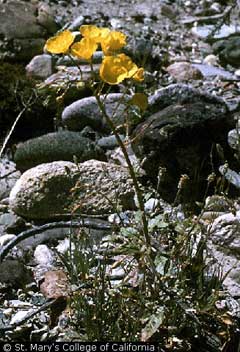
Brother Alfred Brousseau @ USDA-NRCS PLANTS Database |
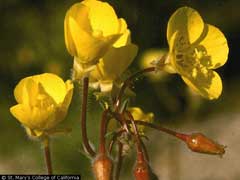 |
| Brother Alfred Brousseau @ USDA-NRCS PLANTS Database |
Translate this page:
Summary
Oenothera brevipes A.Gray is a synonym of Chylismia brevipes. Yellow suncups is a desert annual of sandy and rocky habitats in the lower Colorado River region and surrounding deserts. For foragers, its seeds are exceptional: they are abundant, sheltered inside capsules, available for weeks, easy to harvest and store, largely protected from insects and wind loss, and they can be eaten without cooking. These traits are rare among true desert wild foods, where many seeds are either too tiny, too chaffy, too wind-scattered, or too labor-intensive to process. Ethnobotanical documentation of use appears surprisingly thin given the plant’s real food value, but from a practical foraging perspective, yellow suncups seeds stand out as a genuinely high-return resource.
Physical Characteristics

 Oenothera brevipes is a ANNUAL growing to 0.3 m (1ft).
See above for USDA hardiness. It is hardy to UK zone 9. The species is hermaphrodite (has both male and female organs) and is pollinated by Lepidoptera (Moths & Butterflies), bees. The plant is self-fertile.
It is noted for attracting wildlife.
Suitable for: light (sandy) and medium (loamy) soils and prefers well-drained soil. Suitable pH: mildly acid, neutral and basic (mildly alkaline) soils. It cannot grow in the shade. It prefers dry or moist soil.
UK Hardiness Map
US Hardiness Map
Synonyms
Camissonia brevipes. (Gray.)Raven. Chylismia brevipes
Plant Habitats
Cultivated Beds;
Edible Uses
Edible Parts: Leaves Root Seed Seedpod Shoots
Edible Uses:
Seed.[105, 161, 257]. No more details are given, but the seed is rather small and its use would be very fiddly. Seedpod[213]. No more details are given. Root - cooked. Too small to be a staple food, but useful in an emergency, the roots taste best in late autumn, winter and early spring[213]. Leaves and young shoots - cooked[213]. The seeds are the primary food part and are unusually high value for a desert annual. They are tasty, oily, and easy to harvest and store, with optional gentle toasting and excellent use as a soup-thickening ingredient due to their mucilage. Edible Uses & Rating: The edible part is the seed. As a seed-producing desert annual with unusually favorable harvest and processing traits, yellow suncups rates very highly as a wild food where it occurs. It is one of the rare cases where a desert seed can be gathered efficiently enough to matter. Leaves are not the documented food use here, and the plant’s value is overwhelmingly in its seeds. Taste, Processing & Kitchen Notes: Fresh seeds have a sandy, oily, bread-like flavor with a delicately crunchy texture. That “sandy” note is often a mix of the seed’s natural texture plus desert dust and fine capsule residue, so careful cleaning improves the eating quality. Toasting deepens the oiliness, reduces the sandy overtone, and adds a pleasant bran-like character, but the seeds scorch easily. Gentle heat is essential because bitter smoke and rapid blackening can happen quickly. The seeds contain mucilage, which becomes obvious when simmered: broth thickens fast and the seeds develop a slippery coating. This makes them very good for soups, where they add both flavor and body, but it also means whole seeds can become oddly hard to chew once coated. Crushing or grinding before adding them to soup prevents that problem and produces a smoother, more uniformly thickened result. Seasonality (Phenology): Yellow suncups typically blooms in early spring in warmer deserts, often beginning around March, with seed set following a few weeks later. The exact window depends on rainfall timing and local elevation. Once capsules mature and begin to split, seeds can remain available for several weeks because many capsules retain seed rather than dumping it all immediately to wind. This extended harvest window is part of what makes the species unusually valuable. Safety & Cautions (Food Use): No specific toxin concern is highlighted for yellow suncups seeds in your source material, but standard seed-harvest cautions apply. Avoid plants growing in contaminated soils or along heavily trafficked roadsides. Clean seeds well to reduce grit, dust, and capsule fragments, and toast gently if using heat to reduce any unseen pests. Harvest & Processing Workflow: Harvest when capsules are mature and beginning to split into four parts, but before most seed has fallen. Collect seed heads into a container or bag and allow them to dry further if needed. Thresh by rubbing and shaking to release seeds. Winnow lightly to remove capsule fragments, then do a final cleaning step to remove dust and grit. For storage, keep seeds dry; a brief low-heat toasting can help reduce pest risk. For soup, crush or grind first to prevent mucilage from forming a slippery coating on whole seeds. For porridge or meal-style uses, toasting followed by simmering gives the best balance of flavor and texture. Cultivar/Selection Notes: No cultivars are known for this wild desert annual. Natural populations vary in size and productivity depending on rainfall, site conditions, and competition pressure. Look-Alikes & Confusion Risks: The evening primrose family has many similar-looking desert annuals, and names have shifted across Chylismia, Camissonia, and Oenothera depending on the authority. For field identification, the most practical distinction is capsule structure and the seed stage traits. Yellow suncups has long, narrow capsules that split four ways, and in maturity the split capsule segments can peel back in a distinctive way. Confirm by checking the combination of yellow four-petaled flowers, inferior ovary, and the narrow linear capsule dimensions. When uncertain, avoid relying on leaf shape alone, since leaf cutting varies greatly in desert annuals. Traditional / Indigenous Use Summary: Despite the seeds’ outstanding practical value, recorded Indigenous food use appears infrequently documented in the material you provided. That may reflect gaps in the record rather than true absence of use. From a foraging standpoint, the plant’s “ease-to-return” ratio suggests it could have been an opportunistic seed resource when locally abundant.
References More on Edible Uses
Medicinal Uses
Plants For A Future can not take any responsibility for any adverse effects from the use of plants. Always seek advice from a professional before using a plant medicinally.
None known
References More on Medicinal Uses
The Bookshop: Edible Plant Books
Our Latest books on Perennial Plants For Food Forests and Permaculture Gardens in paperback or digital formats.
Edible Tropical Plants
Food Forest Plants for Hotter Conditions: 250+ Plants For Tropical Food Forests & Permaculture Gardens.
More
Edible Temperate Plants
Plants for Your Food Forest: 500 Plants for Temperate Food Forests & Permaculture Gardens.
More
More Books
PFAF have eight books available in paperback and digital formats. Browse the shop for more information.
Shop Now
Other Uses
Because it is an annual adapted to disturbance and open soil, it is better suited to wild margins, restoration-style plantings, or low-water desert gardens than to irrigated beds.
Special Uses
Attracts Wildlife Scented Plants
References More on Other Uses
Cultivation details
Yellow suncups is a rare desert standout: a seed plant that is genuinely efficient to harvest and rewarding to eat. Its mature capsules protect seeds from immediate loss and insect damage, while the seeds themselves store well and can be eaten with minimal processing. In arid landscapes where many “edible plants” are technically edible but not realistically useful, yellow suncups behaves like a true food resource. Growing Conditions: This species favors arid environments with full sun and well-drained soils, especially sandy or rocky substrates. It thrives in open desert plant communities where competition is limited and where seasonal moisture triggers rapid growth, flowering, and seed set. It commonly occurs among creosote bush and in similar sparse desert vegetation, including Joshua tree landscapes. Habitat & Range: Yellow suncups occurs in desert regions of the southwestern United States, particularly in southern California and southern Arizona, with extensions northward into parts of southern Nevada and southern Utah. It is associated with open sandy or rocky ground and is often seen in places that look harsh and low in productivity—precisely where a reliable seed plant becomes disproportionately important. Size & Landscape Performance: As an annual, yellow suncups does not form permanent structure, but in good rainfall years it can become locally abundant. Plants range widely in height depending on moisture and competition. Its “performance” is best understood as opportunistic: rapid spring growth, a short flowering window, then a quick shift into seed production before the onset of deeper heat and drought. Cultivation (Horticulture): Yellow suncups can be encouraged by allowing some mature plants to drop seed in place, or by scattering saved seed into appropriate open ground before seasonal rains. Because it is an annual adapted to disturbance and open soil, it is better suited to wild margins, restoration-style plantings, or low-water desert gardens than to irrigated beds. If cultivated for seed, the key is timing harvest as capsules begin to split, before seeds are lost to ants or ground fall. Pests & Problems: The seeds are often less bug-damaged than many desert annual seeds, which is part of their value, but losses to ants can be significant once seeds fall. Plants are also vulnerable to being crowded out by invasive mustards and other fast-growing annuals in disturbed habitats. Pollination: Flowers are pollinated by insects attracted to the showy yellow petals in spring. As with many Onagraceae, timing of flower opening and local pollinator activity can influence seed set, but the plant is generally a reliable seeder where it establishes. Identification & Habit: Yellow suncups grows as an upright, hairy annual arising from a taproot. Leaves are mostly basal early on, with additional alternate leaves on the stem. The leaves may be simple or once-pinnate, usually lance-shaped in outline, with margins that range from toothed to lobed to deeply cut. The flowers are showy and yellow, with four petals and four sepals, and the floral structure is characteristic of the evening primrose family: an inferior ovary and eight stamens with anthers attached in a way that often makes them appear T-shaped (versatile). As plants dry down, the long, narrow seed capsules split open in four parts. In the seed stage, those opening capsules can peel back in a distinctive way that makes the plant easier to recognize even when most green tissue has withered. Typical Size: About 10–70 cm tall; upright, hairy annual from a taproot.
References Carbon Farming Information and Carbon Sequestration Information
Temperature Converter
Type a value in the Celsius field to convert the value to Fahrenheit:
Fahrenheit:
The PFAF Bookshop
Plants For A Future have a number of books available in paperback and digital form. Book titles include Edible Plants, Edible Perennials, Edible Trees,Edible Shrubs, Woodland Gardening, and Temperate Food Forest Plants. Our new book is Food Forest Plants For Hotter Conditions (Tropical and Sub-Tropical).
Shop Now
Plant Propagation
Propagation is by seed. Seeds can be broadcast on suitable sandy or rocky soil in an area with minimal competing vegetation. Germination success depends strongly on rainfall timing and surface moisture persistence. Because the plant is adapted to desert boom-and-bust cycles, results can vary year to year even in the same location.
Other Names
If available other names are mentioned here
Oenothera brevipes A.Gray is a synonym of Chylismia brevipes. Yellow suncups. Ecology & Wildlife: The flowers support insect activity in spring, and the plant’s seed production becomes part of the desert food web. Ants, in particular, can remove large quantities of fallen seed. The species’ strategy of retaining seed within splitting capsules helps buffer against immediate loss to wind and some predation, extending availability for both wildlife and foragers.
Native Range
NORTHERN AMERICA: United States (Arizona (west), California (southeast), Nevada (south), Utah (Kane & Washington Cos.))
Weed Potential
Right plant wrong place. We are currently updating this section.
Please note that a plant may be invasive in one area but may not in your area so it's worth checking.
Yellow suncups is a native or long-established desert annual in much of its range and is not typically viewed as a problematic weed. It is more often outcompeted by invasive winter annuals than it is a driver of displacement. In some disturbed sites it may appear abundantly after rain, but it does not form persistent monocultures without repeated favorable conditions.
Conservation Status
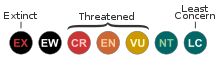
IUCN Red List of Threatened Plants Status :
Growth: S = slow M = medium F = fast. Soil: L = light (sandy) M = medium H = heavy (clay). pH: A = acid N = neutral B = basic (alkaline). Shade: F = full shade S = semi-shade N = no shade. Moisture: D = dry M = Moist We = wet Wa = water.
Now available:
Food Forest Plants for Mediterranean Conditions
350+ Perennial Plants For Mediterranean and Drier Food Forests and Permaculture Gardens.
[Paperback and eBook]
This is the third in Plants For A Future's series of plant guides for food forests tailored to
specific climate zones. Following volumes on temperate and tropical ecosystems, this book focuses
on species suited to Mediterranean conditions—regions with hot, dry summers and cool, wet winters,
often facing the added challenge of climate change.
Read More
Expert comment
Author
A.Gray.
Botanical References
71
Links / References
For a list of references used on this page please go here
Readers comment
| Add a comment |
|
If you have important information about this plant that may help other users please add a comment or link below. Only comments or links that are felt to be directly relevant to a plant will be included. If you think a comment/link or information contained on this page is inaccurate or misleading we would welcome your feedback at [email protected]. If you have questions about a plant please use the Forum on this website as we do not have the resources to answer questions ourselves.
* Please note: the comments by website users are not necessarily those held by PFAF and may give misleading or inaccurate information.
|
Subject : Oenothera brevipes
|
|
|
|