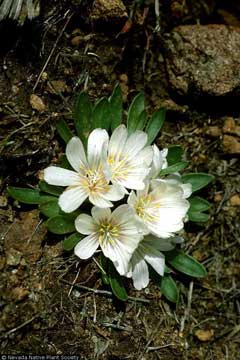
 |
|
Margaret Williams @ USDA-NRCS PLANTS Database |
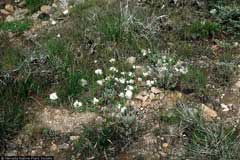 |
| Margaret Williams @ USDA-NRCS PLANTS Database |
Translate this page:
Summary
Southwestern bitterroot is one of the finest native root vegetables of the American Southwest. Despite its name, the peeled roots are not bitter, but pleasantly starchy with a flavour reminiscent of potatoes. The thick roots lie just beneath the soil surface, making them exceptionally easy to harvest with minimal effort. The fleshy leaves are also edible, although they are far less desirable than the roots. Restricted mainly to the mountains of Arizona, this attractive spring-flowering perennial is one of the region's outstanding wild food plants.
Physical Characteristics

 Lewisia_brachycalyx is a PERENNIAL growing to 0.2 m (0ft 8in) by 0.2 m (0ft 8in) at a slow rate.
See above for USDA hardiness. It is hardy to UK zone 5 and is not frost tender. It is in leaf from September to July, in flower in May. The species is hermaphrodite (has both male and female organs) and is pollinated by Insects.
It is noted for attracting wildlife.
Suitable for: light (sandy) and medium (loamy) soils and prefers well-drained soil. Suitable pH: mildly acid and neutral soils. It cannot grow in the shade. It prefers moist soil.
UK Hardiness Map
US Hardiness Map
Synonyms
Oreobroma brachycalyx (Engelm. ex A.Gray) Howell
Plant Habitats
Edible Uses
Southwestern bitterroot is one of the Southwest's outstanding edible native plants. Its large, easily harvested roots require minimal preparation, cook quickly, and possess a flavour comparable to potatoes. Although its leaves are edible, the roots are unquestionably the star attraction. For anyone fortunate enough to encounter this beautiful mountain wildflower, it represents one of the finest native root vegetables in western North America [2-3]. The roots and leaves are edible [2-3]. The roots are the plant's most valuable part and rank among the best native wild foods of the Southwest. The leaves can also be eaten fresh or cooked but are considerably less appealing than the roots[2-3]. Edibility Rating: 5 out of 5 – An outstanding wild root vegetable with excellent flavor, exceptional ease of harvesting, and high food value. Taste and Preparation: The thick roots are off-white with thin, flaky, dark-brown skins. Although the plant is called bitterroot, the bitterness is confined almost entirely to the skins. Simply washing the roots usually removes much of the peeling, as the skins flake away easily. The peeled roots consist almost entirely of starch and have a flavor remarkably similar to potatoes with a mild earthy character. Boiling for about 10 minutes produces a soft, tender texture. They are equally suitable for steaming, baking, or sautéing with butter and herbs, and all cooking methods produce excellent results. The leaves are thick, fleshy, and tender but have a mildly acrid, slightly soapy flavor, making them less suitable for salads. Mixed with milder greens, they can be eaten fresh, while boiling improves their flavor and produces a pale green broth. The leaves become soft when cooked, although the central ribs may remain slightly stringy [2-3]. Seasonality (Phenology): Southwestern bitterroot can be harvested year-round, but it is easiest to find when flowering from late spring to early summer. The fleshy leaves appear during the growing season, then gradually wither as summer approaches [2-3]. Nutritional Value: The roots are rich in complex carbohydrates and provide an excellent energy source. Like many fleshy storage roots, they also supply dietary fiber, minerals, and small amounts of vitamins, while the leaves contribute additional vitamins and antioxidants [2-3]. Traditional Uses: Indigenous peoples throughout western North America have long valued bitterroots. Although mountain bitterroot (Lewisia rediviva) was historically the most important species, southwestern bitterroot roots are equally edible and represent one of the finest native root foods of the Southwest [2-3]. No significant toxicity has been reported. The roots are considered safe when properly prepared. Peeling the thin outer skins improves flavour by removing the slight bitterness concentrated near the surface. Root - cooked. Steeped and boiled[177]. Said to be extremely nutritious. It is easiest to use when the plant is in flower because the outer layer of the root (which is very bitter) slips off easily at this time of the year[85]. The root has a good taste though a decided bitter flavour develops afterwards[105, 161].
References More on Edible Uses
Medicinal Uses
Plants For A Future can not take any responsibility for any adverse effects from the use of plants. Always seek advice from a professional before using a plant medicinally.
Lewisia brachycalyx has traditional medicinal uses recorded by Indigenous peoples within its native range. Traditional Uses: Sore Throats: Indigenous groups historically chewed the fleshy taproot or steeped it into a tea to treat sore throats. Lung Inflammation: Root preparations were also used to relieve symptoms of pleurisy (lung inflammation). Skin Sores: A wash or poultice made from the roots was applied externally to soothe skin sores and irritations.
References More on Medicinal Uses
The Bookshop: Edible Plant Books
Our Latest books on Perennial Plants For Food Forests and Permaculture Gardens in paperback or digital formats.
Edible Tropical Plants
Food Forest Plants for Hotter Conditions: 250+ Plants For Tropical Food Forests & Permaculture Gardens.
More
Edible Temperate Plants
Plants for Your Food Forest: 500 Plants for Temperate Food Forests & Permaculture Gardens.
More
More Books
PFAF have eight books available in paperback and digital formats. Browse the shop for more information.
Shop Now
Other Uses
It performs best in rock gardens and alpine-style plantings. Wildlife Value: The flowers provide an early nectar source for pollinating insects, while the foliage contributes to the diversity of mountain meadow plant communities.
Special Uses
References More on Other Uses
Cultivation details
Southwestern bitterroot grows best in cool mountain climates with well-drained soils. It prefers open meadows, woodland clearings, and open forests where winter moisture gives way to relatively dry summers. Habitat: Occurs primarily in mountain meadows, open forests, and woodland clearings of Arizona, generally at middle to higher elevations. USDA Hardiness Zones: USDA Zones 5–8. Growth Rate: Slow to moderate. These long-lived perennials invest much of their energy in developing substantial underground storage roots. Mature Size: Typically 5–15 cm (2–6 in) tall when flowering, with low basal rosettes of fleshy leaves. Cultivation: Southwestern bitterroot requires excellent drainage and a pronounced seasonal cycle of cool, moist winters followed by relatively dry summers. It performs best in rock gardens and alpine-style plantings where these conditions can be replicated. Pollinators: The attractive white to pink flowers attract a range of native bees and other spring pollinating insects. Identification: Southwestern bitterroot is a small perennial arising from a thick fleshy root. It produces basal rosettes of thick, linear-oblanceolate leaves and clusters of white to pink flowers marked with darker veins. Unlike several related species, the flowers are essentially sessile, with paired bracts closely resembling four sepals. The translucent capsules split horizontally around their middle when mature. Similar Species: Southwestern bitterroot resembles dwarf bitterroot (Lewisia pygmaea), Nevada bitterroot (Lewisia nevadensis), and the famous mountain bitterroot (Lewisia rediviva). It differs by its nearly stalkless flowers and its distribution, being found primarily in Arizona. Like its relatives, it possesses a thick edible storage root. Requires a very well-drained, gritty, humus-rich, deep soil in a sunny position[1, 200]. Prefers a neutral to acid soil[188]. This species is not reliably hardy in Britain[1]. It can withstand consistently very cold weather but does not like alternating periods of mild and cold conditions, nor does it like winter wet[1]. The plant is very susceptible to rotting at the neck in damp soil[200]. Plants die down after flowering and start growing again in the autumn[188]. Very apt to hybridize with other members of this genus[1].
References Carbon Farming Information and Carbon Sequestration Information
Temperature Converter
Type a value in the Celsius field to convert the value to Fahrenheit:
Fahrenheit:
The PFAF Bookshop
Plants For A Future have a number of books available in paperback and digital form. Book titles include Edible Plants, Edible Perennials, Edible Trees,Edible Shrubs, Woodland Gardening, and Temperate Food Forest Plants. Our new book is Food Forest Plants For Hotter Conditions (Tropical and Sub-Tropical).
Shop Now
Plant Propagation
Seed - best sown as soon as it is ripe in a cold frame in a very freely draining soil[129]. Sow stored seed as soon as possible in a cold frame. One months cold stratification should improve germination, though this is still likely to be very slow. When they are large enough to handle, prick the seedlings out into individual pots and grow them on in the greenhouse for at least their first two winters. Plant them out into their permanent positions in late spring or early summer, after the last expected frosts. Division in March/April. Very difficult.
Other Names
If available other names are mentioned here
Southwestern bitterroot, shortsepal bitterroot. Shortsepal lewisia. short-sepal bitter-root.
Native Range
NORTHERN AMERICA: United States (Arizona, California, Utah (Washington Co.)), Mexico (Baja California (Norte))
Weed Potential
Right plant wrong place. We are currently updating this section.
Please note that a plant may be invasive in one area but may not in your area so it's worth checking.
Very low. Southwestern bitterroot is a slow-growing native perennial with no invasive tendencies.
Conservation Status
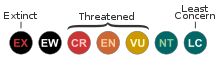
IUCN Red List of Threatened Plants Status : Not listed.
Growth: S = slow M = medium F = fast. Soil: L = light (sandy) M = medium H = heavy (clay). pH: A = acid N = neutral B = basic (alkaline). Shade: F = full shade S = semi-shade N = no shade. Moisture: D = dry M = Moist We = wet Wa = water.
Now available:
Food Forest Plants for Mediterranean Conditions
350+ Perennial Plants For Mediterranean and Drier Food Forests and Permaculture Gardens.
[Paperback and eBook]
This is the third in Plants For A Future's series of plant guides for food forests tailored to
specific climate zones. Following volumes on temperate and tropical ecosystems, this book focuses
on species suited to Mediterranean conditions—regions with hot, dry summers and cool, wet winters,
often facing the added challenge of climate change.
Read More
Expert comment
Author
Engelm. ex A.Gray.
Botanical References
71200270
Links / References
For a list of references used on this page please go here
Readers comment