 |
|
http://picasaweb.google.com/lh/photo/e7-jNcmtIP3MSS2lvO0S_g |
 |
| http://picasaweb.google.com/lh/photo/yqfhsmZ_YChM9kB4P3VH6g |
Translate this page:
Summary
Dwarf bitterroot is another excellent edible member of the Lewisia genus. Although it lacks the historical prominence of mountain bitterroot and the exceptionally large roots of southwestern bitterroot, it provides a nutritious, starchy root that has supported Indigenous peoples for generations. Its small size and relative scarcity mean it is best appreciated as an occasional foraging discovery rather than a staple food, but it remains one of the more valuable native alpine edibles of western North America.
Physical Characteristics

 Lewisia pygmaea is a PERENNIAL growing to 0.2 m (0ft 8in) by 0.1 m (0ft 4in) at a slow rate.
See above for USDA hardiness. It is hardy to UK zone 5 and is not frost tender. It is in leaf from September to July. The species is hermaphrodite (has both male and female organs) and is pollinated by Bees, insects.
It is noted for attracting wildlife.
Suitable for: light (sandy) and medium (loamy) soils and prefers well-drained soil. Suitable pH: mildly acid and neutral soils. It cannot grow in the shade. It prefers moist soil.
UK Hardiness Map
US Hardiness Map
Synonyms
Calandrinia grayi Britton. Calandrinia pygmaea (A.Gray) A.Gray. Claytonia grayi F.Muell. Claytonia parva Kuntze. Oreobroma grayi (Britton) Rydb. Oreobroma pygmaeum (A.Gray) Howell. Talinum pygmaeum A.Gray.
Plant Habitats
Cultivated Beds;
Edible Uses
Edible Parts: Root
Edible Uses:
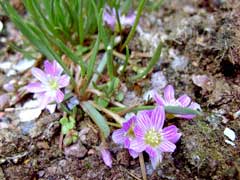
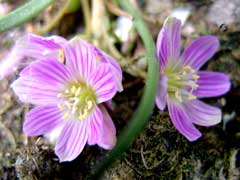
Dwarf bitterroot is another excellent edible member of the Lewisia genus. Although it lacks the historical prominence of mountain bitterroot and the exceptionally large roots of southwestern bitterroot, it provides a nutritious, starchy root that has supported Indigenous peoples for generations. Its small size and relative scarcity mean it is best appreciated as an occasional foraging discovery rather than a staple food, but it remains one of the more valuable native alpine edibles of western North America [2-3]. The roots are edible [2-3]. While the leaves are not generally reported to be edible, people have long recognized the fleshy roots as a traditional food. As with other bitterroots, the roots are best collected while the plants are actively growing and are likely to have a flavor similar to that of other Lewisia species. Edibility Rating: 4 out of 5 – An excellent edible root with a long history of traditional use, although its relatively small size and scarcity reduce its practical value. Taste and Preparation: Although the roots of dwarf bitterroot were not sampled during the original fieldwork, they are reported to be edible and likely resemble those of other Lewisia species. Based on the close similarity within the genus, the peeled roots likely have a mild, starchy flavor resembling potatoes, with a faint earthy note. The thin outer skin may contribute slight bitterness and is best removed before cooking. The roots are well suited to boiling, steaming, baking, or roasting. Like other bitterroots, only brief cooking is likely to produce a soft, floury texture [2-3]. Seasonality (Phenology): Dwarf bitterroot can technically be harvested year-round but is easiest to find when flowering from late spring through late summer. Traditionally, Indigenous peoples gathered the roots in spring as the flower buds first appeared, when they were easiest to find and likely at their highest food quality [2-3]. Nutritional Value: The fleshy roots are rich in complex carbohydrates that serve as the plant's energy reserves. They also provide dietary fiber and small amounts of minerals and other nutrients typical of underground storage organs [2-3]. Traditional Uses: Indigenous peoples of the northwestern United States and Canada traditionally gathered the roots as a seasonal food. Although mountain bitterroot (Lewisia rediviva) was generally considered the more important species, dwarf bitterroot also contributed to traditional diets where it occurred [2-3]. No significant toxicity has been reported. The roots have a long history of traditional consumption and are generally considered safe when properly prepared. Root - cooked. Steeped and boiled[177]. It can also be dried for later use[257]. The root is said to be extremely nutritious[85], though some native North American Indian tribes believed that eating it could cause insanity[257]. It is easiest to use when the plant is in flower because the outer layer of the root (which is very bitter) slips off easily at this time of the year[85]. The root has a good taste though a decided bitter flavour develops afterwards[105, 161].
References More on Edible Uses
Medicinal Uses
Plants For A Future can not take any responsibility for any adverse effects from the use of plants. Always seek advice from a professional before using a plant medicinally.
Lewisia pygmaea does not have documented traditional medicinal properties.
References More on Medicinal Uses
The Bookshop: Edible Plant Books
Our Latest books on Perennial Plants For Food Forests and Permaculture Gardens in paperback or digital formats.
Edible Tropical Plants
Food Forest Plants for Hotter Conditions: 250+ Plants For Tropical Food Forests & Permaculture Gardens.
More
Edible Temperate Plants
Plants for Your Food Forest: 500 Plants for Temperate Food Forests & Permaculture Gardens.
More
More Books
PFAF have eight books available in paperback and digital formats. Browse the shop for more information.
Shop Now
Other Uses
Dwarf bitterroot is best suited to alpine gardens and rock gardens. The flowers provide nectar and pollen for alpine pollinators, while the plant contributes to the biodiversity of high-elevation ecosystems.
Special Uses
References More on Other Uses
Cultivation details
Dwarf bitterroot prefers cool climates with well-drained soils. It grows from sagebrush steppe to alpine meadows and tundra, thriving where snowmelt provides moisture during spring and early summer, followed by relatively dry conditions. Habitat: Occurs across much of western North America in sagebrush steppe, mountain meadows, alpine slopes, tundra, and other cool open habitats. USDA Hardiness Zones: USDA Zones 3–8. Growth Rate: Slow. These long-lived perennials invest much of their energy in developing underground storage roots. Mature Size: Typically 3–10 cm (1–4 in) tall, forming compact rosettes close to the ground. Cultivation: Dwarf bitterroot suits alpine gardens and rock gardens with excellent drainage. It requires cool winters, moist springs, and relatively dry summers to thrive. Pollinators: The delicate white to pinkish-purple flowers attract small native bees, flies, and other spring and summer pollinating insects. Identification: Dwarf bitterroot forms small basal rosettes of thick, linear-oblanceolate leaves arising from a fleshy root. The flowers are borne on stalks above the foliage and have white to pinkish-purple petals, often marked with darker stripes. The translucent capsules split horizontally around the middle when mature, a characteristic feature of the genus. Similar Species: Dwarf bitterroot resembles southwestern bitterroot (Lewisia brachycalyx), Nevada bitterroot (Lewisia nevadensis), and mountain bitterroot (Lewisia rediviva). It is distinguished by its glandular-toothed sepals, stalked flowers, compact alpine habit, and preference for higher elevations. Requires a very well-drained gritty humus-rich deep soil in a sunny position[1, 200]. Prefers a neutral to acid soil[188]. This species is not reliably hardy in Britain. It can withstand consistently very cold weather but does not like alternating periods of mild and cold conditions, nor does it like winter wet[1]. The plant is very susceptible to rotting at the neck in a damp soil[200]. Plants die down after flowering and start growing again in the autumn[188]. A very ornamental plant[1]. Polymorphic[60]. Very apt to hybridize with other members of this genus[1].
References Carbon Farming Information and Carbon Sequestration Information
Temperature Converter
Type a value in the Celsius field to convert the value to Fahrenheit:
Fahrenheit:
The PFAF Bookshop
Plants For A Future have a number of books available in paperback and digital form. Book titles include Edible Plants, Edible Perennials, Edible Trees,Edible Shrubs, Woodland Gardening, and Temperate Food Forest Plants. Our new book is Food Forest Plants For Hotter Conditions (Tropical and Sub-Tropical).
Shop Now
Plant Propagation
Seed - best sown as soon as it is ripe in a cold frame in a very freely draining soil[129]. Sow stored seed as soon as possible in a cold frame. One months cold stratification should improve germination, though this is still likely to be very slow. When they are large enough to handle, prick the seedlings out into individual pots and grow them on in the greenhouse for at least their first two winters. Plant them out into their permanent positions in late spring or early summer, after the last expected frosts. Division in March/April. Very difficult.
Other Names
If available other names are mentioned here
Dwarf bitterroot, alpine bitterroot, pigmy bitterroot, Alpine lewisia.
Native Range
NORTHERN AMERICA: Canada (Yukon), Alberta, British Columbia), United States (Colorado, Idaho, Montana, Oregon, Washington, Wyoming, New Mexico, Arizona, California, Nevada, Utah)
Weed Potential
Right plant wrong place. We are currently updating this section.
Please note that a plant may be invasive in one area but may not in your area so it's worth checking.
Very low. Dwarf bitterroot is a slow-growing native perennial with no invasive tendencies.
Conservation Status
IUCN Red List of Threatened Plants Status : Not listed.

Growth: S = slow M = medium F = fast. Soil: L = light (sandy) M = medium H = heavy (clay). pH: A = acid N = neutral B = basic (alkaline). Shade: F = full shade S = semi-shade N = no shade. Moisture: D = dry M = Moist We = wet Wa = water.
Now available:
Food Forest Plants for Mediterranean Conditions
350+ Perennial Plants For Mediterranean and Drier Food Forests and Permaculture Gardens.
[Paperback and eBook]
This is the third in Plants For A Future's series of plant guides for food forests tailored to
specific climate zones. Following volumes on temperate and tropical ecosystems, this book focuses
on species suited to Mediterranean conditions—regions with hot, dry summers and cool, wet winters,
often facing the added challenge of climate change.
Read More
Expert comment
Author
(A.Gray.)B.L.Rob.
Botanical References
60200270
Links / References
For a list of references used on this page please go here
Readers comment
© 2010, Plants For A Future. Plants For A Future is a charitable company limited by guarantee, registered in England and Wales. Charity No. 1057719, Company No. 3204567.