Translate this page:
Summary
Physical Characteristics

 Lathyrus_palustris is a PERENNIAL CLIMBER growing to 1.2 m (4ft).
See above for USDA hardiness. It is hardy to UK zone 5. It is in flower from July to August. The species is hermaphrodite (has both male and female organs) and is pollinated by Insects.
It can fix Nitrogen.
Suitable for: light (sandy), medium (loamy) and heavy (clay) soils. Suitable pH: mildly acid, neutral and basic (mildly alkaline) soils. It cannot grow in the shade. It prefers moist or wet soil.
UK Hardiness Map
US Hardiness Map
Synonyms
Plant Habitats
Edible Uses
Seed - cooked[105, 161, 179]. The fully grown seeds are shelled and cooked as a vegetable[257]. Some caution is advised, see the notes above on toxicity. Young leaves and stems - cooked[177].
References More on Edible Uses
Medicinal Uses
Plants For A Future can not take any responsibility for any adverse effects from the use of plants. Always seek advice from a professional before using a plant medicinally.
None known
References More on Medicinal Uses
The Bookshop: Edible Plant Books
Our Latest books on Perennial Plants For Food Forests and Permaculture Gardens in paperback or digital formats.
Edible Tropical Plants
Food Forest Plants for Hotter Conditions: 250+ Plants For Tropical Food Forests & Permaculture Gardens.
More
Edible Temperate Plants
Plants for Your Food Forest: 500 Plants for Temperate Food Forests & Permaculture Gardens.
More
More Books
PFAF have eight books available in paperback and digital formats. Browse the shop for more information.
Shop Now
Other Uses
References More on Other Uses
Cultivation details
A good plant for the bog or marsh garden, succeeding in wet soils[1, 200]. It is easily grown in any moderately good garden soil, preferring a position in full sun[200]. Plants climb by means of tendrils[188]. This species has a symbiotic relationship with certain soil bacteria, these bacteria form nodules on the roots and fix atmospheric nitrogen. Some of this nitrogen is utilized by the growing plant but some can also be used by other plants growing nearby[200].
References Carbon Farming Information and Carbon Sequestration Information
Temperature Converter
Type a value in the Celsius field to convert the value to Fahrenheit:
Fahrenheit:
The PFAF Bookshop
Plants For A Future have a number of books available in paperback and digital form. Book titles include Edible Plants, Edible Perennials, Edible Trees,Edible Shrubs, Woodland Gardening, and Temperate Food Forest Plants. Our new book is Food Forest Plants For Hotter Conditions (Tropical and Sub-Tropical).
Shop Now
Plant Propagation
Pre-soak the seed for 24 hours in warm water and then sow in early spring in a cold frame[200]. When they are large enough to handle, prick the seedlings out into individual pots and plant them out in the summer. If you have sufficient seed, then it can also be sown in situ in mid spring[200]. Division in spring. It may not transplant well so care should be taken[200].
Other Names
If available other names are mentioned here
Native Range
TEMPERATE ASIA: Turkey (north), Georgia, Russian Federation (Krasnodar), Russian Federation (Buryatia, Gorno-Altay, Hakasija, Respublika, Tyva, Respublika, Yakutia-Sakha, Altay, Krasnoyarsk, Taymyr, Chita, Irkutsk, Kemerovskaja oblast, Novosibirsk, Omsk, Sverdlovsk, Tomsk, Tyumen, Hanty-Mansijskij avtonomnyj okrug), Kazakhstan, Mongolia, Russian Federation (Kurile Islands, Habarovskij kraj, Primorye, Amur, Kamcatskij kraj, Koryak, Magadanskaja oblast, Sakhalin), China (Gansu Sheng, Hebei Sheng, Heilongjiang Sheng, Hubei Sheng, Jiangsu Sheng, Jilin Sheng, Liaoning Sheng, Nei Mongol Zizhiqu, Qinghai Sheng, Shanxi Sheng, Sichuan Sheng, Yunnan Sheng, Zhejiang Sheng), Korea, Japan (Hokkaidô, Honshu, Kyushu) TROPICAL ASIA: Laos NORTHERN AMERICA: Canada (Yukon (southwest), Québec, Nova Scotia, Ontario, Prince Edward Island, New Brunswick, Newfoundland and Labrador, Saskatchewan, Alberta, Manitoba, British Columbia), United States (Alaska, Connecticut (south), Indiana, Maine, Massachusetts (east), Michigan, New Hampshire (south), New Jersey, New York, Ohio (north), Pennsylvania, Rhode Island, Vermont (north), West Virginia, Illinois (north), Iowa, Minnesota, Missouri (east & north), Nebraska, North Dakota, South Dakota, Wisconsin, Oregon (west), Washington (west), Kentucky (northwest), Maryland, North Carolina, Tennessee, Virginia, California (northwest)) EUROPE: Denmark, Finland, United Kingdom, Ireland, Iceland, Norway, Sweden, Austria, Belgium, Switzerland, Czech Republic, Germany, Hungary, Netherlands, Poland, Belarus, Estonia, Lithuania, Latvia, Moldova, Russian Federation (Arkhangelsk, Neneckij avtonomnyj okrug, Murmansk, Vologda), Ukraine, Former Yugoslavia, Albania, Bulgaria, Italy (north), Romania, Spain, France (incl. Corsica), Portugal
Weed Potential
Right plant wrong place. We are currently updating this section.
Please note that a plant may be invasive in one area but may not in your area so it's worth checking.
Conservation Status
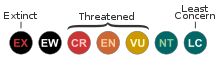
IUCN Red List of Threatened Plants Status :
Growth: S = slow M = medium F = fast. Soil: L = light (sandy) M = medium H = heavy (clay). pH: A = acid N = neutral B = basic (alkaline). Shade: F = full shade S = semi-shade N = no shade. Moisture: D = dry M = Moist We = wet Wa = water.
Now available:
Food Forest Plants for Mediterranean Conditions
350+ Perennial Plants For Mediterranean and Drier Food Forests and Permaculture Gardens.
[Paperback and eBook]
This is the third in Plants For A Future's series of plant guides for food forests tailored to
specific climate zones. Following volumes on temperate and tropical ecosystems, this book focuses
on species suited to Mediterranean conditions—regions with hot, dry summers and cool, wet winters,
often facing the added challenge of climate change.
Read More
Expert comment
Author
L.
Botanical References
17200
Links / References
For a list of references used on this page please go here
Readers comment
| Add a comment |
|
If you have important information about this plant that may help other users please add a comment or link below. Only comments or links that are felt to be directly relevant to a plant will be included. If you think a comment/link or information contained on this page is inaccurate or misleading we would welcome your feedback at [email protected]. If you have questions about a plant please use the Forum on this website as we do not have the resources to answer questions ourselves.
* Please note: the comments by website users are not necessarily those held by PFAF and may give misleading or inaccurate information.
|
Subject : Lathyrus_palustris
|
|
|
|