 |
|
Dawn Endico from Menlo Park, California. Creative Commons Attribution-Share Alike 2.0 |
 |
| Dawn Endico from Menlo Park, California. Creative Commons Attribution-Share Alike 2.0 |
Translate this page:
Summary
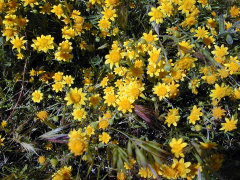
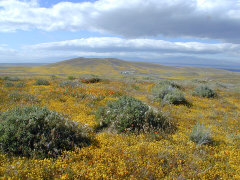
California goldfields is a cheerful annual wildflower that carpets fields with brilliant yellow blooms during spring across parts of the southwestern United States. Beyond its ornamental beauty, it has a modest but genuine history as a food plant. The Cahuilla people of southern California harvested its tiny dry fruits (cypselae), grinding them into flour for food. Although each individual plant produces only a small quantity, vast colonies can make harvesting worthwhile. The plant's abundance, ease of processing, and mild flavour make it one of the more interesting small-seeded members of the sunflower family.
Physical Characteristics

 Lasthenia glabrata is a ANNUAL growing to 0.4 m (1ft 4in) by 0.3 m (1ft) at a fast rate.
See above for USDA hardiness. It is hardy to UK zone 8. The flowers are pollinated by Bees, Insects.
It is noted for attracting wildlife.
Suitable for: light (sandy) and medium (loamy) soils and prefers well-drained soil. Suitable pH: mildly acid, neutral and basic (mildly alkaline) soils. It cannot grow in the shade. It prefers dry or moist soil.
UK Hardiness Map
US Hardiness Map
Synonyms
Lasthenia glabrata var. californica (DC. ex Lindl.) Jeps.
Plant Habitats
Cultivated Beds;
Edible Uses
Edible Parts: Seed
Edible Uses:
California goldfields demonstrates that even tiny annual wildflowers can provide useful food resources. Although harvesting enough cypselae requires patience, the ease of processing, pleasant flavour, and abundance of flowering colonies make this species a worthwhile traditional grain plant. While it cannot compete with cultivated cereals in productivity, it remains an interesting and historically significant wild food of the American Southwest [2-3]. The edible portion consists of the cypselae, the dry, seed-like fruits typical of the sunflower family. Unlike many species, the entire cypsela is used rather than attempting to extract the tiny seed inside. After removing the loosely attached scales, the cypselae can be ground directly into flour. Their small size makes separating the actual seeds impractical and unnecessary. Although yields from individual plants are low, large flowering colonies can provide worthwhile harvests when timed correctly [2-3]. Edibility Rating: 3 out of 5 – A useful traditional grain plant with pleasant flavor and straightforward processing, although collecting sufficient quantities is time-consuming [2-3]. Taste and Preparation: California goldfield cypselae have a mild, pleasant flavor reminiscent of sunflower seeds with a subtle nutty character. Their texture is fine and slightly bran-like, making them well suited for grinding into flour. The fruits require very little processing. After the loose pappus scales are removed, the whole cypselae can be ground and incorporated into breads, cakes, or porridge. Their mild flavor allows them to blend easily with other wild or cultivated flours [2-3]. Seasonality (Phenology): Plants flower from February to June, with the fruits maturing from April through August, most commonly during late spring. Harvest timing is important. Mature cypselae disperse soon after ripening, and plants growing in full sun often mature earlier than those in shaded locations. Waiting until the plants have naturally dried usually produces the best-quality harvest, although slightly immature plants can be dried after collection if necessary [2-3]. Nutritional Value: No detailed nutritional analyses have been published specifically for California goldfields. Like many members of the sunflower family, the cypselae likely provide carbohydrates, small amounts of protein and oil, dietary fiber, and minerals [2-3]. Traditional Uses: The Cahuilla Indians of southern California traditionally gathered the cypselae and ground them into flour for food. A closely related species, yellowray goldfields (Lasthenia glabrata), was harvested and prepared in the same manner. Both species were known by the Cahuilla name "aklakul." No significant toxicity has been reported for the cypselae or seeds when properly identified. As with any wild seed crop, harvest only from clean sites free of herbicides, pesticides, or roadside contamination [2-3].
References More on Edible Uses
Medicinal Uses
Plants For A Future can not take any responsibility for any adverse effects from the use of plants. Always seek advice from a professional before using a plant medicinally.
None Known
References More on Medicinal Uses
The Bookshop: Edible Plant Books
Our Latest books on Perennial Plants For Food Forests and Permaculture Gardens in paperback or digital formats.

Edible Tropical Plants
Food Forest Plants for Hotter Conditions: 250+ Plants For Tropical Food Forests & Permaculture Gardens.
More

Edible Temperate Plants
Plants for Your Food Forest: 500 Plants for Temperate Food Forests & Permaculture Gardens.
More

More Books
PFAF have eight books available in paperback and digital formats. Browse the shop for more information.
Shop Now
Other Uses
Widely cultivated as a native wildflower for meadows, pollinator gardens, and naturalised landscapes. The flowers provide nectar and pollen for a variety of beneficial insects, while the seeds may be consumed by small birds. Dense spring colonies also offer temporary habitat for many invertebrates.
Special Uses
References More on Other Uses
Cultivation details
California goldfields grows best in full sun on well-drained soils, including sandy, gravelly, and seasonally moist sites. It readily colonizes open ground and benefits from winter rainfall followed by warm spring temperatures. Habitat: Open grasslands, fields, valleys, roadsides, open woodland, and disturbed ground from California east to New Mexico, generally below 1,500 m (4,900 ft) elevation. USDA Hardiness Zones: Zones 7–10 (grown as a winter or spring annual). Growth Rate: Fast. Plants germinate during the cool season, flower in spring, produce seed rapidly, and complete their life cycle within a single growing season. Mature Size: Typically 5–40 cm (2–16 in.) tall with a spread of 10–30 cm (4–12 in.), often forming dense colorful colonies. Cultivation: California goldfields is easy to grow from seed and is widely cultivated as a native wildflower for meadows, pollinator gardens, and naturalized landscapes. It prefers full sun and relatively low-fertility soils and readily self-seeds where conditions remain suitable. Pollinators: The bright yellow flower heads attract numerous native bees, hoverflies, butterflies, and other small pollinating insects throughout the flowering season. Identification: California goldfields is recognized by its bright yellow daisy-like flower heads, opposite narrow leaves, and small annual habit. The cup-shaped involucre with a single row of hairy phyllaries and the tiny linear cypselae bearing short awns or awn-tipped scales help distinguish it from related species. Similar Species: Yellowray goldfields (Lasthenia glabrata) closely resembles California goldfields and has also been used as food. It differs by producing cypselae that lack awns, scales, and other pappus structures, making them even easier to process.
References Carbon Farming Information and Carbon Sequestration Information
Temperature Converter
Type a value in the Celsius field to convert the value to Fahrenheit:
Fahrenheit:
The PFAF Bookshop
Plants For A Future have a number of books available in paperback and digital form. Book titles include Edible Plants, Edible Perennials, Edible Trees,Edible Shrubs, Woodland Gardening, and Temperate Food Forest Plants. Our new book is Food Forest Plants For Hotter Conditions (Tropical and Sub-Tropical).
Shop Now
Plant Propagation
Propagated readily from seed. Autumn sowing generally produces the strongest spring displays in regions with mild winters.
Other Names
If available other names are mentioned here
California goldfields, goldfields
Native Range
US. USA. California, Oregon.
Weed Potential
Right plant wrong place. We are currently updating this section.
Please note that a plant may be invasive in one area but may not in your area so it's worth checking.
Low. Although California goldfields readily self-seeds under favourable conditions, it is a short-lived native annual that rarely becomes invasive outside suitable habitats.
Conservation Status
IUCN Red List of Threatened Plants Status : Not listed.
Growth: S = slow M = medium F = fast. Soil: L = light (sandy) M = medium H = heavy (clay). pH: A = acid N = neutral B = basic (alkaline). Shade: F = full shade S = semi-shade N = no shade. Moisture: D = dry M = Moist We = wet Wa = water.
Now available:
Food Forest Plants for Mediterranean Conditions
350+ Perennial Plants For Mediterranean and Drier Food Forests and Permaculture Gardens.
[Paperback and eBook]
This is the third in Plants For A Future's series of plant guides for food forests tailored to
specific climate zones. Following volumes on temperate and tropical ecosystems, this book focuses
on species suited to Mediterranean conditions—regions with hot, dry summers and cool, wet winters,
often facing the added challenge of climate change.
Read More
Expert comment
Author
DC. ex Lindl.
Botanical References
Links / References
For a list of references used on this page please go here
Readers comment
| Add a comment |
|
If you have important information about this plant that may help other users please add a comment or link below. Only comments or links that are felt to be directly relevant to a plant will be included. If you think a comment/link or information contained on this page is inaccurate or misleading we would welcome your feedback at [email protected]. If you have questions about a plant please use the Forum on this website as we do not have the resources to answer questions ourselves.
* Please note: the comments by website users are not necessarily those held by PFAF and may give misleading or inaccurate information.
|
Subject : Lasthenia glabrata
|
|
|
|