 |
|
http://commons.wikimedia.org/wiki/User:Stan_Shebs |
 |
| http://commons.wikimedia.org/wiki/User:Stan_Shebs |
Translate this page:
Summary
Creosote is one of the defining shrubs of the North American deserts, dominating vast areas of the Mojave, Sonoran, and Chihuahuan Deserts. Renowned for the distinctive earthy fragrance released after rain, it is among the oldest and most resilient plants of the Southwest, with some clonal colonies believed to be thousands of years old. Although it has an impressive history of medicinal use among Native American peoples, creosote is not a food plant. The flower buds have occasionally been prepared as a caper-like condiment, but the shrub contains biologically active compounds that make internal consumption inadvisable. Its greatest value lies in traditional medicine and its remarkable ecological importance rather than its culinary potential. Sometimes misspelt as Larrea tridendata
Physical Characteristics

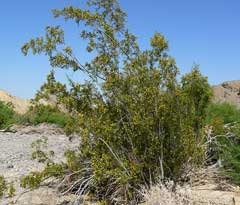
 Larrea_tridentata is an evergreen Shrub growing to 4 m (13ft) by 4 m (13ft) at a slow rate.
See above for USDA hardiness. It is hardy to UK zone 8. It is in leaf all year. The species is hermaphrodite (has both male and female organs) and is pollinated by Bees, insects.
It is noted for attracting wildlife.
Suitable for: light (sandy), medium (loamy) and heavy (clay) soils, prefers well-drained soil and can grow in nutritionally poor soil. Suitable pH: mildly acid, neutral and basic (mildly alkaline) soils. It can grow in semi-shade (light woodland) or no shade. It prefers dry or moist soil and can tolerate drought.
UK Hardiness Map
US Hardiness Map
Synonyms
L. divaricata. L. mexicana. Larrea tridendata (incorrect)
Plant Habitats
Edible Uses
Creosote should not be regarded as an edible plant. While historical records indicate that some Native Americans occasionally prepared the unopened flower buds as a caper-like garnish, the shrub contains potent resinous compounds that may be harmful if consumed. The flower buds are the only part ever reported to have limited food use. Cooking or pickling them in vinegar reduces some of the bitterness, but they remain strongly resinous and medicinal in flavor. All other parts of the plant should be regarded as inedible. Because of the plant's chemical composition and documented toxicity concerns, internal consumption of any part is not recommended [2-3]. Edibility Rating: 1 out of 5 – Historically used only in a very limited way as a caper substitute. Potential toxicity greatly outweighs any food value [2-3]. Taste and Preparation: Fresh flower buds possess an intensely bitter, resinous, medicinal flavor with only a faint vegetable-like undertone. Their texture resembles capers, although the dense sticky hairs give them a tacky mouthfeel. Boiling improves the flavor slightly but does not eliminate the bitterness or resinous qualities. Pickling in vinegar produces a more acceptable condiment, although it remains far inferior to true capers. The buds are produced in great abundance during flowering, making collection relatively easy, but preparing them for food is generally not worthwhile given their poor flavor and potential health risks [2-3]. Seasonality (Phenology): Flower buds are produced mainly during spring (March to June) but may appear following favorable rainfall at almost any time of year. The evergreen shrub provides foliage year-round. Nutritional Value: Little nutritional information exists because creosote has never been an important food plant. Its tissues contain numerous biologically active secondary compounds rather than significant food reserves. Traditional Uses: Creosote has an exceptionally long history as a medicinal plant throughout the deserts of the American Southwest. Traditionally, various Native American peoples used it externally and internally to treat wounds, burns, skin infections, rashes, arthritis, bronchitis, toothaches, snakebites, and numerous other ailments. People commonly prepared the leaves as medicinal washes, poultices, or decoctions [2-3]. The plant has often been described as a natural desert medicine chest. Modern research has identified a variety of antimicrobial and antioxidant compounds within the resin, although concerns over liver and kidney toxicity have limited its acceptance as an internal herbal medicine. Warning: Creosote contains powerful resinous compounds that can be harmful if consumed. Long-term internal use has been associated with liver and kidney damage, and the plant should not be used as a food. The flower buds have limited historical culinary use, but this should not be interpreted as evidence of safety for regular consumption. Traditional medicinal use was generally undertaken with considerable knowledge and caution, and modern use should be approached carefully as well. The flower buds are pickled in vinegar and used as a caper substitute[183]. The stems and leaves are a tea substitute[183]. The twigs are chewed to alleviate thirst[2, 183]. A resin is obtained from the leaves and twigs, it delays or prevents oils and fats from becoming rancid[183].
References More on Edible Uses
Medicinal Uses
Plants For A Future can not take any responsibility for any adverse effects from the use of plants. Always seek advice from a professional before using a plant medicinally.
Creosote bush was widely used by various North American Indian tribes. A decoction of the leaves was used to treat diarrhoea and stomach troubles whilst the young twigs were used to treat toothache and a poultice of the leaves was used to treat chest complaints and as a wash for skin problems[254]. It continued to be widely used as a treatment for rheumatic disease, venereal infections, urinary infections and certain types of cancer, especially leukaemia until its sale was banned in North America due to concern over its potential toxic effect upon the liver[254]. There have been a number of cases of acute or sub-acute hepatitis attributed to the use of this herb and so its internal use is not recommended until further research has been carried out[254]. A tea made from the leaves is used as an expectorant and pulmonary antiseptic[213]. Some N. American Indian tribes heated the shoot tips of this plant and dripped the sap (probably the resin[K]) into tooth cavities to treat toothache[213].
References More on Medicinal Uses
The Bookshop: Edible Plant Books
Our Latest books on Perennial Plants For Food Forests and Permaculture Gardens in paperback or digital formats.
Edible Tropical Plants
Food Forest Plants for Hotter Conditions: 250+ Plants For Tropical Food Forests & Permaculture Gardens.
More
Edible Temperate Plants
Plants for Your Food Forest: 500 Plants for Temperate Food Forests & Permaculture Gardens.
More
More Books
PFAF have eight books available in paperback and digital formats. Browse the shop for more information.
Shop Now
Other Uses
Carbon Farming - Industrial Crop: hydrocarbon.
Wildlife Value: Creosote is one of the most ecologically important shrubs in North American deserts. It provides shelter for reptiles, birds, mammals, and countless invertebrates while stabilizing desert soils. Numerous insects are closely associated with creosote, including several species found almost exclusively on this shrub. Pollinators: The bright yellow flowers attract numerous native bees, solitary bees, flies, butterflies, and other desert pollinating insects, particularly following seasonal rains. Creosote is among the most iconic plants of the American Southwest and one of its most important medicinal shrubs. While its flower buds have a small place in historical ethnobotany, the plant should not be considered an edible wild food. Its ecological significance, extraordinary longevity, and rich history of traditional medicinal use make it a fascinating species, but its culinary value is extremely limited and outweighed by legitimate safety concerns.
Special Uses
References More on Other Uses
Cultivation details
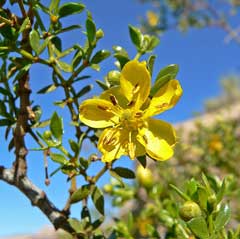
Creosote thrives in full sun on well-drained sandy, gravelly, or rocky soils. It is extremely drought-tolerant and grows best in hot, arid climates with low annual rainfall. Once established, it requires virtually no supplemental irrigation. Habitat: A dominant shrub of the Mojave, Sonoran, and Chihuahuan Deserts, creosote occupies desert flats, alluvial fans, rocky slopes, bajadas, and washes throughout the southwestern United States and northern Mexico. USDA Hardiness Zones: Zones 8–11. Growth Rate: Slow. Individual plants establish slowly but are exceptionally long-lived, with some desert colonies surviving for thousands of years through clonal growth. Mature Size: Typically 1–4 m (3–13 ft) tall with a spread of 1–4 m (3–13 ft), forming rounded evergreen shrubs. Cultivation: Creosote is easily grown in hot, frost-free climates provided excellent drainage is available. It performs poorly in humid climates and should never be overwatered. Once established, it requires little maintenance. Warning: Creosote contains powerful resinous compounds that can be harmful if consumed. Long-term internal use has been associated with liver and kidney damage, and the plant should not be used as a food. The flower buds have limited historical culinary use, but this should not be interpreted as evidence of safety for regular consumption. Traditional medicinal use was generally undertaken with considerable knowledge and caution, and modern use should likewise be approached carefully. Identification: Creosote is recognized by its open, gray-brown branching habit, paired resinous leaflets, bright yellow five-petalled flowers, and distinctive fuzzy fruits. The leaves release the characteristic "desert rain" aroma after rainfall, making the shrub one of the easiest desert plants to recognise. Similar Species: Few shrubs resemble creosote closely. Bursage (Ambrosia spp.) and brittlebush (Encelia farinosa) may occupy similar habitats but lack the paired resinous leaflets, bright yellow flowers, and distinctive aromatic scent of creosote. Requires a moderately fertile moisture-retentive soil in full sun or light shade[200]. This species is not hardy in the colder areas of the country, it tolerates temperatures down to between -5 and -10°c[200]. The plant is resinous and aromatic[200]. Carbon Farming - Cultivation: experimental. Management: coppice.
References Carbon Farming Information and Carbon Sequestration Information
Temperature Converter
Type a value in the Celsius field to convert the value to Fahrenheit:
Fahrenheit:
The PFAF Bookshop
Plants For A Future have a number of books available in paperback and digital form. Book titles include Edible Plants, Edible Perennials, Edible Trees,Edible Shrubs, Woodland Gardening, and Temperate Food Forest Plants. Our new book is Food Forest Plants For Hotter Conditions (Tropical and Sub-Tropical).
Shop Now
Plant Propagation
Seed - we have no information for this species but suggest sowing the seed in a greenhouse in spring. When they are large enough to handle, prick the seedlings out into individual pots and grow them on in the greenhouse for at least their first winter. Plant them out into their permanent positions in late spring or early summer, after the last expected frosts. Cuttings of new growth in spring in a frame[200].
Other Names
If available other names are mentioned here
Sometimes misspelt as Larrea tridendata. Creosote, creosote bush, chaparral, greasewood.
Native Range
NORTHERN AMERICA: United States (New Mexico, Texas, Arizona, California, Nevada (south), Utah (Washington Co.)), Mexico (Baja California (Norte), Baja California Sur, Chihuahua, Coahuila de Zaragoza, Durango, Nuevo León, San Luis Potosí, Sonora, Tamaulipas, Zacatecas, Aguascalientes, Hidalgo, Querétaro)
Weed Potential
Right plant wrong place. We are currently updating this section.
Please note that a plant may be invasive in one area but may not in your area so it's worth checking.
Very low. Creosote is a slow-growing native desert shrub that does not become invasive outside its natural range.
Conservation Status
IUCN Red List of Threatened Plants Status : This taxon has not yet been assessed
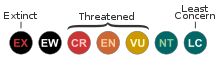
Growth: S = slow M = medium F = fast. Soil: L = light (sandy) M = medium H = heavy (clay). pH: A = acid N = neutral B = basic (alkaline). Shade: F = full shade S = semi-shade N = no shade. Moisture: D = dry M = Moist We = wet Wa = water.
Now available:
Food Forest Plants for Mediterranean Conditions
350+ Perennial Plants For Mediterranean and Drier Food Forests and Permaculture Gardens.
[Paperback and eBook]
This is the third in Plants For A Future's series of plant guides for food forests tailored to
specific climate zones. Following volumes on temperate and tropical ecosystems, this book focuses
on species suited to Mediterranean conditions—regions with hot, dry summers and cool, wet winters,
often facing the added challenge of climate change.
Read More
Expert comment
Author
(Sessé.&Moc. ex DC.)Coville.
Botanical References
200
Links / References
For a list of references used on this page please go here
Readers comment
© 2010, Plants For A Future. Plants For A Future is a charitable company limited by guarantee, registered in England and Wales. Charity No. 1057719, Company No. 3204567.