 |
|
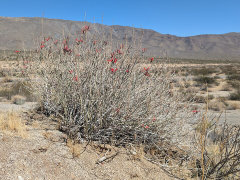
Krzysztof Ziarnek, Kenraiz. Creative Commons Attribution-Share Alike 4.0 |
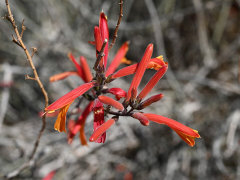 |
| Krzysztof Ziarnek, Kenraiz. Creative Commons Attribution-Share Alike 4.0 |
Translate this page:
Summary
Chuparosa is one of the finest edible-flowered shrubs of the North American deserts. Its brilliant red tubular flowers appear during late winter and early spring, often before the leaves emerge, providing one of the earliest nectar sources for hummingbirds and one of the few fresh plant foods available to desert foragers. Unlike many desert wildflowers, chuparosa flowers are genuinely pleasant to eat. Their crisp, juicy texture and distinctive cucumber-like flavour make them an excellent addition to salads. The flowers also contain enough moisture to provide welcome refreshment during desert travel, an advantage noted by experienced foragers. Field observations found the flavor remarkably consistent across numerous populations throughout the Colorado Desert. While many wild foods vary considerably between locations, chuparosa flowers consistently remained mildly sweet, refreshing, and cucumber-like, making this one of the most dependable edible flowers of the Southwest.
Physical Characteristics

 Justicia californica is a SHRUB growing to 1.5 m (5ft) by 2 m (6ft) at a medium rate.
See above for USDA hardiness. It is hardy to UK zone 9. The flowers are pollinated by Bees, Insects, Hummingbirds.
It is noted for attracting wildlife.
Suitable for: light (sandy) and medium (loamy) soils, prefers well-drained soil and can grow in nutritionally poor soil. Suitable pH: mildly acid, neutral and basic (mildly alkaline) soils and can grow in very alkaline soils.
It cannot grow in the shade. It prefers dry or moist soil and can tolerate drought.
UK Hardiness Map
US Hardiness Map
Synonyms
Beloperone californica Benth.
Plant Habitats
Edible Uses
Only the flowers are considered edible [2-3]. Fresh flowers have a mild sweetness combined with a refreshing cucumber-like flavor and a soft, moist texture. The red corollas, stamens and pistils are all edible and may be eaten raw or cooked. The green calyces are less palatable and are best discarded before eating. The flowers also make a pleasant herbal beverage when briefly steeped in hot water. Leaves, stems, roots, and fruits are not regarded as edible [2-3]. Edibility Rating: 4/5. Chuparosa receives an edibility rating of 4 out of 5. Although it provides few calories, its flowers are among the best edible blossoms of the southwestern deserts. They are abundant, attractive, easy to identify, pleasant tasting, and available over a relatively long flowering season. The rating is reduced slightly only because the edible portion is limited to the flowers [2-3]. Taste, Processing & Culinary Use: Fresh flowers are best eaten immediately after gathering. They have a pleasant sweetness and a refreshing, cucumber-like flavor that is remarkably consistent from plant to plant. The petals are soft, juicy, and delicate, making them an attractive addition to mixed salads or as an edible garnish. Morning harvests often provide the freshest flowers and, when dew is present, additional moisture. Wash the flowers before eating, although vigorous rinsing may reduce some of their natural sweetness. You can also steep the flowers in hot water to make a mild, refreshing herbal tea with subtle cucumber notes. Drying preserves much of the flavor, although the flowers darken considerably and become less attractive. Unlike many edible flowers, chuparosa retains much of its character after drying. Seasonality (Phenology): Chuparosa commonly flowers from February to May, although flowering may begin earlier or continue longer following favourable rainfall. The brilliant red flowers frequently appear before the leaves emerge. Flower production is often heaviest during late winter and early spring, when relatively few other desert shrubs are in bloom. Seed capsules mature during late spring and early summer. Safety & Cautions: No significant hazards are reported for consuming the flowers. Only flowers should be eaten. Avoid plants growing beside roads or in areas exposed to pesticides. As with any wild edible, correctly identify the plant before harvesting. If you're trying the flowers for the first time, sample only small quantities initially to check for individual sensitivities. Harvest & Processing: Harvest freshly opened flowers during the cooler morning hours when they are fully hydrated. Pick only clean, undamaged flowers. Remove the green calyces before culinary use if desired. Flowers are best eaten fresh but may also be dried for later use or steeped fresh or dried as a herbal tea. Because flowering can continue for many weeks, only a small proportion of flowers should be harvested from any individual shrub to preserve nectar resources for wildlife [2-3]. Traditional Indigenous Uses: Although not a major staple food of the Sonoran Desert, chuparosa flowers were traditionally eaten fresh and appreciated as a seasonal food. Their moisture content and pleasant flavor made them particularly valuable during spring travel across arid landscapes. The flowers could also be prepared as a simple beverage. The shrub was valued primarily as a readily available fresh food rather than an important source of calories [2-3]. Nutritional Value: Detailed nutritional analyses are unavailable. The flowers contain natural sugars, moisture, and small amounts of vitamins and antioxidants typical of brightly coloured edible blossoms. Their greatest value lies in providing fresh moisture and minor nutrients rather than significant energy.
References More on Edible Uses
Medicinal Uses
Plants For A Future can not take any responsibility for any adverse effects from the use of plants. Always seek advice from a professional before using a plant medicinally.
Justicia californica has a history of traditional medicinal use by indigenous desert peoples and has recently drawn scientific interest for its active compounds, though it is primarily grown today as an ornamental. Traditional Uses: Herbal Teas: Indigenous groups like the Cahuilla and traditional desert folk healers brewed the leaves and stems into a tea to treat everyday ailments such as colds, coughs, flus, and sore throats. Stomach and Bowel Relief: The tea was also consumed to soothe digestive discomfort, upset stomachs, and constipation. Topical Applications: Crushed plant parts or washes were historically applied externally to help soothe skin irritations, sores, wounds, and minor skin swelling. Modern Scientific Findings: Phytochemical Analysis: Laboratory assays on plant extracts confirm the presence of bioactive compounds including flavonoids, tannins, alkaloids, and high levels of phenolic compounds.Antioxidant & Antibacterial Properties: Tests demonstrate that these chemical constituents exhibit free-radical scavenging (antioxidant) capabilities and preliminary antibacterial activity, providing a biochemical basis for its historical use in fighting germs and oxidative stress.
References More on Medicinal Uses
The Bookshop: Edible Plant Books
Our Latest books on Perennial Plants For Food Forests and Permaculture Gardens in paperback or digital formats.
Edible Tropical Plants
Food Forest Plants for Hotter Conditions: 250+ Plants For Tropical Food Forests & Permaculture Gardens.
More
Edible Temperate Plants
Plants for Your Food Forest: 500 Plants for Temperate Food Forests & Permaculture Gardens.
More
More Books
PFAF have eight books available in paperback and digital formats. Browse the shop for more information.
Shop Now
Other Uses
Chuparosa is one of the outstanding edible flowering shrubs of the North American deserts. Chuparosa is an excellent ornamental shrub for dry gardens and native landscaping. Wildlife & Ecology: Chuparosa plays an important ecological role within desert ecosystems. The abundant flowers support hummingbirds, native bees, and other nectar-feeding wildlife during a critical season. Small birds use the shrub for shelter, while insects utilize its flowers and foliage. Because flowering often begins before leaf emergence, the shrub provides one of the earliest nectar resources available in many desert habitats.
Special Uses
References More on Other Uses
Cultivation details
Chuparosa grows best in full sun and well-drained sandy or gravelly soils. Once established, it is highly drought-tolerant and thrives in intense desert heat. The shrub tolerates alkaline soils and rocky sites, but dislikes prolonged waterlogging. Supplementary irrigation encourages prolonged flowering but is rarely necessary after establishment. Habitat & Distribution: Chuparosa is native to the Sonoran Desert, especially the Colorado Desert of southeastern California and southwestern Arizona, extending into northwestern Mexico. It typically grows below 1,200 meters in elevation in washes, rocky slopes, desert flats, and open scrub communities. It is particularly common in warm, frost-free desert habitats. Cultivation: Chuparosa is an excellent ornamental shrub for dry gardens and native landscaping. Its long flowering season and brilliant red blossoms attract hummingbirds throughout late winter and spring. Once established, it requires very little maintenance. Pruning after flowering encourages denser growth and increased flowering the following season. It performs best with excellent drainage and minimal summer irrigation. Justicia californica is classified as a semi-evergreen to drought-deciduous shrub. Rather than following traditional winter seasons, its foliage retention depends almost entirely on water availability. Drought-Deciduous: In its native desert habitat, the plant strategically drops its sparse, grey-green leaves during periods of extreme summer heat or prolonged drought to conserve moisture.Photosynthetic Stems: When it drops its leaves, the plant does not die back; its smooth, succulent green stems take over photosynthesis, allowing it to survive completely leafless. Evergreen Behavior: If the shrub is grown in a garden setting with regular, supplemental irrigation, it will behave as an evergreen and retain its foliage year-round.Note: In colder climates, it may act as a winter-deciduous plant or die back to the ground during hard frosts, usually returning from the roots in spring. Pollinators: Chuparosa is one of the premier hummingbird plants of the Sonoran Desert. Its bright red tubular flowers are highly attractive to several hummingbird species, which serve as the principal pollinators. Native bees and other nectar-feeding insects occasionally visit the flowers but play a smaller role in pollination. The shrub provides an important nectar source during late winter when few other desert plants are flowering. Identification: Chuparosa is a small, open, many-branched shrub with grey-green stems and sparse grey-green leaves that are often absent during flowering. The bright red tubular flowers, borne in spikes or racemes, are unmistakable and are among the most distinctive flowers of the Sonoran Desert. Leaves are opposite, softly hairy and variable in shape, ranging from oval to heart-shaped. The club-shaped fruits develop after flowering. No other southwestern shrub combines leafless spring flowering with such abundant brilliant red tubular blossoms, making identification straightforward.
References Carbon Farming Information and Carbon Sequestration Information
Temperature Converter
Type a value in the Celsius field to convert the value to Fahrenheit:
Fahrenheit:
The PFAF Bookshop
Plants For A Future have a number of books available in paperback and digital form. Book titles include Edible Plants, Edible Perennials, Edible Trees,Edible Shrubs, Woodland Gardening, and Temperate Food Forest Plants. Our new book is Food Forest Plants For Hotter Conditions (Tropical and Sub-Tropical).
Shop Now
Plant Propagation
Propagation is usually by seed or semi-hardwood cuttings. Fresh seed germinates readily under warm conditions. Cuttings root successfully when taken during active growth. Established shrubs are long-lived and tolerate prolonged drought exceptionally well.
Other Names
If available other names are mentioned here
Chuparosa, hummingbird bush and beloperone.
Native Range
US. USA. Arizona, California, Mexico Northwest.
Weed Potential
Right plant wrong place. We are currently updating this section.
Please note that a plant may be invasive in one area but may not in your area so it's worth checking.
Chuparosa has very low weed potential. It spreads only by seed and establishes slowly under suitable desert conditions. Outside its native range, it rarely naturalizes because it requires hot, dry climates and excellent drainage. For PFAF purposes, its weed potential is best rated 1/5 (very low).
Conservation Status
IUCN Red List of Threatened Plants Status : Not listed.
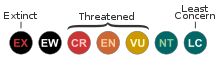
Growth: S = slow M = medium F = fast. Soil: L = light (sandy) M = medium H = heavy (clay). pH: A = acid N = neutral B = basic (alkaline). Shade: F = full shade S = semi-shade N = no shade. Moisture: D = dry M = Moist We = wet Wa = water.
Now available:
Food Forest Plants for Mediterranean Conditions
350+ Perennial Plants For Mediterranean and Drier Food Forests and Permaculture Gardens.
[Paperback and eBook]
This is the third in Plants For A Future's series of plant guides for food forests tailored to
specific climate zones. Following volumes on temperate and tropical ecosystems, this book focuses
on species suited to Mediterranean conditions—regions with hot, dry summers and cool, wet winters,
often facing the added challenge of climate change.
Read More
Expert comment
Author
(Benth.) D.N.Gibson
Botanical References
Links / References
For a list of references used on this page please go here
Readers comment
| Add a comment |
|
If you have important information about this plant that may help other users please add a comment or link below. Only comments or links that are felt to be directly relevant to a plant will be included. If you think a comment/link or information contained on this page is inaccurate or misleading we would welcome your feedback at [email protected]. If you have questions about a plant please use the Forum on this website as we do not have the resources to answer questions ourselves.
* Please note: the comments by website users are not necessarily those held by PFAF and may give misleading or inaccurate information.
|
Subject : Justicia californica
|
|
|
|