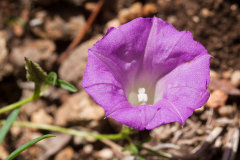
 |
|
Patrick Alexander from Las Cruces, NM. Creative Commons Zero, Public Domain Dedication |
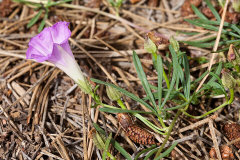 |
| Patrick Alexander from Las Cruces, NM. Creative Commons Zero, Public Domain Dedication |
Translate this page:
Summary
Huachuca morning glory is a beautiful perennial vine of the Sky Island mountain ranges whose modest appearance conceals a highly desirable edible tuber. Traditionally gathered by Native Americans, the small underground storage organs cook quickly and develop a flavour and texture remarkably similar to cultivated sweet potatoes. Although the plant's limited distribution and scattered colonies prevent it from becoming a major wild food resource, its excellent culinary qualities make it one of the most rewarding edible native plants of southeastern Arizona and southwestern New Mexico. Combined with its attractive flowers, drought tolerance and importance to native pollinators, Huachuca morning glory remains both an ornamental wildflower and an outstanding example of the hidden food plants of the American Southwest.
Physical Characteristics

 Ipomoea plummerae is a PERENNIAL CLIMBER growing to 0.4 m (1ft 2in) by 0.9 m (3ft) at a medium rate.
See above for USDA hardiness. It is hardy to UK zone 8. The flowers are pollinated by Bees, Insects.
It is noted for attracting wildlife.
Suitable for: light (sandy) and medium (loamy) soils and prefers well-drained soil. Suitable pH: mildly acid, neutral and basic (mildly alkaline) soils. It can grow in semi-shade (light woodland) or no shade. It prefers dry or moist soil.
UK Hardiness Map
US Hardiness Map
Synonyms
Ipomoea plummerae f. typica Ooststr.
Plant Habitats
Edible Uses
The underground tubers are the edible portion of the plant and are among the finest native root vegetables of the American Southwest. Despite belonging to the same genus as cultivated sweet potato (Ipomoea batatas), relatively little has been written about this remarkable wild food outside ethnobotanical literature. Native Americans valued the tubers and gathered them from mountain habitats during the growing season. Unlike bush morning glory, which develops enormous woody storage roots, Huachuca morning glory produces compact globe-shaped tubers approximately 1–2 cm in diameter. While individually small, they are remarkably easy to prepare and possess excellent eating qualities. Fresh tubers are covered by thin brown skins surrounding firm white flesh. Peeling is unnecessary, as the skins soften readily during cooking and contribute little bitterness. Boiling requires only about fifteen minutes to produce a tender texture. The cooked flavour is strikingly similar to cultivated sweet potatoes. The flesh becomes soft, moist and pleasantly sweet without any significant bitterness or undesirable aftertaste. Unlike many wild root vegetables, the tubers require no elaborate preparation to become palatable. The tubers occur relatively close to the soil surface, generally between 10 and 30 cm deep. This makes excavation considerably easier than with bush morning glory, whose enormous storage roots often penetrate much deeper. Locating plants, however, presents the greater challenge. Colonies are usually scattered, and the modest size of individual tubers means that gathering a substantial quantity requires considerable searching. Plants can theoretically be harvested throughout the year because the tubers remain underground during dormancy. In practice, this is rarely possible because dormant plants leave almost no visible evidence above ground. Harvesting is therefore best undertaken while the vines are actively growing and flowering following the summer monsoon. Among the native edible plants of the Sky Island region, Huachuca morning glory ranks as one of the highest-quality root vegetables. Known Hazards: Huachuca morning glory is generally regarded as a safe edible species when correctly identified. The underground tubers were traditionally gathered and eaten by Native Americans and are considered the only edible part of the plant. As with other members of the morning glory family, the seeds should not be regarded as edible. Seeds of numerous Ipomoea species contain biologically active alkaloids, and there is no evidence that the seeds of I. plummerae were ever used as food. Consumption should therefore be limited to the tubers. Care should be taken when identifying dormant plants. The above-ground stems disappear during much of the year, making it extremely difficult to locate the tubers once the foliage has died back. Digging should only be undertaken when the plant is actively growing and can be positively identified. Seasonality (Phenology): Huachuca morning glory spends much of the year dormant as an underground tuber. New shoots emerge after reliable summer rains, followed by rapid vegetative growth and flowering. Seed develops during late summer before the vines gradually die back as moisture declines and cooler autumn weather arrives. The short growing season makes flowering the easiest time to locate plants in the wild. Once dormant, the species is extremely difficult to find. Expert Forager Notes [2-3]: Among the native edible plants of the Sky Islands, Huachuca morning glory is one of the most pleasant surprises. While many wild tubers require extensive processing to remove bitterness or fibrous textures, this species needs very little preparation. After only a short period of boiling, the tubers closely resemble cultivated sweet potatoes in both flavour and texture. Finding the plants represents the greatest challenge rather than digging them. The vines are small, appear only after seasonal rains and may be widely scattered across mountain slopes. Once flowering begins, however, the attractive pink blossoms make colonies much easier to locate. The tubers usually occur only 10–30 cm beneath the surface, making excavation straightforward compared with many other native root crops. Their relatively small size means that gathering a worthwhile quantity requires patience, but the quality of the finished food more than compensates for the effort. The species demonstrates how many valuable native food plants remain largely unknown outside the regions where Indigenous peoples traditionally harvested them. In terms of eating quality alone, Huachuca morning glory deserves recognition as one of the finest wild root vegetables native to the American Southwest[2-3].
References More on Edible Uses
Medicinal Uses
Plants For A Future can not take any responsibility for any adverse effects from the use of plants. Always seek advice from a professional before using a plant medicinally.
No significant medicinal uses have been documented for Huachuca morning glory. Traditional records focus almost entirely on its value as an edible tuber rather than as a medicinal plant.
References More on Medicinal Uses
The Bookshop: Edible Plant Books
Our Latest books on Perennial Plants For Food Forests and Permaculture Gardens in paperback or digital formats.

Edible Tropical Plants
Food Forest Plants for Hotter Conditions: 250+ Plants For Tropical Food Forests & Permaculture Gardens.
More

Edible Temperate Plants
Plants for Your Food Forest: 500 Plants for Temperate Food Forests & Permaculture Gardens.
More
More Books
PFAF have eight books available in paperback and digital formats. Browse the shop for more information.
Shop Now
Other Uses
Today the species is valued primarily as an attractive native wildflower. Its delicate foliage and showy pink flowers make it well suited to rock gardens and collections of southwestern native plants. The flowers provide nectar for bees, butterflies, and other native pollinating insects during the late summer flowering season. Pollinators: The large pink trumpet-shaped flowers attract native bees, butterflies, moths and other nectar-feeding insects. Their flowering period provides an important nectar source during late summer when relatively few other native plants remain in bloom. Wildlife Value: The flowers contribute nectar to numerous pollinators, while the underground tubers may occasionally be eaten by small mammals. As a native perennial of the Sky Island ecosystems, the plant forms part of the diverse herbaceous flora that supports mountain biodiversity. Combined with its attractive flowers, drought tolerance and importance to native pollinators, Huachuca morning glory remains both an ornamental wildflower and an outstanding example of the hidden food plants of the American Southwest.
Special Uses
References More on Other Uses
Cultivation details
Huachuca morning glory grows best in full sun or light shade on well-drained sandy or gravelly soils. Good drainage is essential, particularly during winter dormancy when excessive moisture may damage the underground tubers. The species is naturally adapted to climates with dry springs followed by summer rainfall. During dormancy the soil should remain relatively dry, while moderate moisture during active growth encourages vigorous flowering. Like many perennial geophytes from arid climates, the plant spends much of the year underground. Gardeners unfamiliar with this growth cycle should not assume dormant plants have died. Because the species develops compact underground storage tubers, transplanting is generally easier than with bush morning glory provided the tubers are handled carefully. USDA Hardiness: USDA Hardiness Zones 7–10. Plant Height: Usually 5–35 cm. Plant Width: Typically spreads 30–90 cm across surrounding vegetation, occasionally wider under favourable conditions. Growth Rate: Moderate. Plants remain dormant for much of the year before growing rapidly following seasonal summer rainfall. Flowering Period: Flowering usually occurs from July to September and closely follows the North American monsoon. In exceptionally dry years flowering may be sparse or absent. Seed Production: Rounded capsules mature during late summer and autumn. The seeds ensure long-term persistence of wild populations but have no known traditional food use. Pollinators: The large pink trumpet-shaped flowers attract native bees, butterflies, moths and other nectar-feeding insects. Their flowering period provides an important nectar source during late summer when relatively few other native plants remain in bloom. Pests and Diseases: The species is generally free from significant pests and diseases in its natural habitat. Excessively wet soils present the greatest cultivation risk and may encourage tuber rot during dormancy. Young shoots may occasionally be browsed by herbivores, although mature plants usually recover quickly from minor damage. Botanical Description: Huachuca morning glory is a small perennial vine native to the mountain ranges of southeastern Arizona and southwestern New Mexico. Unlike the sprawling bush morning glory of the Great Plains, this species produces delicate trailing stems from a compact underground tuber. The plant usually grows between 5 and 35 cm high, although the slender stems may spread further across surrounding vegetation. Growth begins from a rounded underground tuber measuring approximately 1–2 cm in diameter. These storage organs enable the plant to survive extended periods of drought before producing new shoots following seasonal summer rains. Leaves are alternate and deeply divided into three to seven narrow thread-like segments, giving the plant a finely dissected appearance unlike most other morning glories. The foliage is smooth and hairless and often blends with surrounding grasses and herbs until the flowers appear. The flowers are the familiar trumpet shape characteristic of the morning glory family. They are pink to pinkish-purple, formed from five united petals, and borne singly or in small groups on stalks that are longer than the calyx. Flowering is closely tied to the North American monsoon and usually occurs during July, August and September after substantial summer rainfall. Following pollination, rounded capsules develop containing several dark seeds. These seeds contribute to natural reproduction but have no known food value. The species spends much of the year dormant below ground. During dry periods there may be no visible indication that a living plant is present beneath the soil surface. Status; Huachuca morning glory is native to the Sky Island mountain ranges of southeastern Arizona and adjacent southwestern New Mexico. It is a regional endemic with a relatively limited distribution compared with many other members of the genus. Although never especially abundant, the species is locally common in suitable habitats and is not currently considered globally threatened. Most populations occur on public lands within relatively intact mountain ecosystems. Habitat: Huachuca morning glory grows in open mountain woodlands, rocky slopes, grassy clearings, canyon margins and open pine-oak forests. It is most frequently encountered on well-drained soils derived from granite or other rocky substrates at middle elevations. The species is closely associated with the seasonal summer rains of the American Southwest. During prolonged drought it may remain completely dormant underground, emerging only when sufficient moisture stimulates new growth. Unlike many desert plants, it generally avoids the hottest lowland habitats and instead occupies cooler mountain environments where summer rainfall is more dependable. Suitable for a Food Forest: Although not suitable for conventional food forest systems, Huachuca morning glory represents an interesting perennial root crop for dryland gardens and native plant collections. Its compact growth habit and edible underground tubers make it an attractive species for specialist collections of North American food plants. Because the edible tuber is relatively small and harvesting destroys the plant, it is better regarded as a conservation or educational species than a productive crop. Its attractive flowers also provide ornamental value while supporting native pollinating insects.
References Carbon Farming Information and Carbon Sequestration Information
Temperature Converter
Type a value in the Celsius field to convert the value to Fahrenheit:
Fahrenheit:
The PFAF Bookshop
Plants For A Future have a number of books available in paperback and digital form. Book titles include Edible Plants, Edible Perennials, Edible Trees,Edible Shrubs, Woodland Gardening, and Temperate Food Forest Plants. Our new book is Food Forest Plants For Hotter Conditions (Tropical and Sub-Tropical).
Shop Now
Plant Propagation
Propagation is primarily by seed or by careful division of dormant tubers. Fresh seed generally germinates more readily than stored seed. Scarifying the hard seed coat or soaking seeds in warm water before sowing may improve germination. Established tubers occasionally produce multiple growing points that can be divided during dormancy. Care should be taken to retain healthy buds on each division. Young plants establish relatively quickly once adequate summer moisture becomes available.
Other Names
If available other names are mentioned here
Huachuca Morning Glory, Plummer's Morning Glory.
Native Range
US. USA. Argentina Northeast, Argentina Northwest, Arizona, Bolivia, Colombia, Mexico Central, Mexico Gulf, Mexico Northeast, Mexico Northwest, Mexico Southwest, New Mexico, Peru, Texas [2-5].
Weed Potential
Right plant wrong place. We are currently updating this section.
Please note that a plant may be invasive in one area but may not in your area so it's worth checking.
Huachuca morning glory (Ipomoea plummerae) has little or no weed potential. It is a slow-growing perennial with a naturally restricted distribution in the Sky Island mountain ranges of southeastern Arizona and southwestern New Mexico. Unlike several tropical Ipomoea species that spread aggressively by seed or vigorous vines, I. plummerae forms relatively small colonies arising from underground tubers and depends on seasonal summer rainfall for active growth. Plants remain dormant for much of the year, produce comparatively few stems, and do not readily invade cultivated ground or natural plant communities outside their native range. Its slow rate of spread, specialised habitat requirements and limited geographic distribution make it unlikely to become invasive.
Conservation Status
IUCN Red List of Threatened Plants Status : Not listed. Although never especially abundant, the species is locally common in suitable habitats and is not currently considered globally threatened. Most populations occur on public lands within relatively intact mountain ecosystems.

Growth: S = slow M = medium F = fast. Soil: L = light (sandy) M = medium H = heavy (clay). pH: A = acid N = neutral B = basic (alkaline). Shade: F = full shade S = semi-shade N = no shade. Moisture: D = dry M = Moist We = wet Wa = water.
Now available:
Food Forest Plants for Mediterranean Conditions
350+ Perennial Plants For Mediterranean and Drier Food Forests and Permaculture Gardens.
[Paperback and eBook]
This is the third in Plants For A Future's series of plant guides for food forests tailored to
specific climate zones. Following volumes on temperate and tropical ecosystems, this book focuses
on species suited to Mediterranean conditions—regions with hot, dry summers and cool, wet winters,
often facing the added challenge of climate change.
Read More
Expert comment
Author
A.Gray
Botanical References
Links / References
For a list of references used on this page please go here
Readers comment
| Add a comment |
|
If you have important information about this plant that may help other users please add a comment or link below. Only comments or links that are felt to be directly relevant to a plant will be included. If you think a comment/link or information contained on this page is inaccurate or misleading we would welcome your feedback at [email protected]. If you have questions about a plant please use the Forum on this website as we do not have the resources to answer questions ourselves.
* Please note: the comments by website users are not necessarily those held by PFAF and may give misleading or inaccurate information.
|
Subject : Ipomoea plummerae
|
|
|
|