 |
|
http://commons.wikimedia.org/wiki/File:Koeh-075.jpg |
 |
| http://commons.wikimedia.org/wiki/User:KENPEI |
Translate this page:
Summary
Bloom Color: White, Yellow. Main Bloom Time: Early summer, Late summer, Mid summer. Form: Oval.
Physical Characteristics

 Illicium anisatum is an evergreen Shrub growing to 6 m (19ft) by 6 m (19ft) at a slow rate.
See above for USDA hardiness. It is hardy to UK zone 7 and is not frost tender. It is in leaf all year, in flower from March to May, and the seeds ripen in October. The species is hermaphrodite (has both male and female organs).
Suitable for: light (sandy) and medium (loamy) soils and prefers well-drained soil. Suitable pH: mildly acid and neutral soils. It can grow in semi-shade (light woodland) or no shade. It prefers moist soil.
UK Hardiness Map
US Hardiness Map
Synonyms
I. religiosum. Sieb.&Zucc.
Plant Habitats
Woodland Garden Sunny Edge; Dappled Shade;
Edible Uses
Edible Parts:
Edible Uses: Condiment
The fruit is used as a flavouring[2, 132, 177] and is also chewed after meals in order to sweeten the breath[4]. The fruit is about 25mm in diameter[2]. Some caution is advised because it is said to be poisonous in quantity[19, 177].
References More on Edible Uses
Medicinal Uses
Plants For A Future can not take any responsibility for any adverse effects from the use of plants. Always seek advice from a professional before using a plant medicinally.
Antibacterial Carminative Diuretic Odontalgic Stimulant Stomachic
Diuretic, odontalgic, stimulant[4, 61]. The fruit is carminative, stimulant and stomachic[21, 240]. It is used primarily to promote digestion and the appetite, and to relieve flatulence[21]. It also makes a good additive to other medicines to improve their taste[21]. The leaves and the seeds are antibacterial[240].
References More on Medicinal Uses
Other Uses
References More on Other Uses
Cultivation details
Landscape Uses:Border, Pest tolerant, Massing, Screen, Woodland garden. Prefers a light, moist well-drained loam and a sheltered position[1, 11]. Prefers a humus-rich lime-free soil[182, 200]. Succeeds in sun or semi-shade[200]. A slow-growing plant[188]. This species is not very cold-hardy, it tolerates temperatures down to about -10°c but normally requires the protection of a wall in most of Britain[184]. It succeeds outdoors in the mildest areas of the country[59]. Star anise is a very ornamental and aromatic plant that is much planted near Buddhist shrines and temples in Japan[184]. The plants have the scent of anise[219]. All parts of the plant are pleasingly aromatic. The leaves release a powerful aromatic odour when touched and the flowers have a spicy odour[245]. Plants seldom grow larger than about 2 metres in Britain, but are often 10 metres tall in their native habitat[58]. Special Features:
Attracts birds, Fragrant foliage, Not North American native, Fragrant flowers, Attractive flowers or blooms.
References Carbon Farming Information and Carbon Sequestration Information
Temperature Converter
Type a value in the Celsius field to convert the value to Fahrenheit:
Fahrenheit:
Plant Propagation
Seed - it does not require pre-treatment and can be sown in early spring in a greenhouse[113]. Prick out the seedlings into individual pots when they are large enough to handle and grow them on in the greenhouse for at least their first winter. Plant out in late spring or early summer, after the last expected frosts, and give some protection from the cold over the winter for the first year or two. Layering in early spring. Takes 18 months[78]. Cuttings of half-ripe wood, August in a frame[113]. Pot up the cuttings when they start to root and grow them on in the greenhouse for their first winter, planting out after the last expected frosts.
Other Names
If available other names are mentioned here
Native Range
TEMPERATE ASIA: Japan (Honshu (west), Kyushu, Ryukyu Islands, Shikoku), Korea, South, Taiwan
Weed Potential
Right plant wrong place. We are currently updating this section.
Please note that a plant may be invasive in one area but may not
in your area so it's worth checking.
Conservation Status
IUCN Red List of Threatened Plants Status :
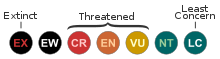
IUCN Red List
Growth: S = slow M = medium F = fast. Soil: L = light (sandy) M = medium H = heavy (clay). pH: A = acid N = neutral B = basic (alkaline). Shade: F = full shade S = semi-shade N = no shade. Moisture: D = dry M = Moist We = wet Wa = water.
Support Plants For A Future
Plants For A Future relies on regular donations to keep our free database and search facilities going, to pay for ongoing research, improvements and enhancements, and to develop and publish new books.
Read more
Choose Currency
Donate in £ GBP
Donate in $ USD
Donate in € EUR
Securely pay via PayPal or Credit/Debit Card without an account.
Expert comment
Author
L.
Botanical References
1158200
Links / References
For a list of references used on this page please go here
Readers comment
© 2010, Plants For A Future. Plants For A Future is a charitable company limited by guarantee, registered in England and Wales. Charity No. 1057719, Company No. 3204567.