 |
|
Public domain |
 |
| USFWS Mountain-Prairie. Creative Commons Attribution 2.0 |
Translate this page:
Summary
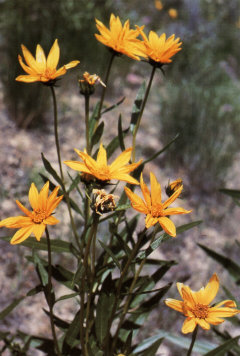
Nuttall’s sunflower is a tall perennial of moist mountain valleys, stream margins, wet meadows and open grasslands. It produces comparatively large, flattened wild sunflower seeds that may remain attached to downward-facing heads longer than those of many annual species. The seeds are edible and are the only part that should be promoted as food. The leaves and flower heads resemble those of other wild sunflowers in flavour and texture but are not specifically documented as edible. Some plants produce swollen underground structures or tuber-like rhizomes, yet no dependable evidence confirms that these parts are safe to eat. Its greatest modern value lies in pollinator habitat, wildlife food, soil stabilization and naturalistic planting. Its rhizomatous habit requires space and management in smaller gardens. Nuttall’s sunflower, Helianthus nuttallii, belongs to the sunflower family (Asteraceae) and the genus Helianthus. Common names include Nuttall’s sunflower and Nuttall sunflower. It is a rhizomatous perennial generally suited to approximately USDA Zones 3–8. Plants commonly grow 100–300 cm tall and may spread 60–150 cm or more as rhizomes form expanding colonies. It is native across large parts of western and central North America.
Physical Characteristics

 Helianthus nuttallii is a PERENNIAL growing to 3 m (9ft) by 1.5 m (5ft) at a fast rate.
See above for USDA hardiness. It is hardy to UK zone 4. The flowers are pollinated by Bees, Insects.
It is noted for attracting wildlife.
Suitable for: light (sandy), medium (loamy) and heavy (clay) soils and prefers well-drained soil. Suitable pH: mildly acid, neutral and basic (mildly alkaline) soils. It cannot grow in the shade. It prefers moist soil.
UK Hardiness Map
US Hardiness Map
Synonyms
Helianthus angustifolius subsp. nuttallii (Torr. & A.Gray) Anashch.
Plant Habitats
Edible Uses
The mature seeds are edible raw or cooked. They may be roasted, ground, added to porridge, or mixed with other seeds. Their flat shells can separate relatively easily from the kernels and may float during water processing. The underground tuber-like structures should not be eaten. Jerusalem artichoke and several other sunflower species have edible tubers, but this edibility cannot be inferred for Nuttall’s sunflower without direct evidence [2-3]. Edible Uses & Rating: An edibility rating of 3/5 is appropriate. The seeds are nutritious and can be larger and easier to retain than those of some wild sunflowers. However, production remains modest compared with cultivated common sunflower. The plant would rate more highly if the underground parts had a well-established food history or if seed harvesting were consistently efficient [2-3]. Taste, Processing & Kitchen Notes: The seeds have the familiar mild, oily, and nutty sunflower flavor. Light roasting improves aroma and creates a delicately crisp texture. The flattened, wing-like shells may detach more readily than the shells of some other wild species. During water separation, shell fragments often float, although repeated sorting remains necessary. Leaves and immature heads are generally rough, resinous, and bitter. Even if they resemble documented edible parts of common sunflower, they should not be treated as food without species-specific support [2-3]. Seasonality (Phenology): Shoots emerge from rhizomes in spring. Flowering normally occurs from late summer into early autumn. This late bloom gives the species considerable ecological value. Seeds mature in autumn. Heads often bend or hang downward as they dry, yet many cypselae remain attached despite wind. This can create a slightly longer gathering period than that offered by prairie sunflower. Safety & Cautions (Food Use): Clean, mature seeds have no widely reported special hazards. Moldy, rancid or insect-damaged material should be discarded. Do not consume the tuber-like underground structures merely because edible tubers occur elsewhere in the genus. Harvest seed only from clean wetlands and stream margins free from sewage, agricultural chemicals or industrial contamination. Harvest & Processing Workflow: Cut or bend mature downward-facing heads over a collection container. Gloves may be helpful because the foliage and receptacles are rough. Dry the heads under cover, rub out the cypselae, and remove chaff. Light roasting, cracking, or coarse grinding followed by flotation can assist processing. Because the plant is important to wildlife, leave a significant share of heads unharvested [2-3]. Cultivar/Selection Notes: There are no widely recognized food cultivars. Regional populations vary in height, flowering time, moisture tolerance, and seed characteristics. Local provenance is important in restoration plantings. Potential crop selection could focus on larger kernels, reduced rhizome spread, more uniform ripening, and stronger seed retention. Look-Alikes & Confusion Risks: Nuttall’s sunflower resembles other tall perennial sunflowers, including Maximilian sunflower and Jerusalem artichoke. Accurate identification may require examination of leaves, phyllaries, cypselae, rhizomes, and habitat. Underground swellings are not a reliable indicator of identification or edibility. Confusion with Jerusalem artichoke could lead someone to eat an undocumented plant part [2-3]. Traditional/Indigenous Use Summary: Its seeds were used within the broad traditional practice of gathering wild sunflower seeds. The species did not achieve the major-crop status of common sunflower, and evidence of use of the underground structures is lacking. Where productive colonies occurred, the persistent mature seeds could provide a useful autumn resource [2-3].
References More on Edible Uses
Medicinal Uses
Plants For A Future can not take any responsibility for any adverse effects from the use of plants. Always seek advice from a professional before using a plant medicinally.
Helianthus nuttallii (Nuttall's sunflower) contains medicinal properties used in traditional Indigenous medicine. The plant's roots, leaves, and seeds have been historically prepared as remedies. Traditional uses for Helianthus nuttallii include Stomach remedies: Traditional healers used an infusion of crushed leaves to treat stomachaches and digestive complaints. Fever and colds: The plant was used in remedies to reduce fevers and alleviate cold symptoms. Pain relief: Pounded leaves were used as topical poultices to relieve pain and swelling.Worm treatment: Extracts were used to eliminate intestinal worms in humans and animals. The genus Helianthus is known to contain bioactive compounds such as sesquiterpene lactones and phenolic acids, which confer antioxidant and anti-inflammatory properties in these plants.
References More on Medicinal Uses
The Bookshop: Edible Plant Books
Our Latest books on Perennial Plants For Food Forests and Permaculture Gardens in paperback or digital formats.
Edible Tropical Plants
Food Forest Plants for Hotter Conditions: 250+ Plants For Tropical Food Forests & Permaculture Gardens.
More
Edible Temperate Plants
Plants for Your Food Forest: 500 Plants for Temperate Food Forests & Permaculture Gardens.
More
More Books
PFAF have eight books available in paperback and digital formats. Browse the shop for more information.
Shop Now
Other Uses
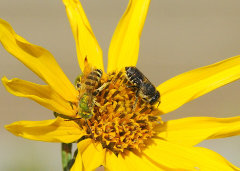
Nuttall’s sunflower is a valuable perennial seed and habitat plant. Its edible seeds are worthwhile but secondary to its role in supporting insects, birds, and wetland-edge ecology. Ecology & Wildlife: Flowers provide late pollen and nectar. Seeds feed birds and small mammals, while tall stems offer cover and perching structure. The rhizomes bind moist soils and can reduce erosion along streambanks and meadow margins. The plant is especially useful where a tall, resilient native perennial is needed for wet ground.
Special Uses
References More on Other Uses
Cultivation details
Nuttall’s sunflower is a valuable perennial for seed and habitat. Its edible seeds are worthwhile but secondary to its role in supporting insects, birds, and wetland-edge ecology. It is best planted in large landscapes where its height and rhizomatous expansion can be accommodated. Its underground parts should remain untouched for food purposes. Growing Conditions: Nuttall’s sunflower prefers full sun and moist, moderately fertile soil. It tolerates seasonal wetness better than common or prairie sunflower and often grows where roots have dependable access to water. It is extremely cold hardy but may struggle during prolonged heat and drought unless moisture remains available. Habitat & Range: The species occurs across western and central Canada and the United States. Habitats include wet meadows, moist prairies, streambanks, marsh margins, ditches and open mountain valleys. Size & Landscape Performance: Plants usually grow 1–3 m tall and spread 60–150 cm or more. Colonies may become substantially wider over time through rhizomes. Its tall late flowers suit meadow plantings, wildlife gardens, and the backs of large borders. Dense colonies can shade and displace smaller plants. Cultivation (Horticulture): Grow in full sun with reliable moisture. Seed can be sown after cold stratification, while rhizome division provides faster establishment. Use barriers or regular division where spread must be restricted. Cutting stems back in early summer can reduce final height but may also reduce seed production. Pests & Problems: Aphids, beetles and caterpillars may feed on foliage and stems. Rusts, mildews and leaf spots can develop. Birds and insects may consume much of the seed crop. The main horticultural problem is vigorous rhizomatous spread in moist ground. Identification & Habit: Nuttall’s sunflower is a tall perennial arising from rhizomes. Stems are upright and usually bear narrow lance-shaped to ovate leaves. Multiple yellow heads develop along the upper stems and branches. The mature cypselae are relatively large, flat, and sometimes appear winged. Seed heads often turn downward as they ripen [2-3]. Pollinators: Late flowers attract native bees, bumblebees, honeybees, butterflies, beetles, and flies. The bloom period can bridge the gap between summer wildflowers and autumn asters. Large colonies provide substantial late-season pollen and nectar. Nuttall’s sunflower, Helianthus nuttallii, belongs to the sunflower family (Asteraceae) and the genus Helianthus. Common names include Nuttall’s sunflower and Nuttall sunflower. It is a rhizomatous perennial generally suited to approximately USDA Zones 3–8. Plants commonly grow 100–300 cm tall and may spread 60–150 cm or more as rhizomes form expanding colonies. It is native across large parts of western and central North America.
References Carbon Farming Information and Carbon Sequestration Information
Temperature Converter
Type a value in the Celsius field to convert the value to Fahrenheit:
Fahrenheit:
The PFAF Bookshop
Plants For A Future have a number of books available in paperback and digital form. Book titles include Edible Plants, Edible Perennials, Edible Trees,Edible Shrubs, Woodland Gardening, and Temperate Food Forest Plants. Our new book is Food Forest Plants For Hotter Conditions (Tropical and Sub-Tropical).
Shop Now
Plant Propagation
Propagation is by seed or rhizome division. Seeds often benefit from cold, moist stratification. Rhizome pieces establish readily in moist soil. Even small rhizome sections may regenerate, which should be considered when moving or controlling the plant.
Other Names
If available other names are mentioned here
Nuttall’s sunflower and Nuttall sunflower.
Native Range
US. USA. Alberta, Arizona, British Columbia, California, Colorado, Idaho, Iowa, Kansas, Manitoba, Minnesota, Missouri, Montana, Nebraska, Nevada, New Mexico, North Dakota, Oklahoma, Ontario, Oregon, Québec, Saskatchewan, South Dakota, Utah, Washington, Wyoming.
Weed Potential
Right plant wrong place. We are currently updating this section.
Please note that a plant may be invasive in one area but may not in your area so it's worth checking.
Weed potential is moderate to high in moist gardens. The plant can form broad, persistent colonies through underground spread. It is ecologically appropriate within its native range but should be positioned carefully near smaller or less competitive plants.
Conservation Status
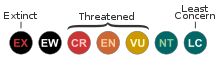
IUCN Red List of Threatened Plants Status : Least Concern.
Growth: S = slow M = medium F = fast. Soil: L = light (sandy) M = medium H = heavy (clay). pH: A = acid N = neutral B = basic (alkaline). Shade: F = full shade S = semi-shade N = no shade. Moisture: D = dry M = Moist We = wet Wa = water.
Now available:
Food Forest Plants for Mediterranean Conditions
350+ Perennial Plants For Mediterranean and Drier Food Forests and Permaculture Gardens.
[Paperback and eBook]
This is the third in Plants For A Future's series of plant guides for food forests tailored to
specific climate zones. Following volumes on temperate and tropical ecosystems, this book focuses
on species suited to Mediterranean conditions—regions with hot, dry summers and cool, wet winters,
often facing the added challenge of climate change.
Read More
Expert comment
Author
Torr. & A.Gray
Botanical References
Links / References
For a list of references used on this page please go here
Readers comment
| Add a comment |
|
If you have important information about this plant that may help other users please add a comment or link below. Only comments or links that are felt to be directly relevant to a plant will be included. If you think a comment/link or information contained on this page is inaccurate or misleading we would welcome your feedback at [email protected]. If you have questions about a plant please use the Forum on this website as we do not have the resources to answer questions ourselves.
* Please note: the comments by website users are not necessarily those held by PFAF and may give misleading or inaccurate information.
|
Subject : Helianthus nuttallii
|
|
|
|