 |
|
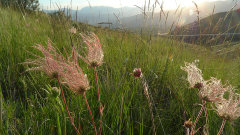
Thayne Tuason. Creative Commons Attribution-Share Alike 4.0 |
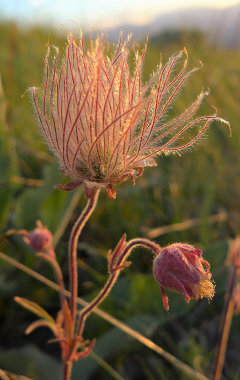 |
| Thayne Tuason. Creative Commons Attribution-Share Alike 4.0 |
Translate this page:
Summary
Geum triflorum var. ciliatum (Pursh) Fassett (Prairie-smoke) is an accepted variety of Geum triflorum. Prairie-smoke is one of the most distinctive native wildflowers of the North American prairies and mountain meadows. While its nodding pinkish flowers are attractive, the plant is best known for its spectacular seed heads. After flowering, the elongated feathery styles create smoky, silvery-pink plumes that give the plant its common name. Although sometimes mentioned as a wild edible, prairie-smoke is better considered a beverage and medicinal plant rather than a true food source. Prairie-smoke (Geum triflorum var. ciliatum) belongs to the rose family (Rosaceae) and the genus Geum. Common names include prairie-smoke, old man’s whiskers, three-flowered avens, torchflower, and purple avens (although this latter name is more commonly applied to Geum rivale). It is a hardy perennial wildflower generally suited to USDA Zones 3–8. Plants typically grow 15–40 cm tall when flowering, with a spread of about 20–40 cm.
Physical Characteristics

 Geum triflorum var. ciliatum is a PERENNIAL growing to 0.4 m (1ft 4in) by 0.4 m (1ft 4in) at a medium rate.
See above for USDA hardiness. It is hardy to UK zone 4. The flowers are pollinated by Bees, Insects.
It is noted for attracting wildlife.
Suitable for: light (sandy), medium (loamy) and heavy (clay) soils, prefers well-drained soil and can grow in nutritionally poor soil. Suitable pH: mildly acid, neutral and basic (mildly alkaline) soils. It can grow in semi-shade (light woodland) or no shade. It prefers moist soil and can tolerate drought.
UK Hardiness Map
US Hardiness Map
Synonyms
Erythrocoma ciliata (Pursh) Greene. Geum ciliatum Pursh. Sieversia ciliata (Pursh) G.Don.
Plant Habitats
Edible Uses
The roots of prairie-smoke have traditionally been used to make an aromatic beverage. They are not normally eaten as a vegetable because of their intense bitterness [2-3]. The roots contain eugenol, the same aromatic compound responsible for the characteristic fragrance of cloves. This gives the roots a pleasant spicy aroma, but the taste is dominated by bitter tannins. The plant has occasionally been compared to chocolate because of beverages prepared from the roasted roots, but the similarity is mainly due to the warm, aromatic quality rather than sweetness or true chocolate flavor [2-3]. Edible Uses & Rating: The roots can be dried, roasted, and infused to make a tea-like beverage. They have also historically been used as a flavoring ingredient. Edibility Rating: 1/5. Prairie-smoke has interesting beverage potential but very limited food value. It is mainly useful as a flavoring plant rather than a source of calories or nutrients. Taste, Processing & Kitchen Notes: Fresh prairie-smoke roots have a strong clove-like fragrance but a very bitter flavor. The bitterness comes primarily from tannins, which are common in many members of the rose family [2-3]. Roasting improves the aroma and produces a richer beverage. Only a small amount of root is needed because the flavor is strong. Simmering chopped roots in water extracts the aromatic compounds. Traditional preparations often improved the drink by combining the roots with other ingredients. Sweeteners, milk, roasted grains, or similar additions balance the bitterness and highlight the warm spice-like aroma. Eating the roots themselves is not recommended. Even after cooking, they remain strongly astringent and unpleasant [2-3]. Nutritional Value: Prairie-smoke is not an important nutritional plant. The roots contain starches and plant compounds, but their strong tannin content limits practical food use. Its value comes mostly from aromatic compounds such as eugenol rather than calories. Seasonality (Phenology): New growth appears in spring. Flowers usually appear from late spring into early summer. Roots can theoretically be collected when the plant is identifiable, but harvesting should be done carefully because removing roots kills the plant. The ornamental seed plumes develop after flowering and may persist into summer. Safety & Cautions (Food Use): Prairie-smoke should be used sparingly. High levels of tannins can cause digestive irritation if consumed excessively. The plant is better treated as an occasional beverage flavoring rather than a regular food. Wild populations should be harvested conservatively because root collection destroys individual plants [2-3]. Harvest & Processing Workflow: Roots are dug from mature plants, cleaned thoroughly, and chopped. Drying and roasting improves the aroma and reduces the raw, bitter qualities. A small quantity of roasted root can then be simmered in water to create an aromatic drink. The root material is strained out before drinking. Cultivar/Selection Notes: Prairie-smoke is widely cultivated as an ornamental native plant. Selection is generally focused on flower display, dense growth, drought tolerance, and attractive seed heads rather than food qualities. It is especially valued in prairie restoration and native landscaping. Look-Alikes & Confusion Risks: Other Geum species can appear similar, especially before flowering. Prairie-smoke is easily recognized when mature by its nodding flowers and long, silky, plume-like seed heads. These feathery fruits are among the most distinctive features of the genus. Traditional/Indigenous Use Summary: Prairie-smoke was used by several Native American groups, primarily medicinally and occasionally as a beverage plant. Related Geum species have a long history of use as aromatic plants because of their clove-scented roots. In Europe, some avens roots were historically used to flavor drinks, including beer, and as a substitute for cloves [2-3].
References More on Edible Uses
Medicinal Uses
Plants For A Future can not take any responsibility for any adverse effects from the use of plants. Always seek advice from a professional before using a plant medicinally.
Geum triflorum var. ciliatum (commonly known as Prairie Smoke or Purple Avens) has a history of traditional and Indigenous medicinal uses. Historically, the plant's roots were the primary source of medicine and were prepared in the following ways: Coughs and Fevers: A strong root decoction was used as a tonic to treat severe coughs, chest ailments, and fevers. Wound Care: An infusion of the roots mixed with oil was applied as a salve to treat blisters, rashes, sores, and flesh wounds. Oral and Eye Health: The root decoction was used as a mouthwash for sore throats or as an eyewash. Aches and Pain: Roots brewed in hot water were used as a body or joint wash for stiff muscles, aches, and rheumatism. The following notes are for Geum triflorum: A strong decoction of the roots is used as a tonic in the treatment of severe coughs and fevers[207, 257]. This decoction can also be used as an eyewash and a mouthwash for sore throats [213, 257]. An infusion of the roots, mixed with oil, can be applied as a salve to sores, rashes, blisters, and flesh wounds [257]. An infusion can also be used as a wash for aching joints, stiff, sore muscles, etc [257].
References More on Medicinal Uses
The Bookshop: Edible Plant Books
Our Latest books on Perennial Plants For Food Forests and Permaculture Gardens in paperback or digital formats.
Edible Tropical Plants
Food Forest Plants for Hotter Conditions: 250+ Plants For Tropical Food Forests & Permaculture Gardens.
More
Edible Temperate Plants
Plants for Your Food Forest: 500 Plants for Temperate Food Forests & Permaculture Gardens.
More
More Books
PFAF have eight books available in paperback and digital formats. Browse the shop for more information.
Shop Now
Other Uses
Prairie-smoke forms low clumps of attractive fern-like foliage. Flowering stems rise above the leaves, followed by ornamental feathery seed heads. It is excellent for native gardens, rock gardens, meadow plantings, and low-water landscapes. Ecology & Wildlife: Prairie-smoke contributes to prairie biodiversity, supports native insects, and provides soil stability in dry environments. Its drought tolerance, deep root system, and ability to thrive without irrigation make it valuable for ecological restoration and resilient landscapes.
Special Uses
References More on Other Uses
Cultivation details
Prairie-smoke is a beautiful and ecologically valuable wildflower with minor edible use. Its roots produce a distinctive clove-scented beverage, but bitterness prevents it from becoming a major wild food. Its greatest value today is as a native ornamental, pollinator plant, and prairie restoration species. Growing Conditions: Prairie-smoke prefers sunny sites with well-drained soils. It grows naturally in dry prairies, open grasslands, rocky slopes, and mountain meadows. Once established, it tolerates drought, cold winters, and nutrient-poor soils. Habitat & Range: Native to much of central and western North America. It occurs from prairie ecosystems into montane habitats, including open forests, grasslands, and rocky areas. Size & Landscape Performance: Prairie-smoke forms low clumps of attractive fern-like foliage. Flowering stems rise above the leaves, followed by ornamental feathery seed heads. It is excellent for native gardens, rock gardens, meadow plantings, and low-water landscapes. Cultivation (Horticulture): Prairie-smoke is relatively easy to cultivate if provided with good drainage. It dislikes constantly wet soils, especially during winter. In suitable conditions, plants are long-lived and require little maintenance. Pests & Problems: Generally trouble-free. Poor drainage is the main cultivation issue and may lead to root problems. Browsing by wildlife can occasionally occur. Identification & Habit: A low perennial herb growing from a thick rootstock. Leaves are mostly basal, divided, and somewhat fern-like. Flowers are nodding, usually pinkish to cream-colored, and occur in small clusters. After flowering, the styles elongate into long, silky, feather-like structures that create the famous “smoke” appearance. Pollinators: Prairie-smoke flowers attract native bees and other early-season insects. The nodding flowers require pollinators capable of accessing the enclosed floral structures, making them particularly useful for supporting certain native bee species. Prairie-smoke (Geum triflorum var. ciliatum) belongs to the rose family (Rosaceae) and the genus Geum. Common names include prairie-smoke, old man’s whiskers, three-flowered avens, torchflower, and purple avens (although this latter name is more commonly applied to Geum rivale). It is a hardy perennial wildflower generally suited to USDA Zones 3–8. Plants typically grow 15–40 cm tall when flowering, with a spread of about 20–40 cm.
References Carbon Farming Information and Carbon Sequestration Information
Temperature Converter
Type a value in the Celsius field to convert the value to Fahrenheit:
Fahrenheit:
The PFAF Bookshop
Plants For A Future have a number of books available in paperback and digital form. Book titles include Edible Plants, Edible Perennials, Edible Trees,Edible Shrubs, Woodland Gardening, and Temperate Food Forest Plants. Our new book is Food Forest Plants For Hotter Conditions (Tropical and Sub-Tropical).
Shop Now
Plant Propagation
Propagation is by seed or division. Seeds often benefit from cold stratification before germination. Established clumps can be divided carefully.
Other Names
If available other names are mentioned here
Prairie-smoke, old man’s whiskers, three-flowered avens, torchflower, and purple avens (although this latter name is more commonly applied to Geum rivale).
Native Range
US. USA. Alberta, British Columbia, California, Colorado, Idaho, Montana, Nevada, New Mexico, Oregon, Saskatchewan, Utah, Washington, Wyoming.
Weed Potential
Right plant wrong place. We are currently updating this section.
Please note that a plant may be invasive in one area but may not in your area so it's worth checking.
Low. Prairie-smoke is not considered invasive. It may slowly spread in suitable habitats but generally remains a well-behaved perennial.
Conservation Status
IUCN Red List of Threatened Plants Status : Not listed.

Growth: S = slow M = medium F = fast. Soil: L = light (sandy) M = medium H = heavy (clay). pH: A = acid N = neutral B = basic (alkaline). Shade: F = full shade S = semi-shade N = no shade. Moisture: D = dry M = Moist We = wet Wa = water.
Now available:
Food Forest Plants for Mediterranean Conditions
350+ Perennial Plants For Mediterranean and Drier Food Forests and Permaculture Gardens.
[Paperback and eBook]
This is the third in Plants For A Future's series of plant guides for food forests tailored to
specific climate zones. Following volumes on temperate and tropical ecosystems, this book focuses
on species suited to Mediterranean conditions—regions with hot, dry summers and cool, wet winters,
often facing the added challenge of climate change.
Read More
Expert comment
Author
(Pursh) Fassett
Botanical References
Links / References
For a list of references used on this page please go here
Readers comment
| Add a comment |
|
If you have important information about this plant that may help other users please add a comment or link below. Only comments or links that are felt to be directly relevant to a plant will be included. If you think a comment/link or information contained on this page is inaccurate or misleading we would welcome your feedback at [email protected]. If you have questions about a plant please use the Forum on this website as we do not have the resources to answer questions ourselves.
* Please note: the comments by website users are not necessarily those held by PFAF and may give misleading or inaccurate information.
|
Subject : Geum triflorum var. ciliatum
|
|
|
|