 |
|
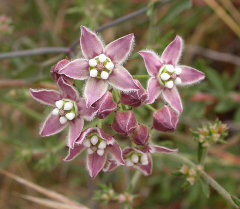
Copyright by Curtis Clark, licensed as noted. Creative Commons Attribution-Share Alike 2.5 |
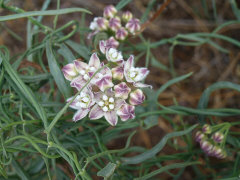 |
| Chris English. Creative Commons Attribution-Share Alike 3.0 |
Translate this page:
Summary
Climbing milkvine is one of the more useful members of the genus because its very young seedpods can be prepared as a vegetable. It is common across much of the Southwest and often hides among desert shrubs. Climbing milkvine (Funastrum cynanchoides) belongs to the Dogbane family (Apocynaceae). Common names include climbing milkvine, fringed milkvine, climbing twinevine, and rope-star. It is a perennial vine suitable for USDA Zones 7–11 and may reach 1–3 m long.
Physical Characteristics

 Funastrum cynanchoides is a PERENNIAL CLIMBER growing to 2 m (6ft) by 0.3 m (1ft in) at a medium rate.
See above for USDA hardiness. It is hardy to UK zone 8. The flowers are pollinated by Bees, Insects.
Suitable for: light (sandy), medium (loamy) and heavy (clay) soils, prefers well-drained soil and can grow in nutritionally poor soil. Suitable pH: mildly acid, neutral and basic (mildly alkaline) soils. It cannot grow in the shade. It prefers dry or moist soil and can tolerate drought.
UK Hardiness Map
US Hardiness Map
Synonyms
Philibertella cynanchoides (Decne.) Vail. Philibertia cynanchoides (Decne.) A.Gray. Sarcostemma cynanchoides Decne.
Plant Habitats
Edible Uses
Very young immature seedpods are edible after cooking. They must be harvested before fibrous strings develop [2-3]. Edible Uses & Rating: Moderate food value. The young pods are among the more edible parts of the genus [2-3]. Taste, Processing & Kitchen Notes: Young pods are mild and surprisingly pleasant, resembling green beans in flavor and texture. They are hollow, tender, and free from significant bitterness. As the pods mature, tough fibers rapidly develop, rendering them unsuitable as food. Boiling is the preferred preparation method [2-3]. Seasonality (Phenology): Flowering may occur from spring through autumn, depending on rainfall. Young pods typically appear in late summer or early autumn. Safety & Cautions (Food Use): All parts contain milky latex. Pods must be harvested very young and thoroughly cooked. Older pods should be avoided. Harvest & Processing Workflow: Harvest only soft green pods before fibers form. Rinse thoroughly, boil, and discard the cooking water if desired. Cultivar/Selection Notes: No cultivated selections are known. Look-Alikes & Confusion Risks: Can resemble other milkvines. Flower and leaf characteristics are often needed for accurate identification. Traditional and Historical Uses: Various desert peoples reportedly utilized the young pods as a seasonal vegetable [2-3].
References More on Edible Uses
Medicinal Uses
Plants For A Future can not take any responsibility for any adverse effects from the use of plants. Always seek advice from a professional before using a plant medicinally.
While Native American tribes historically used some Funastrum species (such as Funastrum clausum) for remedies like poultices or eye infections, there is no established modern medicinal use for Funastrum cynanchoides. It should be treated with caution, as it is known to be highly toxic to pets and humans if ingested in large quantities. Toxicity: Chewing on the stems, leaves, or seed pods can cause severe poisoning, leading to issues such as severe dehydration, fever, and severe gastrointestinal distress. Historical Context: While it belongs to the Dogbane family (Apocynaceae)—which contains some plants used in traditional and folk medicine—Funastrum cynanchoides is primarily appreciated today as an ornamental vine and a host plant for native butterflies.
References More on Medicinal Uses
The Bookshop: Edible Plant Books
Our Latest books on Perennial Plants For Food Forests and Permaculture Gardens in paperback or digital formats.
Edible Tropical Plants
Food Forest Plants for Hotter Conditions: 250+ Plants For Tropical Food Forests & Permaculture Gardens.
More
Edible Temperate Plants
Plants for Your Food Forest: 500 Plants for Temperate Food Forests & Permaculture Gardens.
More
More Books
PFAF have eight books available in paperback and digital formats. Browse the shop for more information.
Shop Now
Other Uses
Primarily appreciated as an ornamental vine and a host plant for native butterflies. Flowers are visited by bees, butterflies, wasps, and other pollinating insects.
Special Uses
References More on Other Uses
Cultivation details
The best edible milkvine of the Southwest, though still a secondary food resource rather than a staple. Growing Conditions: Thrives in hot, dry climates and tolerates drought exceptionally well. Habitat & Range: Occurs from California and Arizona eastward through New Mexico and Texas into northern Mexico. Size & Growth Habit: A scrambling or twining perennial vine that climbs through shrubs and small trees. Pollinators: Flowers are visited by bees, butterflies, wasps, and other pollinating insects. Climbing milkvine (Funastrum cynanchoides) belongs to the Dogbane family (Apocynaceae). Common names include climbing milkvine, fringed milkvine, climbing twinevine, and rope-star. It is a perennial vine suitable for USDA Zones 7–11 and may reach 1–3 m long. Identification Features: Twining stems with milky sap, opposite leaves, fragrant flowers, and long spindle-shaped follicles.
References Carbon Farming Information and Carbon Sequestration Information
Temperature Converter
Type a value in the Celsius field to convert the value to Fahrenheit:
Fahrenheit:
The PFAF Bookshop
Plants For A Future have a number of books available in paperback and digital form. Book titles include Edible Plants, Edible Perennials, Edible Trees,Edible Shrubs, Woodland Gardening, and Temperate Food Forest Plants. Our new book is Food Forest Plants For Hotter Conditions (Tropical and Sub-Tropical).
Shop Now
Plant Propagation
Seed.
Other Names
If available other names are mentioned here
Climbing milkvine, fringed milkvine, climbing twinevine, and rope-star.
Native Range
US. USA. Arizona, Arkansas, Mexico Northeast, Mexico Northwest, New Mexico, Oklahoma, Texas.
Weed Potential
Right plant wrong place. We are currently updating this section.
Please note that a plant may be invasive in one area but may not in your area so it's worth checking.
Low. Native and generally well-behaved within its natural range.
Conservation Status
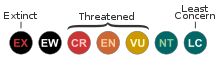
IUCN Red List of Threatened Plants Status : Not listed.
Growth: S = slow M = medium F = fast. Soil: L = light (sandy) M = medium H = heavy (clay). pH: A = acid N = neutral B = basic (alkaline). Shade: F = full shade S = semi-shade N = no shade. Moisture: D = dry M = Moist We = wet Wa = water.
Now available:
Food Forest Plants for Mediterranean Conditions
350+ Perennial Plants For Mediterranean and Drier Food Forests and Permaculture Gardens.
[Paperback and eBook]
This is the third in Plants For A Future's series of plant guides for food forests tailored to
specific climate zones. Following volumes on temperate and tropical ecosystems, this book focuses
on species suited to Mediterranean conditions—regions with hot, dry summers and cool, wet winters,
often facing the added challenge of climate change.
Read More
Expert comment
Author
(Decne.) Schltr.
Botanical References
Links / References
For a list of references used on this page please go here
Readers comment
| Add a comment |
|
If you have important information about this plant that may help other users please add a comment or link below. Only comments or links that are felt to be directly relevant to a plant will be included. If you think a comment/link or information contained on this page is inaccurate or misleading we would welcome your feedback at [email protected]. If you have questions about a plant please use the Forum on this website as we do not have the resources to answer questions ourselves.
* Please note: the comments by website users are not necessarily those held by PFAF and may give misleading or inaccurate information.
|
Subject : Funastrum cynanchoides
|
|
|
|