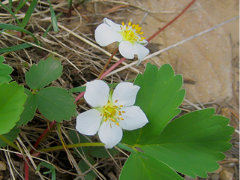
 |
|
Lebsack, Tom. Lady Bird Johnson Wildflower Center. |
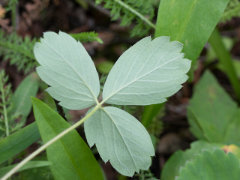 |
| Lebsack, Tom. Lady Bird Johnson Wildflower Center. |
Translate this page:
Summary
Grayleaf strawberry is closely related to woodland strawberry and contributes genetic ancestry to many cultivated strawberries grown today. It produces exceptionally flavorful berries despite their small size. The bluish-gray foliage helps distinguish it from other wild strawberries. Like woodland strawberry, it thrives in mountain meadows, open forests, and sandy soils. Grayleaf strawberry (Fragaria virginiana subsp. glauca) belongs to the Rose family (Rosaceae). Common names include grayleaf strawberry, wild strawberry, Virginia strawberry, and mountain strawberry. Plants typically grow 5–20 cm tall and spread by runners to form extensive colonies. Hardy in USDA Zones 3–9.
Physical Characteristics

 Fragaria virginiana subsp. glauca is a PERENNIAL growing to 0.2 m (0ft 8in) by 0.2 m (0ft 8in) at a fast rate.
See above for USDA hardiness. It is hardy to UK zone 4. The flowers are pollinated by Bees, Insects.
It is noted for attracting wildlife.
Suitable for: light (sandy) and medium (loamy) soils, prefers well-drained soil and can grow in nutritionally poor soil. Suitable pH: mildly acid, neutral and basic (mildly alkaline) soils. It can grow in semi-shade (light woodland) or no shade. It prefers dry or moist soil and can tolerate drought.
UK Hardiness Map
US Hardiness Map
Synonyms
Fragaria glauca (S.Watson) Rydb. Fragaria ovalis var. glauca (S.Watson) A.Nelson. Fragaria virginiana var. glauca S.Watson
Plant Habitats
Edible Uses
Leaves, flowers, and fruits are edible. Fruits are highly prized and often gathered fresh. Leaves and flowers can be used in salads, teas, or cooked preparations [2-3]. Edible Uses & Rating: * Fresh berries. * Jams, preserves, and desserts. * Tea from leaves and flowers. * Young leaves as greens. Edibility Rating: 5/5. The fruits rank among the best native berries available to foragers [2-3]. Taste, Processing & Culinary Notes: Grayleaf strawberry fruits are intensely aromatic and sweet with balanced acidity. Many people consider them to have a superior flavor to cultivated strawberries. The leaves are somewhat astringent due to tannins, but make a pleasant herbal tea when dried [2-3]. The berries are excellent fresh and can also be dried, frozen, or preserved. Their small size limits large-scale harvesting, but not their culinary value [2-3]. Seasonality (Phenology): Flowering typically occurs from spring into early summer. Fruits ripen from June through July, extending later at higher elevations. Safety & Cautions: Generally regarded as very safe. As with all strawberries, occasional allergic reactions may occur in sensitive individuals. Harvest & Processing: Harvest berries when fully red and fragrant. Fruits bruise easily and are best consumed soon after collection [2-3].
References More on Edible Uses
Medicinal Uses
Plants For A Future can not take any responsibility for any adverse effects from the use of plants. Always seek advice from a professional before using a plant medicinally.
(Fragaria virginiana) The whole plant is antiseptic, astringent, emmenagogue, galactogogue and odontalgic[172]. It has been used to regulate the menstrual cycle[172]. A tea made from the leaves has been used as a nerve tonic and is slightly astringent[222]. A poultice made from the dried powdered leaves mixed with oil has been used to treat open sores[257]. A tea made from the roots is diuretic[222]. It has been used in the treatment of diarrhoea, irregular menses, gonorrhoea, stomach and lung ailments[222, 257].
References More on Medicinal Uses
The Bookshop: Edible Plant Books
Our Latest books on Perennial Plants For Food Forests and Permaculture Gardens in paperback or digital formats.
Edible Tropical Plants
Food Forest Plants for Hotter Conditions: 250+ Plants For Tropical Food Forests & Permaculture Gardens.
More
Edible Temperate Plants
Plants for Your Food Forest: 500 Plants for Temperate Food Forests & Permaculture Gardens.
More
More Books
PFAF have eight books available in paperback and digital formats. Browse the shop for more information.
Shop Now
Other Uses
One of the most desirable edible groundcovers of western North America. Pollinator Value: Flowers attract native bees, hoverflies, beetles, and numerous beneficial insects. The blossoms provide an important source of spring nectar. Wildlife Value: The fruits are eagerly consumed by birds, rodents, bears, foxes, and many other animals. Dense patches provide habitat for insects and small wildlife.
Special Uses
References More on Other Uses
Cultivation details
Grayleaf strawberry is an outstanding native fruit plant. Its flavorful berries, adaptability, wildlife value, and historical importance make it one of the most desirable edible groundcovers of western North America. For foragers, few summer treats rival a patch of ripe wild strawberries hidden in a mountain meadow. Growing Conditions: * Full sun to partial shade. * Moist but well-drained soils. * Tolerates sandy and rocky soils. * Moderately drought-tolerant once established. * Prefers cool mountain climates. Habitat & Range: Grayleaf strawberry occurs across much of western North America, especially in mountain meadows, open forests, woodland clearings, and grassland edges. Weed Potential: Low. Although it spreads by runners, it is generally beneficial and easily managed. Pests & Problems: Birds frequently harvest fruit before humans do. Occasional fungal diseases may occur in wet conditions, but serious issues are uncommon. Identification: A low-growing perennial with three bluish-green leaflets, white flowers, runners, and small red fruits. The fruits often have the achenes slightly embedded in shallow pits, unlike the woodland strawberry, where the achenes sit prominently on the surface. Pollinator Value: Flowers attract native bees, hoverflies, beetles, and numerous beneficial insects. The blossoms provide an important spring nectar source. Wildlife Value: The fruits are eagerly consumed by birds, rodents, bears, foxes, and many other animals. Dense patches provide habitat for insects and small wildlife. Grayleaf strawberry (Fragaria virginiana subsp. glauca) belongs to the Rose family (Rosaceae). Common names include grayleaf strawberry, wild strawberry, Virginia strawberry, and mountain strawberry. Plants typically grow 5–20 cm tall and spread by runners to form extensive colonies. Hardy in USDA Zones 3–9.
References Carbon Farming Information and Carbon Sequestration Information
Temperature Converter
Type a value in the Celsius field to convert the value to Fahrenheit:
Fahrenheit:
The PFAF Bookshop
Plants For A Future have a number of books available in paperback and digital form. Book titles include Edible Plants, Edible Perennials, Edible Trees,Edible Shrubs, Woodland Gardening, and Temperate Food Forest Plants. Our new book is Food Forest Plants For Hotter Conditions (Tropical and Sub-Tropical).
Shop Now
Plant Propagation
Readily propagated by runners, division, or seed.
Other Names
If available other names are mentioned here
Grayleaf strawberry, wild strawberry, Virginia strawberry, and mountain strawberry.
Native Range
US. USA. Alaska, Alberta, Arizona, British Columbia, California, Colorado, Idaho, Iowa, Labrador, Maine, Manitoba, Massachusetts, Minnesota, Montana, New Brunswick, New Hampshire, New Mexico, New York, Newfoundland, North Dakota, Northwest Territories, Nova Scotia, Nunavut, Ontario, Prince Edward I., Québec, Rhode I., Saskatchewan, South Dakota, Utah, Vermont, Wisconsin, Wyoming, Yukon
Weed Potential
Right plant wrong place. We are currently updating this section.
Please note that a plant may be invasive in one area but may not in your area so it's worth checking.
Low. Although it spreads by runners, it is generally beneficial and easily managed.
Conservation Status
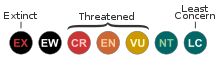
IUCN Red List of Threatened Plants Status : Not listed.
Growth: S = slow M = medium F = fast. Soil: L = light (sandy) M = medium H = heavy (clay). pH: A = acid N = neutral B = basic (alkaline). Shade: F = full shade S = semi-shade N = no shade. Moisture: D = dry M = Moist We = wet Wa = water.
Now available:
Food Forest Plants for Mediterranean Conditions
350+ Perennial Plants For Mediterranean and Drier Food Forests and Permaculture Gardens.
[Paperback and eBook]
This is the third in Plants For A Future's series of plant guides for food forests tailored to
specific climate zones. Following volumes on temperate and tropical ecosystems, this book focuses
on species suited to Mediterranean conditions—regions with hot, dry summers and cool, wet winters,
often facing the added challenge of climate change.
Read More
Expert comment
Author
(S.Watson) Staudt
Botanical References
Links / References
For a list of references used on this page please go here
Readers comment
| Add a comment |
|
If you have important information about this plant that may help other users please add a comment or link below. Only comments or links that are felt to be directly relevant to a plant will be included. If you think a comment/link or information contained on this page is inaccurate or misleading we would welcome your feedback at [email protected]. If you have questions about a plant please use the Forum on this website as we do not have the resources to answer questions ourselves.
* Please note: the comments by website users are not necessarily those held by PFAF and may give misleading or inaccurate information.
|
Subject : Fragaria virginiana subsp. glauca
|
|
|
|