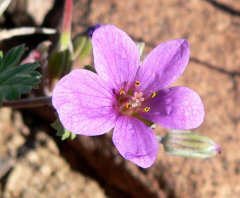
 |
|
Stan Shebs Creative Commons Attribution-Share Alike 3.0 |
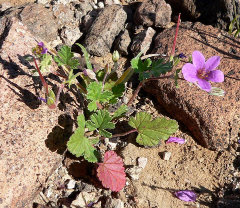 |
| Stan Shebs Creative Commons Attribution-Share Alike 3.0 |
Translate this page:
Summary
Texas filaree is the native or regional counterpart to the much more widespread redstem filaree in parts of the Southwest. It is less common overall but can be abundant where it occurs. Its leaves are the documented edible part, though other tender parts may be mild and chewable when young. It is best treated as a seasonal potherb rather than a major root or whole-plant vegetable. Texas filaree, Erodium texanum, belongs to the geranium family (Geraniaceae) and the genus Erodium. Common names include Texas filaree, tufted filaree, and bull filaree. It is a small annual of deserts and transition zones, generally suited to USDA Zones 7–10 as a cool-season or spring annual. Mature plants usually grow about 5–30 cm tall and spread 10–30 cm across.
Physical Characteristics

 Erodium texanum is a ANNUAL growing to 0.3 m (1ft) by 0.3 m (1ft in) at a fast rate.
See above for USDA hardiness. It is hardy to UK zone 8. The flowers are pollinated by Bees, Insects.
It is noted for attracting wildlife.
Suitable for: light (sandy), medium (loamy) and heavy (clay) soils, prefers well-drained soil and can grow in nutritionally poor soil. Suitable pH: mildly acid, neutral and basic (mildly alkaline) soils. It can grow in semi-shade (light woodland) or no shade. It prefers dry or moist soil and can tolerate drought.
UK Hardiness Map
US Hardiness Map
Synonyms
None known.
Plant Habitats
Edible Uses
The leaves are reported to be edible and make a good cooked green. Other tender aboveground parts may be chewable when young, but the leaves are the safest documented food use. Mature fruits should not be eaten [2-3]. Edible Uses & Rating: Texas filaree ranks as a good minor potherb. It is less widely available than redstem filaree, but where it grows abundantly, it can provide a useful cooked green. Its food value is modest but dependable in suitable desert and transition habitats [2-3]. Taste, Processing & Kitchen Notes: The flavor is similar to redstem filaree: green, mildly bitter, somewhat tannic, and faintly geranium-like. Cooking makes the leaves much more pleasant by reducing bitterness and astringency. The leaf hairs are soft, peach-fuzz-like, and generally do not cause major texture problems. Roots may have tough cores and are less important than the leaves. Seasonality (Phenology): Texas filaree is mainly a spring plant, blooming from about March to April in many desert and transition-zone habitats. The best edible leaves are gathered before or during early flowering, while plants are still tender. Safety & Cautions (Food Use): Use leaves cooked when eating more than small amounts. Avoid mature fruits because their sharp, twisted beaks become hard and inedible. As with redstem filaree, wash thoroughly because low-growing hairy leaves collect grit. Harvest & Processing Workflow: Gather young leafy plants from clean sites. Trim away tough roots and any developing hard fruits. Wash carefully, then boil or simmer as potherbs. If using tender stems or young flower stalks, cook with the leaves. Cultivar/Selection Notes: There are no cultivated food forms. The best harvest comes from lush colonies after good rainfall. Look-Alikes & Confusion Risks: Texas filaree differs from redstem filaree by its simpler leaves with 3–5 lobes rather than finely pinnate, divided leaves. The purple flowers and long beaked fruits confirm the genus. Young plants may be confused with other small desert herbs, so identification is easiest during flowering [2-3]. Traditional/Indigenous Use Summary: Texas filaree is less documented than redstem filaree, but it belongs to the same useful group of small geranium-family spring greens available in arid landscapes.
References More on Edible Uses
Medicinal Uses
Plants For A Future can not take any responsibility for any adverse effects from the use of plants. Always seek advice from a professional before using a plant medicinally.
Erodium texanum (Texas storksbill or filaree) has a history of traditional and folk medicinal uses. Herbalists and Native American traditions have historically used the plant as a diuretic, a mild astringent, and a treatment for skin diseases or rashes. Traditional medicinal applications for Erodium species generally include:Skin Health & Wound Care: The leaves and roots were historically used to treat dermatological disorders, including rashes, sores, and minor animal bites or skin infections. The chewed root was often applied directly as a soothing poultice. Bleeding: The plant acts as a natural astringent and hemostatic (an agent that restricts blood flow) and has been used in folk medicine to treat hemorrhaging and postpartum bleeding. Urinary & Digestive Relief: Herbal brews and teas were consumed to act as a diuretic and relieve urinary tract issues or indigestion.Lactation: The plant's roots and leaves were sometimes eaten by nursing mothers to help increase milk flow.A Note on Scientific Evidence: While many Erodium species (such as E. cicutarium) are known to contain tannins, flavonoids, and antioxidants, modern clinical studies verifying the efficacy and exact dosage of Erodium texanum remain limited. Most of the reported benefits rely on ethnobotanical records rather than modern pharmaceutical data (https://pubmed.ncbi.nlm.nih.gov/).
References More on Medicinal Uses
The Bookshop: Edible Plant Books
Our Latest books on Perennial Plants For Food Forests and Permaculture Gardens in paperback or digital formats.
Edible Tropical Plants
Food Forest Plants for Hotter Conditions: 250+ Plants For Tropical Food Forests & Permaculture Gardens.
More
Edible Temperate Plants
Plants for Your Food Forest: 500 Plants for Temperate Food Forests & Permaculture Gardens.
More
More Books
PFAF have eight books available in paperback and digital formats. Browse the shop for more information.
Shop Now
Other Uses
A small, seasonal annual, more useful in wildflower and forage contexts than as a garden ornamental. Its flowers are attractive at close range but not showy at landscape scale. Rarely cultivated intentionally. Ecology & Wildlife: Texas filaree contributes spring forage, small flowers for insects, and seed for wildlife in desert and transition habitats. It is part of the short-season annual flora that appears after winter and spring moisture.
Special Uses
References More on Other Uses
Cultivation details
Texas filaree is a useful local potherb where abundant. It is not as universally available as redstem filaree, but it is mild, edible, and worth recognizing in the Southwest. Growing Conditions: It grows in full sun to light shade in desert and transition-zone soils, especially after seasonal rainfall. It tolerates dry, open, and disturbed ground. Habitat & Range: Texas filaree occurs across the Southwest in deserts, grasslands, transition zones, and open dry habitats. It is less common than redstem filaree but can be locally abundant. Size & Landscape Performance: It is a small, seasonal annual, more useful in wildflower and forage contexts than as a garden ornamental. Its flowers are attractive at close range but not showy at landscape scale. Cultivation (Horticulture): Rarely cultivated intentionally. It can be grown from seed in open, well-drained soil with cool-season moisture. Pests & Problems: Few pest issues are significant. Its main limitation is seasonal dependence on rainfall. Identification & Habit: Texas filaree is a small hairy annual from a taproot, with simple basal leaves divided into 3–5 lobes, purple flowers, and long beaked fruits that split into five spirally twisted segments. Pollinators: Small bees, flies, and other insects may visit the flowers. Its pollinator value is modest but useful during the spring bloom period. Texas filaree, Erodium texanum, belongs to the geranium family (Geraniaceae) and the genus Erodium. Common names include Texas filaree, tufted filaree, and bull filaree. It is a small annual of deserts and transition zones, generally suited to USDA Zones 7–10 as a cool-season or spring annual. Mature plants usually grow about 5–30 cm tall and spread 10–30 cm across.
References Carbon Farming Information and Carbon Sequestration Information
Temperature Converter
Type a value in the Celsius field to convert the value to Fahrenheit:
Fahrenheit:
The PFAF Bookshop
Plants For A Future have a number of books available in paperback and digital form. Book titles include Edible Plants, Edible Perennials, Edible Trees,Edible Shrubs, Woodland Gardening, and Temperate Food Forest Plants. Our new book is Food Forest Plants For Hotter Conditions (Tropical and Sub-Tropical).
Shop Now
Plant Propagation
Propagation is by seed. The twisted fruit segments help place seeds into soil as they coil and uncoil with moisture changes.
Other Names
If available other names are mentioned here
Texas filaree, tufted filaree, and bull filaree.
Native Range
US. USA. Arizona, California, Mexico Northeast, Mexico Northwest, Nevada, New Mexico, Oklahoma, Texas, Utah.
Weed Potential
Right plant wrong place. We are currently updating this section.
Please note that a plant may be invasive in one area but may not in your area so it's worth checking.
Moderate. It can be locally abundant but is generally less weedy and widespread than redstem filaree.
Conservation Status
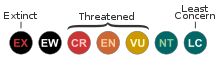
IUCN Red List of Threatened Plants Status : Not listed.
Growth: S = slow M = medium F = fast. Soil: L = light (sandy) M = medium H = heavy (clay). pH: A = acid N = neutral B = basic (alkaline). Shade: F = full shade S = semi-shade N = no shade. Moisture: D = dry M = Moist We = wet Wa = water.
Now available:
Food Forest Plants for Mediterranean Conditions
350+ Perennial Plants For Mediterranean and Drier Food Forests and Permaculture Gardens.
[Paperback and eBook]
This is the third in Plants For A Future's series of plant guides for food forests tailored to
specific climate zones. Following volumes on temperate and tropical ecosystems, this book focuses
on species suited to Mediterranean conditions—regions with hot, dry summers and cool, wet winters,
often facing the added challenge of climate change.
Read More
Expert comment
Author
A.Gray
Botanical References
Links / References
For a list of references used on this page please go here
Readers comment
| Add a comment |
|
If you have important information about this plant that may help other users please add a comment or link below. Only comments or links that are felt to be directly relevant to a plant will be included. If you think a comment/link or information contained on this page is inaccurate or misleading we would welcome your feedback at [email protected]. If you have questions about a plant please use the Forum on this website as we do not have the resources to answer questions ourselves.
* Please note: the comments by website users are not necessarily those held by PFAF and may give misleading or inaccurate information.
|
Subject : Erodium texanum
|
|
|
|