 |
|
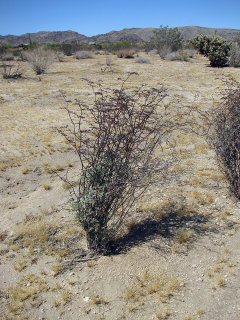
Jules Jardinier. Creative Commons Attribution-Share Alike 3.0 |
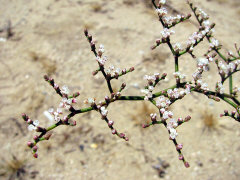 |
| Jules Jardinier. Creative Commons Attribution-Share Alike 3.0 |
Translate this page:
Summary
Yucca buckwheat is a shrubby desert Eriogonum with edible seeds. It is more important as a dryland habitat plant and pollinator resource than as a major food source, but its seeds add ethnobotanical interest. Its narrow, upright habit and pale flowers make it a useful shrub in desert plant communities. Yucca buckwheat, Eriogonum plumatella, belongs to the buckwheat family (Polygonaceae). Common names include yucca buckwheat and yucca wild buckwheat. It is a desert shrub native to the southwestern United States, especially desert regions of California and southern Nevada. It is generally suited to USDA Zones 8–10. Plants often grow about 30–100 cm tall and 30–60 cm wide, though some sources note plants may reach about 4 feet tall.
Physical Characteristics

 Eriogonum plumatella is a SHRUB growing to 1 m (3ft 3in) by 0.6 m (2ft) at a medium rate.
See above for USDA hardiness. It is hardy to UK zone 8. The flowers are pollinated by Bees, Insects.
It is noted for attracting wildlife.
Suitable for: light (sandy) and medium (loamy) soils, prefers well-drained soil and can grow in nutritionally poor soil. Suitable pH: mildly acid, neutral and basic (mildly alkaline) soils. It cannot grow in the shade. It prefers dry or moist soil and can tolerate drought.
UK Hardiness Map
US Hardiness Map
Synonyms
Eriogonum plumatella var. typicum S.Stokes
Plant Habitats
Edible Uses
The edible part is the seed. No major edible leaf, stem, or root use is emphasized [2-3]. Edible Uses & Rating: Yucca buckwheat ranks as a modest wild seed food. Like many shrubby buckwheats, seed yield may be lower and harder to process than in herbaceous annual species [2-3]. Taste, Processing & Kitchen Notes: Seeds can be gathered from dry flower clusters, cleaned, toasted, boiled, or ground. Shrubby buckwheat achenes may be meager and sometimes tannic, so roasting and mixing with other seeds or grains is recommended. Seasonality (Phenology): Flowering occurs over a long season, commonly April through October. Seed maturity follows flowering and varies with rainfall and elevation. Safety & Cautions (Food Use). Use only mature seeds. Avoid large harvests from sparse desert shrubs, as they are important pollinator plants and slow to replace. Harvest & Processing Workflow: Collect dry flower clusters when seeds are mature, dry further, rub, winnow, and toast or grind [2-3]. Cultivar/Selection Notes: No food cultivars are known. Ornamental selection would focus on habit, drought tolerance, and flower display. Look-Alikes & Confusion Risks: It resembles other shrubby desert buckwheats. Range, shrub form, small woolly leaves, and tiered inflorescence structure help recognition. Traditional/Indigenous Use Summary: Yucca buckwheat belongs to the group of western buckwheats whose seeds were used as dryland foods when available [2-3].
References More on Edible Uses
Medicinal Uses
Plants For A Future can not take any responsibility for any adverse effects from the use of plants. Always seek advice from a professional before using a plant medicinally.
Eriogonum plumatella (known as yucca wild buckwheat) is a species of wild buckwheat native to the deserts of California and Nevada, which is part of a genus often used by Native American tribes for medicinal purposes. While specific, distinct medicinal uses for E. plumatella are less documented than for its relative, the sulphur-flower buckwheat (Eriogonum umbellatum), the plant is identified as a California native with ecological value and potential for similar traditional uses. General Medical Uses of Related Eriogonum Species: Because species within the Eriogonum genus are often used similarly, traditional medicinal uses for wild buckwheats, particularly in the region where E. plumatella grows, include: Dermatological Aid: Poultices made from leaves and roots have been used for cuts, bruises, swellings, and to treat lameness or rheumatism. Gastrointestinal Aid: Infusions of flowers or roots have been taken to treat stomachaches or symptoms of poisoning.Cold Remedy: Decoctions of roots have been used to treat colds.Gynecological Aid: Some species have been used to treat menstrual issues.Important Safety Information. Potential Toxicity: Some buckwheat species contain nicotine or other compounds that can be toxic, so use with caution. No Medical Advice: The information provided is for educational purposes based on ethnobotanical studies. Always consult a healthcare professional before using any plant medicinally.
References More on Medicinal Uses
The Bookshop: Edible Plant Books
Our Latest books on Perennial Plants For Food Forests and Permaculture Gardens in paperback or digital formats.
Edible Tropical Plants
Food Forest Plants for Hotter Conditions: 250+ Plants For Tropical Food Forests & Permaculture Gardens.
More
Edible Temperate Plants
Plants for Your Food Forest: 500 Plants for Temperate Food Forests & Permaculture Gardens.
More
More Books
PFAF have eight books available in paperback and digital formats. Browse the shop for more information.
Shop Now
Other Uses
Suitable for desert-native gardens. Ecology & Wildlife: Provides nectar, pollen, and seed in desert scrub communities.
Special Uses
References More on Other Uses
Cultivation details
Yucca buckwheat is a useful desert shrub with minor seed value and strong ecological value. Growing Conditions: Full sun, sandy or gravelly soils, and dry desert conditions. Habitat & Range: It occurs in desert bioregions on sandy or gravelly sites at about 400–1,700 m elevation, extending from California to southern Nevada and nearby desert areas. Size & Landscape Performance: Its narrow shrub habit and pale flowers make it suitable for desert-native gardens. Cultivation (Horticulture): Grow from seed in sharp drainage. Avoid waterlogged soils. Pests & Problems: Few pests; overwatering is the main problem. Identification & Habit: A desert shrub with woolly oval leaves, branching inflorescences, and pale yellow to white flowers, sometimes appearing in horizontal tiers. Pollinators: Likely valuable to small bees, flies, butterflies, and other desert insects. Yucca buckwheat, Eriogonum plumatella, belongs to the buckwheat family (Polygonaceae). Common names include yucca buckwheat and yucca wild buckwheat. It is a desert shrub native to the southwestern United States, especially desert regions of California and southern Nevada. It is generally suited to USDA Zones 8–10. Plants often grow about 30–100 cm tall and 30–60 cm wide, though some sources note plants may reach about 4 feet tall.
References Carbon Farming Information and Carbon Sequestration Information
Temperature Converter
Type a value in the Celsius field to convert the value to Fahrenheit:
Fahrenheit:
The PFAF Bookshop
Plants For A Future have a number of books available in paperback and digital form. Book titles include Edible Plants, Edible Perennials, Edible Trees,Edible Shrubs, Woodland Gardening, and Temperate Food Forest Plants. Our new book is Food Forest Plants For Hotter Conditions (Tropical and Sub-Tropical).
Shop Now
Plant Propagation
Seed.
Other Names
If available other names are mentioned here
Yucca buckwheat and yucca wild buckwheat.
Native Range
US. USA. Arizona, California, Nevada.
Weed Potential
Right plant wrong place. We are currently updating this section.
Please note that a plant may be invasive in one area but may not in your area so it's worth checking.
Low.
Conservation Status
IUCN Red List of Threatened Plants Status : Not listed.
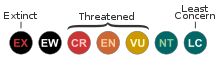
Growth: S = slow M = medium F = fast. Soil: L = light (sandy) M = medium H = heavy (clay). pH: A = acid N = neutral B = basic (alkaline). Shade: F = full shade S = semi-shade N = no shade. Moisture: D = dry M = Moist We = wet Wa = water.
Now available:
Food Forest Plants for Mediterranean Conditions
350+ Perennial Plants For Mediterranean and Drier Food Forests and Permaculture Gardens.
[Paperback and eBook]
This is the third in Plants For A Future's series of plant guides for food forests tailored to
specific climate zones. Following volumes on temperate and tropical ecosystems, this book focuses
on species suited to Mediterranean conditions—regions with hot, dry summers and cool, wet winters,
often facing the added challenge of climate change.
Read More
Expert comment
Author
Durand & Hilg.
Botanical References
Links / References
For a list of references used on this page please go here
Readers comment
| Add a comment |
|
If you have important information about this plant that may help other users please add a comment or link below. Only comments or links that are felt to be directly relevant to a plant will be included. If you think a comment/link or information contained on this page is inaccurate or misleading we would welcome your feedback at [email protected]. If you have questions about a plant please use the Forum on this website as we do not have the resources to answer questions ourselves.
* Please note: the comments by website users are not necessarily those held by PFAF and may give misleading or inaccurate information.
|
Subject : Eriogonum plumatella
|
|
|
|