 |
|
Joe Decruyenaere. Creative Commons Attribution-Share Alike 2.0 |
 |
| Joe Decruyenaere. Creative Commons Attribution-Share Alike 2.0 |
Translate this page:
Summary
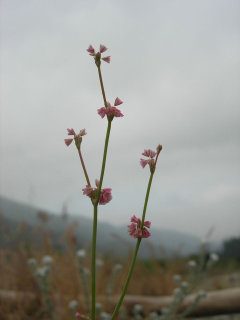
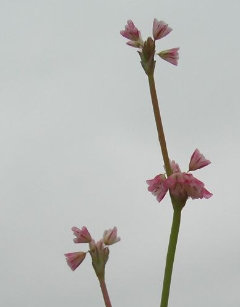
Davidson’s buckwheat is a delicate annual seed plant of open western drylands. It is not a leafy vegetable or root crop; its food value lies in its small achenes. Like many annual buckwheats, it can be almost invisible in poor rainfall years but more useful after good seasonal moisture. Its practical importance depends on abundance, because each individual plant is small. Davidson’s buckwheat, Eriogonum davidsonii, belongs to the buckwheat family (Polygonaceae) and the genus Eriogonum. Common names include Davidson’s buckwheat and Davidson’s wild buckwheat. It is a small annual wild buckwheat of the southwestern United States and northern Baja California. As an annual, it is best thought of as adapted to roughly USDA Zones 7–10 where seasonal moisture and open dry soils allow germination. Plants commonly grow about 10–40 cm tall, with a slender spread of about 10–40 cm. It grows in sandy or gravelly soils in habitats including grassland, saltbush, chaparral, sagebrush, oak woodland, and montane conifer woodland.
Physical Characteristics

 Eriogonum davidsonii is a ANNUAL growing to 0.4 m (1ft 4in) by 0.4 m (1ft 4in) at a fast rate.
See above for USDA hardiness. It is hardy to UK zone 8. The flowers are pollinated by Bees, Insects.
It is noted for attracting wildlife.
Suitable for: light (sandy) and medium (loamy) soils and prefers well-drained soil. Suitable pH: mildly acid, neutral and basic (mildly alkaline) soils. It cannot grow in the shade. It prefers dry or moist soil.
UK Hardiness Map
US Hardiness Map
Synonyms
Eriogonum baileyi var. davidsonii (Greene) M.E.Jones. Eriogonum molestum var. davidsonii (Greene) Jeps. Eriogonum vimineum var. davidsonii (Greene) S.Stokes.
Plant Habitats
Edible Uses
The edible part is the seed. The achenes can be gathered when mature and treated as a small wild grain [2-3]. Edible Uses & Rating: Davidson’s buckwheat ranks as a modest wild seed food. It is potentially useful in dense stands but not worth much effort when scattered. Its value is similar to that of other small annual buckwheats: good in principle, limited by harvest efficiency [2-3]. Taste, Processing & Kitchen Notes: The seeds should be dried, rubbed from the flower clusters, winnowed, and then toasted, boiled, or ground into meal. Some wild buckwheat achenes can taste tannic or bitter, so light roasting and mixing with milder grains are sensible kitchen approaches. Seasonality (Phenology): Davidson’s buckwheat flowers mainly from May to September. Seed harvest follows flowering and is best attempted when the dry flower clusters hold mature achenes but before they have fallen. Safety & Cautions (Food Use): Use mature seeds only and avoid assuming that every similar annual buckwheat has the same documented food use. As with other dryland seed plants, avoid roadside, mining-influenced, or chemically treated sites [2-3]. Harvest & Processing Workflow: Collect dry flowering heads, dry them further if needed, rub to release achenes, winnow carefully, then toast or grind. Timing matters because the useful seed window can be brief. Cultivar/Selection Notes: No food cultivars are known. Practical selection means finding productive stands after favorable rainfall. Look-Alikes & Confusion Risks: Many annual Eriogonum species are difficult to distinguish. Davidson’s buckwheat is slender, usually erect, and bears small white, pink, or reddish flowers at spaced nodes, but exact identification often requires close floral characters and range [2-3]. Traditional/Indigenous Use Summary: Davidson’s buckwheat belongs to the wider western buckwheat seed-food pattern, where small achenes were gathered when productive stands occurred [2-3].
References More on Edible Uses
Medicinal Uses
Plants For A Future can not take any responsibility for any adverse effects from the use of plants. Always seek advice from a professional before using a plant medicinally.
Eriogonum davidsonii (Davidson's buckwheat) has limited documented medicinal use compared to other species in its genus, with its primary documented use being as a food source. Key findings regarding this species include: Ethnobotanical Use: Historical records, such as those from the Kawaiisu, indicate that the plant's seeds were used as a food source rather than for specific medicinal purposes. Genus Context: While many Eriogonum species (such as E. fasciculatum or E. umbellatum) are widely documented for medicinal uses, including treating colds, stomachaches, and wounds, specific medicinal applications for E. davidsonii are underrepresented in ethnobotanical literature. Note: The Wisdom Library and the Jepson Herbarium list the species' botanical synonyms, confirming its identity within the broader, sometimes medicinal, genus of buckwheat.
References More on Medicinal Uses
The Bookshop: Edible Plant Books
Our Latest books on Perennial Plants For Food Forests and Permaculture Gardens in paperback or digital formats.
Edible Tropical Plants
Food Forest Plants for Hotter Conditions: 250+ Plants For Tropical Food Forests & Permaculture Gardens.
More
Edible Temperate Plants
Plants for Your Food Forest: 500 Plants for Temperate Food Forests & Permaculture Gardens.
More
More Books
PFAF have eight books available in paperback and digital formats. Browse the shop for more information.
Shop Now
Other Uses
Ecology & Wildlife: Provides seasonal nectar and small seeds for dryland insects and wildlife. Limited ornamental value except in naturalistic annual displays after rainfall. It could be grown from seed in dry native annual beds, but it is rarely cultivated.
Special Uses
References More on Other Uses
Cultivation details
Davidson’s buckwheat is a minor but valid wild seed plant. It is best valued as part of a broader dryland seed-gathering strategy rather than as a stand-alone staple. Growing Conditions: It prefers open sandy or gravelly soils, full sun, and seasonal moisture followed by dry conditions. Habitat & Range: It is native to the southwestern United States and northern Baja California, especially in sandy and gravelly habitats across several dryland plant communities. Size & Landscape Performance: It is small and delicate, with limited ornamental value except in naturalistic annual displays after rainfall. Cultivation (Horticulture): It could be grown from seed in dry native annual beds, but it is rarely cultivated. Pests & Problems: Poor rainfall, weak seed set, and seed shattering are the main limitations. Identification & Habit: An annual buckwheat with basal fuzzy leaves, slender branching stems, small involucres, and tiny flowers that may be white, pink, or red. Pollinators: Small bees, flies, and other dryland insects likely visit the flowers. Davidson’s buckwheat, Eriogonum davidsonii, belongs to the buckwheat family (Polygonaceae) and the genus Eriogonum. Common names include Davidson’s buckwheat and Davidson’s wild buckwheat. It is a small annual wild buckwheat of the southwestern United States and northern Baja California. As an annual, it is best thought of as adapted to roughly USDA Zones 7–10 where seasonal moisture and open dry soils allow germination. Plants commonly grow about 10–40 cm tall, with a slender spread of about 10–40 cm. It grows in sandy or gravelly soils in habitats including grassland, saltbush, chaparral, sagebrush, oak woodland, and montane conifer woodland.
References Carbon Farming Information and Carbon Sequestration Information
Temperature Converter
Type a value in the Celsius field to convert the value to Fahrenheit:
Fahrenheit:
The PFAF Bookshop
Plants For A Future have a number of books available in paperback and digital form. Book titles include Edible Plants, Edible Perennials, Edible Trees,Edible Shrubs, Woodland Gardening, and Temperate Food Forest Plants. Our new book is Food Forest Plants For Hotter Conditions (Tropical and Sub-Tropical).
Shop Now
Plant Propagation
Seed.
Other Names
If available other names are mentioned here
Davidson’s buckwheat and Davidson’s wild buckwheat.
Native Range
US. USA. Arizona, California, Mexico Northwest, Nevada, Utah.
Weed Potential
Right plant wrong place. We are currently updating this section.
Please note that a plant may be invasive in one area but may not in your area so it's worth checking.
Low.
Conservation Status
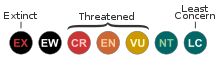
IUCN Red List of Threatened Plants Status : Not listed.
Growth: S = slow M = medium F = fast. Soil: L = light (sandy) M = medium H = heavy (clay). pH: A = acid N = neutral B = basic (alkaline). Shade: F = full shade S = semi-shade N = no shade. Moisture: D = dry M = Moist We = wet Wa = water.
Now available:
Food Forest Plants for Mediterranean Conditions
350+ Perennial Plants For Mediterranean and Drier Food Forests and Permaculture Gardens.
[Paperback and eBook]
This is the third in Plants For A Future's series of plant guides for food forests tailored to
specific climate zones. Following volumes on temperate and tropical ecosystems, this book focuses
on species suited to Mediterranean conditions—regions with hot, dry summers and cool, wet winters,
often facing the added challenge of climate change.
Read More
Expert comment
Author
Greene
Botanical References
Links / References
For a list of references used on this page please go here
Readers comment
| Add a comment |
|
If you have important information about this plant that may help other users please add a comment or link below. Only comments or links that are felt to be directly relevant to a plant will be included. If you think a comment/link or information contained on this page is inaccurate or misleading we would welcome your feedback at [email protected]. If you have questions about a plant please use the Forum on this website as we do not have the resources to answer questions ourselves.
* Please note: the comments by website users are not necessarily those held by PFAF and may give misleading or inaccurate information.
|
Subject : Eriogonum davidsonii
|
|
|
|