 |
|
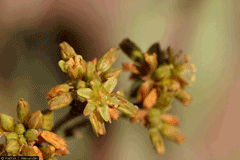
Patrick J. Alexander @ USDA-NRCS PLANTS Database |
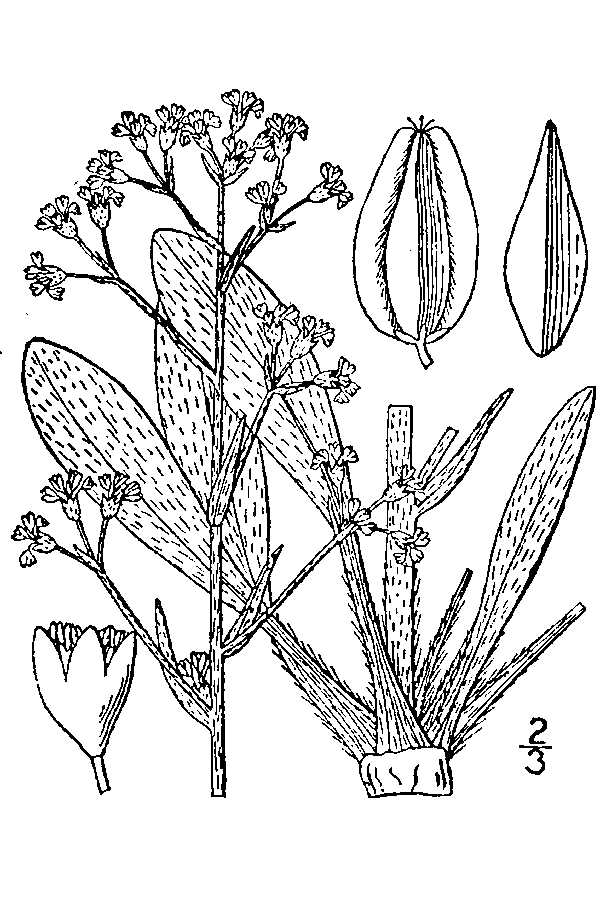 |
| USDA-NRCS PLANTS Database / Britton, N.L., and A. Brown. 1913. An illustrated flora of the northern United States, Canada and the British Possessions. Vol. 1: 648. |
Translate this page:
Summary
Winged buckwheat is a dryland perennial buckwheat with edible roots and seeds. It is part of a large and difficult western genus, but it is more substantial than many tiny annual buckwheats and can be locally useful where abundant. Its food value lies mainly in its seeds and roots, though the plant is better understood as a minor wild food than a major staple.
Physical Characteristics

 Eriogonum alatum is a PERENNIAL growing to 0.8 m (2ft 7in) by 0.6 m (2ft).
See above for USDA hardiness. It is hardy to UK zone 9. It is in flower from July to October. The species is hermaphrodite (has both male and female organs) and is pollinated by Bees, insects.
It is noted for attracting wildlife.
Suitable for: light (sandy) and medium (loamy) soils, prefers well-drained soil and can grow in nutritionally poor soil. Suitable pH: mildly acid, neutral and basic (mildly alkaline) soils. It cannot grow in the shade. It prefers dry or moist soil. The plant can tolerates strong winds but not maritime exposure.
UK Hardiness Map
US Hardiness Map
Synonyms
E. alatum subsp. typicum S.Stokes. Pterogonum alatum (Torr.) H.Gross
Plant Habitats
Cultivated Beds;
Edible Uses
Edible Parts: Root Seed
Edible Uses:
The edible parts are the roots and seeds. The seeds are the more typical buckwheat food use, while the roots appear to have been used in more limited or specific contexts. Edible Uses & Rating: Winged buckwheat ranks as a moderate wild food. The seeds are potentially useful when gathered in quantity, but the harvest window is brief and processing is necessary. The root use is more limited and should not encourage destructive harvest from sparse populations. Taste, Processing & Kitchen Notes: The seeds can be treated like other small buckwheat achenes: gathered dry, winnowed, toasted, boiled, or ground into meal. Buckwheat seeds may contain tannic bitterness, so cooking or parching is likely helpful. Roots should be cooked if used, but they are not likely to be as practical as seeds. Seasonality (Phenology): Winged buckwheat flowers from summer into autumn, often July to October. Seeds mature shortly after flowering, and the harvest period may be short. Safety & Cautions (Food Use): Use caution with roots because harvesting kills or damages perennial plants. Seeds should be properly cleaned and cooked or toasted. Avoid plants growing on contaminated roadsides or mining-influenced soils. Harvest & Processing Workflow: Harvest seed heads when dry but before the achenes drop. Dry further, rub to release seeds, winnow, then toast or grind. Root harvest should be conservative and only from abundant stands. Cultivar/Selection Notes: No food cultivars are known. For practical use, select dense stands with heavy seed set. Look-Alikes & Confusion Risks: Many Eriogonum species look similar. Identification usually requires flowers, involucres, growth form, and habitat. Misidentification within the genus is common, though not all species have documented food use. Traditional/Indigenous Use Summary: Winged buckwheat has documented Indigenous use, including root use among the Zuni. However, it should be treated as a minor traditional food/medicinal plant rather than a broad staple. Root - raw or dried for later use[155, 177, 257]. Seed - ground into a powder and made into a mush[257].
References More on Edible Uses
Medicinal Uses
Plants For A Future can not take any responsibility for any adverse effects from the use of plants. Always seek advice from a professional before using a plant medicinally.
Anodyne Salve
Eriogonum alatum (Winged Buckwheat) has a significant history of traditional medicinal use among North American Indigenous peoples, including the Navajo and Zuni, acting as a "life medicine" for internal ailments. It is primarily used to treat diarrhea, coughs, stomachaches, and to treat wounds or rashes. Key Traditional Medicinal Uses: Respiratory & Internal: A cold infusion of the root is used for coughs and diarrhea.Wounds & Skin: The powdered root is mixed with oil (or fat) to make a salve for sores and a poultice for swelling, rashes, and cuts.Oral Health: The root infusion can be used as a mouthwash for sore gums.Pain & Fever: Used for general body aches, rheumatism (via steam baths), and as an emetic (vomiting agent) for stomachaches."Life Medicine": The Navajo (Diné) traditionally use the plant for severe internal ailments.Important Safety Note: Some sources warn that all parts of the plant can be poisonous. The leaves can contain nicotine, which is toxic. Always consult a professional before using wild plants medicinally. Disclaimer: This information is for educational purposes based on historical and ethnobotanical records and is not medical advice. The plant has been used in the treatment of pain and also to make a lotion to treat rashes[155, 257]. A cold infusion of the root has been used to treat diarrhoea and bad coughs[257]. It has also been used as a mouthwash for sore gums[257]. The powdered root has been mixed with oil and used as a dressing on a baby's sore navel[257]. The Navajo (Diné) people consider the species to be a 'life medicine', using a mixture of shredded roots and water primarily to treat internal ailments[270]. The species is used as a ceremonial medicine[270]. The Zuni use it as an emetic for stomachaches[270].
References More on Medicinal Uses
The Bookshop: Edible Plant Books
Our Latest books on Perennial Plants For Food Forests and Permaculture Gardens in paperback or digital formats.
Edible Tropical Plants
Food Forest Plants for Hotter Conditions: 250+ Plants For Tropical Food Forests & Permaculture Gardens.
More
Edible Temperate Plants
Plants for Your Food Forest: 500 Plants for Temperate Food Forests & Permaculture Gardens.
More
More Books
PFAF have eight books available in paperback and digital formats. Browse the shop for more information.
Shop Now
Other Uses
Provides nectar and pollen for insects and seeds for small wildlife.
Special Uses
References More on Other Uses
Cultivation details
Winged buckwheat, Eriogonum alatum, belongs to the buckwheat family (Polygonaceae) and the genus Eriogonum. Common names include winged buckwheat and winged eriogonum. It is a native perennial herb or subshrub of the western and southwestern United States, generally suitable to USDA Zones 4–9 in dry, open sites. Plants commonly reach about 40–80 cm tall and spread 30–60 cm across. USDA lists it as a native perennial forb/herb or subshrub. Winged buckwheat is a useful but not outstanding dryland buckwheat. It is worth knowing where abundant, especially for seed use, but it requires careful identification and conservative harvest. Growing Conditions: It prefers full sun, dry sandy or gravelly soils, grasslands, brushlands, and open woodland edges. Habitat & Range: It is native to the western Great Plains, the Southwest, and northern Mexico, including dry open habitats. Size & Landscape Performance: Its upright habit and dryland tolerance make it suitable for native xeric plantings, especially where seed heads and pollinator value are desired. Cultivation (Horticulture): Grow from seed in sharply drained soil. Avoid rich, wet soils. Pests & Problems: Usually few pest issues. Overwatering and poor drainage are the main problems. Identification & Habit: A perennial herb or subshrub with simple leaves and flowering structures typical of Eriogonum: six tepals, usually nine stamens, and dry achenes. Pollinators: Like many wild buckwheats, it is attractive to small bees, flies, butterflies, and other dryland pollinators.
References Carbon Farming Information and Carbon Sequestration Information
Temperature Converter
Type a value in the Celsius field to convert the value to Fahrenheit:
Fahrenheit:
The PFAF Bookshop
Plants For A Future have a number of books available in paperback and digital form. Book titles include Edible Plants, Edible Perennials, Edible Trees,Edible Shrubs, Woodland Gardening, and Temperate Food Forest Plants. Our new book is Food Forest Plants For Hotter Conditions (Tropical and Sub-Tropical).
Shop Now
Plant Propagation
Seed - best sown as soon as it is ripe in the autumn in a sandy compost in a greenhouse. Sow stored seed in early spring in a warm greenhouse[1]. As soon as they are large enough to handle, prick the seedlings out into individual pots and grow them on in the greenhouse for at least their first winter. Plant out in late spring or early summer, after the last expected frosts. Division in early spring[1]. This has to be done with care because the plant resents root disturbance[200]. Try to obtain divisions from around the edges of the plants without digging up the whole clump. Tease the divisions out with as much root on them as possible and pot them up. Grow them on in light shade in the greenhouse until they are rooting well and plant them out in the summer. Cuttings of greenwood with a heel in the summer[200].
Other Names
If available other names are mentioned here
Winged buckwheat and Winged Eriogonum
Native Range
NORTHERN AMERICA: United States (Kansas (west), Nebraska (southwest), Oklahoma (west), Colorado, Wyoming (southeast), New Mexico, Texas (n. & w.), Arizona, Utah (east)), Mexico (Chihuahua)
Weed Potential
Right plant wrong place. We are currently updating this section.
Please note that a plant may be invasive in one area but may not in your area so it's worth checking.
Low. It is native and not generally aggressive.
Conservation Status
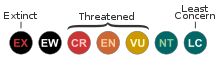
IUCN Red List of Threatened Plants Status : Not listed.
Growth: S = slow M = medium F = fast. Soil: L = light (sandy) M = medium H = heavy (clay). pH: A = acid N = neutral B = basic (alkaline). Shade: F = full shade S = semi-shade N = no shade. Moisture: D = dry M = Moist We = wet Wa = water.
Now available:
Food Forest Plants for Mediterranean Conditions
350+ Perennial Plants For Mediterranean and Drier Food Forests and Permaculture Gardens.
[Paperback and eBook]
This is the third in Plants For A Future's series of plant guides for food forests tailored to
specific climate zones. Following volumes on temperate and tropical ecosystems, this book focuses
on species suited to Mediterranean conditions—regions with hot, dry summers and cool, wet winters,
often facing the added challenge of climate change.
Read More
Expert comment
Author
Torr.
Botanical References
235270
Links / References
For a list of references used on this page please go here
Readers comment
© 2010, Plants For A Future. Plants For A Future is a charitable company limited by guarantee, registered in England and Wales. Charity No. 1057719, Company No. 3204567.