 |
|
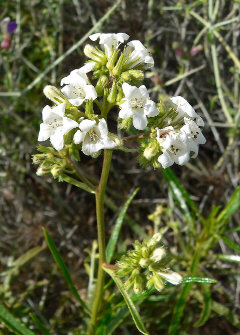
Stan Shebs Creative Commons Attribution-Share Alike 3.0 |
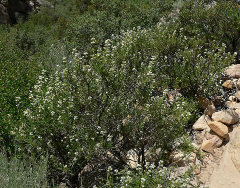 |
| Stan Shebs Creative Commons Attribution-Share Alike 3.0 |
Translate this page:
Summary
Narrowleaf yerba santa is a dryland medicinal tea shrub, not a food plant. Its sticky, resinous leaves produce a highly aromatic infusion with a sweet, cooling, piney, bay-like character. The plant is best understood as a traditional respiratory-support herb and chaparral shrub rather than as an edible green. It is especially useful to know in desert-edge and pinyon-juniper country because the evergreen leaves can be recognized and gathered through much of the year. Narrowleaf yerba santa, Eriodictyon angustifolium, belongs to the borage family (Boraginaceae) in the broad modern sense, though the genus is also often treated in the waterleaf family or Namaceae in botanical references. It belongs to the genus Eriodictyon. Common names include narrowleaf yerba santa and narrow-leaved yerba santa. It is an aromatic evergreen shrub generally suited to USDA Zones 7–10 in dry western climates. Plants commonly grow about 40–170 cm tall, with a spread of roughly 60–180 cm where rhizomes and suckering growth are allowed to develop. Lady Bird Johnson Wildflower Center lists its native habitat as washes and dry rocky slopes in chaparral and pinyon-juniper woodlands.
Physical Characteristics

 Eriodictyon angustifolium is a SHRUB growing to 1.7 m (5ft) by 1.7 m (5ft) at a medium rate.
See above for USDA hardiness. It is hardy to UK zone 8. The flowers are pollinated by Bees, Insects.
It is noted for attracting wildlife.
Suitable for: light (sandy) and medium (loamy) soils, prefers well-drained soil and can grow in nutritionally poor soil. Suitable pH: mildly acid, neutral and basic (mildly alkaline) soils. It cannot grow in the shade. It prefers dry or moist soil and can tolerate drought.
UK Hardiness Map
US Hardiness Map
Synonyms
Eriodictyon glutinosum var. angustifolium (Nutt.) Torr.
Plant Habitats
Edible Uses
The leaves are used for tea only. The leaves should not be treated as edible greens and should not be swallowed after chewing. Regular or heavy consumption is not recommended because this is a medicinal shrub and because members of this broader family group may contain compounds that deserve caution [2-3]. Edible Uses & Rating: As a beverage herb, narrowleaf yerba santa ranks high for flavor and aromatic quality. As a food plant, it ranks very low because it is not a bulk edible. Its proper use is as a strong herbal tea in modest amounts, especially when a soothing, resinous, cooling infusion is wanted [2-3]. Taste, Processing & Kitchen Notes: The tea is one of the more pleasant medicinal teas of the arid West when brewed lightly. It has a sweet-fruit impression blended with pine, bay laurel, and resinous chaparral aromatics. If made too strong, the resinous quality can become acrid. Fresh leaves are shiny, sticky, and aromatic, but chewing them is much more intense than drinking the tea and should not result in swallowing leaf material. Dried leaves retain much of the aroma and are often easier to store and dose [2-3]. Seasonality (Phenology): Because the shrub is evergreen, leaves are available throughout the year. New spring leaves are usually the preferred tea material. Flowering occurs in late spring, with white, hairy flowers arranged in coiled or head-like terminal clusters. Safety & Cautions (Food Use): Use as a tea should be occasional and moderate. This is a medicinal beverage shrub, not a daily food plant. Strong brews may be irritating due to resinous compounds. People who are pregnant, taking medications, managing chronic illness, or sensitive to medicinal herbs should be cautious. Do not use as a cold salad green or swallow chewed leaves [2-3]. Harvest & Processing Workflow: Harvest a small number of clean, healthy leaves from vigorous shrubs, preferably new but fully expanded leaves. Dry them in a shaded, well-ventilated place or use fresh. For tea, steep lightly in hot water and strain. Avoid overbrewing, which can pull out harsher resinous notes. Harvest conservatively because shrubs are valuable wildlife and pollinator plants. Cultivar/Selection Notes. There are no food cultivars. Horticultural selection would focus on drought tolerance, compact habit, leaf aroma, and suitability for restoration or native gardens [2-3]. Look-Alikes & Confusion Risks: Narrowleaf yerba santa may be confused with other Eriodictyon species, especially where ranges overlap. The narrow, linear to lanceolate leaves, rolled margins, shiny, resinous upper surfaces, and whitish, hairy lower surfaces are useful characters. Species-level identification is important because local endemics and rare taxa may occur in the genus. Traditional/Indigenous Use Summary: Yerba santa means “holy herb,” a name reflecting its long-standing reputation as a medicinal plant. Narrowleaf yerba santa has been used as a tea and as a respiratory herb in the broader western medicinal plant tradition, especially among dryland peoples with access to the shrub. The USDA Forest Service notes that Eriodictyon angustifolium, E. californicum, and E. trichocalyx are among the most commonly seen and used yerba santa species [2-3].
References More on Edible Uses
Medicinal Uses
Plants For A Future can not take any responsibility for any adverse effects from the use of plants. Always seek advice from a professional before using a plant medicinally.
Eriodictyon angustifolium (narrow-leaf Yerba Santa) has a long history of traditional medical use and shows promising modern pharmacological properties. Its key medical applications include respiratory support, topical treatments, and research-stage anti-aging and neuroprotective benefits. Key medical uses and benefits include: Respiratory Conditions: Traditionally used by Native Americans as tea or a poultice to treat coughs, colds, asthma, and bronchitis. The plant contains chemicals that act as expectorants, loosening chest mucus and reducing inflammation. Hair Greying Prevention: Research suggests that E. angustifolium extract promotes melanin production and protects hair follicular keratinocytes from radiation-induced DNA damage. Extracts are being evaluated to help prevent or slow human hair greying. Topical & Pain Relief: Historically, poultices of fresh leaves were applied topically to soothe rheumatic pain, reduce fever, and manage bruises.Pharmaceutical Masking: Because of its natural flavor-masking compounds, it has historically been used in bitter drug preparations.
References More on Medicinal Uses
The Bookshop: Edible Plant Books
Our Latest books on Perennial Plants For Food Forests and Permaculture Gardens in paperback or digital formats.

Edible Tropical Plants
Food Forest Plants for Hotter Conditions: 250+ Plants For Tropical Food Forests & Permaculture Gardens.
More

Edible Temperate Plants
Plants for Your Food Forest: 500 Plants for Temperate Food Forests & Permaculture Gardens.
More

More Books
PFAF have eight books available in paperback and digital formats. Browse the shop for more information.
Shop Now
Other Uses
A useful evergreen shrub in dry native gardens, especially where silver-backed, resinous foliage and drought tolerance are desired. It may spread by rhizomes and is best used in naturalistic plantings rather than tight formal beds. It is suitable for chaparral, desert-edge, and pinyon-juniper style plantings. Ecology & Wildlife: Narrowleaf yerba santa contributes evergreen cover, nectar, and post-disturbance shrub structure in arid western plant communities. It is especially valuable in dry rocky habitats where few broadleaf evergreen shrubs thrive.
Special Uses
References More on Other Uses
Cultivation details
Narrowleaf yerba santa is an excellent medicinal tea shrub but not a true food plant. Its strengths are aroma, resilience, drought tolerance, evergreen leaves, and respiratory-herbal tradition. It should be used respectfully, sparingly, and primarily as tea. Growing Conditions: This shrub prefers full sun, dry rocky slopes, washes, chaparral, and pinyon-juniper settings. It needs sharp drainage and performs best in lean mineral soils with low summer water. Habitat & Range: Narrowleaf yerba santa occurs in western desert and pinyon-juniper regions, including California and other southwestern states. In California it is considered rare or limited, though more common elsewhere, and is associated with pinyon-juniper woodland at about 1,500–1,900 m elevation. Size & Landscape Performance: It can make a useful evergreen shrub in dry native gardens, especially where silver-backed, resinous foliage and drought tolerance are desired. It may spread by rhizomes and is best used in naturalistic plantings rather than tight formal beds. Cultivation (Horticulture): Grow in full sun with excellent drainage and minimal irrigation after establishment. It is suitable for chaparral, desert-edge, and pinyon-juniper style plantings. Avoid rich, wet soils. Pests & Problems: The main problems are overwatering, poor drainage, and trying to grow it outside its dryland adaptation. It may sucker or spread where conditions suit it. Identification & Habit: Narrowleaf yerba santa is an aromatic evergreen shrub with alternate, leathery, narrow leaves. The upper surfaces are dark green, shiny, sticky, and resinous, while the lower surfaces are covered with fine white hairs. Flowers are white, tubular to funnel-shaped, and borne in terminal clusters. Pollinators: The flowers are attractive to bees, butterflies, flies, and other small insects. Yerba santas are valuable chaparral and dryland nectar plants, and related species are widely recognized for pollinator value. Narrowleaf yerba santa, Eriodictyon angustifolium, belongs to the borage family (Boraginaceae) in the broad modern sense, though the genus is also often treated in the waterleaf family or Namaceae in botanical references. It belongs to the genus Eriodictyon. Common names include narrowleaf yerba santa and narrow-leaved yerba santa. It is an aromatic evergreen shrub generally suited to USDA Zones 7–10 in dry western climates. Plants commonly grow about 40–170 cm tall, with a spread of roughly 60–180 cm where rhizomes and suckering growth are allowed to develop. Lady Bird Johnson Wildflower Center lists its native habitat as washes and dry rocky slopes in chaparral and pinyon-juniper woodlands.
References Carbon Farming Information and Carbon Sequestration Information
Temperature Converter
Type a value in the Celsius field to convert the value to Fahrenheit:
Fahrenheit:
The PFAF Bookshop
Plants For A Future have a number of books available in paperback and digital form. Book titles include Edible Plants, Edible Perennials, Edible Trees,Edible Shrubs, Woodland Gardening, and Temperate Food Forest Plants. Our new book is Food Forest Plants For Hotter Conditions (Tropical and Sub-Tropical).
Shop Now
Plant Propagation
Propagation is usually by seed or rhizome/sucker division. Seed may benefit from disturbance cues, and some Eriodictyon species respond strongly after fire or soil disturbance.
Other Names
If available other names are mentioned here
Narrowleaf yerba santa and narrow-leaved yerba santa
Native Range
US. USA. Arizona, California, Mexico Northwest, Nevada, Utah
Weed Potential
Right plant wrong place. We are currently updating this section.
Please note that a plant may be invasive in one area but may not in your area so it's worth checking.
Low to moderate. It is not usually a broad invasive threat, but it may spread locally by rhizomes in suitable habitat.
Conservation Status
IUCN Red List of Threatened Plants Status : Not listed.
Growth: S = slow M = medium F = fast. Soil: L = light (sandy) M = medium H = heavy (clay). pH: A = acid N = neutral B = basic (alkaline). Shade: F = full shade S = semi-shade N = no shade. Moisture: D = dry M = Moist We = wet Wa = water.
Now available:
Food Forest Plants for Mediterranean Conditions
350+ Perennial Plants For Mediterranean and Drier Food Forests and Permaculture Gardens.
[Paperback and eBook]
This is the third in Plants For A Future's series of plant guides for food forests tailored to
specific climate zones. Following volumes on temperate and tropical ecosystems, this book focuses
on species suited to Mediterranean conditions—regions with hot, dry summers and cool, wet winters,
often facing the added challenge of climate change.
Read More
Expert comment
Author
Nutt.
Botanical References
Links / References
For a list of references used on this page please go here
Readers comment
| Add a comment |
|
If you have important information about this plant that may help other users please add a comment or link below. Only comments or links that are felt to be directly relevant to a plant will be included. If you think a comment/link or information contained on this page is inaccurate or misleading we would welcome your feedback at [email protected]. If you have questions about a plant please use the Forum on this website as we do not have the resources to answer questions ourselves.
* Please note: the comments by website users are not necessarily those held by PFAF and may give misleading or inaccurate information.
|
Subject : Eriodictyon angustifolium
|
|
|
|