 |
|
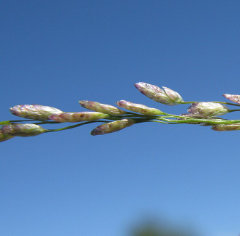
Harry Rose from South West Rocks, Australia. Creative Commons Attribution 2.0 |
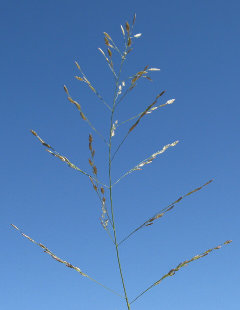 |
| Harry Rose from South West Rocks, Australia. Creative Commons Attribution 2.0 |
Translate this page:
Summary
Mexican love grass is another highly productive grain-producing species adapted to warm climates. It has a long history of use as a staple food in parts of North America and demonstrates the potential of small-seeded grasses as resilient food crops in dry environments.
Physical Characteristics

 Eragrostis mexicana is a ANNUAL growing to 0.8 m (2ft 7in) by 0.2 m (0ft 8in) at a fast rate.
See above for USDA hardiness. It is hardy to UK zone 8. The flowers are pollinated by Wind.
It is noted for attracting wildlife.
Suitable for: light (sandy), medium (loamy) and heavy (clay) soils, prefers well-drained soil and can grow in nutritionally poor soil. Suitable pH: mildly acid, neutral and basic (mildly alkaline) soils. It cannot grow in the shade. It prefers dry or moist soil and can tolerate drought.
UK Hardiness Map
US Hardiness Map
Synonyms
Poa mexicana Hornem.
Plant Habitats
Edible Uses
The grains are edible and nutritious, suitable for use as a staple when abundant [2-3]. Edible Uses & Rating: This species ranks as a high-value wild grain. It is particularly notable for its historical role as a staple food and its reliability in arid climates [2-3]. Taste, Processing & Kitchen Notes: Grains are small but plentiful and similar in use to other Eragrostis species. They can be toasted, boiled into porridge, or ground into flour. The flavor is mild and grain-like, with improved qualities when toasted. Seasonality (Phenology): Blooms in summer, with seeds maturing from late summer into autumn. Timing varies depending on rainfall and temperature. Safety & Cautions (Food Use): No specific toxicity issues are known. As with all wild grains, harvesting from clean environments is important [2-3]. Harvest & Processing Workflow: Harvest mature seed heads when dry. Seeds can be easily separated and winnowed. Processing is simple and efficient due to the plant’s natural tendency to release seeds [2-3]. Cultivar/Selection Notes: While not widely cultivated today, this species has clear potential for development as a dryland grain crop. Look-Alikes & Confusion Risks: Similar to other love grasses. Differences are subtle, but confusion is not problematic from a food perspective [2-3]. Traditional/Indigenous Use Summary: This species was an important staple for Indigenous peoples in the southwestern United States and northern Mexico, particularly along river systems where it was harvested in quantity [2-3].
References More on Edible Uses
Medicinal Uses
Plants For A Future can not take any responsibility for any adverse effects from the use of plants. Always seek advice from a professional before using a plant medicinally.
Eragrostis mexicana (Mexican lovegrass) is harvested from the wild for local use as food and medicine. While specific, detailed medical applications for E. mexicana are not explicitly detailed in the provided search results, it is closely related to other Eragrostis species used traditionally for digestive disorders, as diuretics, and to treat fevers. Potential Medicinal Uses Based on Related Species: While specific pharmacological data for E. mexicana is limited, studies on other plants in the Eragrostis genus indicate potential bioactive properties: Respiratory Support: Traditional systems have used Eragrostis species to alleviate bronchial congestion and act as an expectorant. Wound Healing: Extracts have been used topically as poultices to treat wounds and cuts due to potential antimicrobial properties. Fever Reduction: The roots and other parts of related grasses are utilized for their antipyretic (fever-reducing) properties. Gastrointestinal Health: Some species are used to treat colic, flatulence, and other stomach infections. Identification and Safety: Description: E. mexicana is a native grass of North America and Mexico, often found in disturbed areas. Toxicity: Generally, no hazards are known for Eragrostis pilosa, though caution is always recommended with wild herbal remedies. Note on Similar Species: Eragrostis mexicana is sometimes confused with Argemone mexicana (Mexican poppy), a completely different plant which is toxic but used for treating jaundice and malaria.
References More on Medicinal Uses
The Bookshop: Edible Plant Books
Our Latest books on Perennial Plants For Food Forests and Permaculture Gardens in paperback or digital formats.
Edible Tropical Plants
Food Forest Plants for Hotter Conditions: 250+ Plants For Tropical Food Forests & Permaculture Gardens.
More
Edible Temperate Plants
Plants for Your Food Forest: 500 Plants for Temperate Food Forests & Permaculture Gardens.
More
More Books
PFAF have eight books available in paperback and digital formats. Browse the shop for more information.
Shop Now
Other Uses
Suitable for naturalistic plantings but may appear weedy. A fine-textured grass with open, branching seed heads. Ecology & Wildlife: Provides seeds for birds and contributes to grassland ecosystems, especially in disturbed or marginal lands.
Special Uses
References More on Other Uses
Cultivation details
Mexican love grass is a highly valuable wild cereal with historical significance and strong potential for future food systems, especially in water-limited environments. Growing Conditions: Prefers full sun and well-drained soils. Tolerant of drought and heat. Habitat & Range: Native to North America, especially common in the southwestern United States and Mexico. Also occurs in parts of South America and Australia. Size & Landscape Performance: Forms loose clumps with airy seed heads. Suitable for naturalistic plantings but may appear weedy. Cultivation (Horticulture): Easy to grow from seed. Requires minimal care and thrives in poor soils. Pests & Problems: Few pest issues. Can become invasive in disturbed habitats. Identification & Habit: A fine-textured grass with open, branching seed heads bearing numerous tiny grains. Pollinators: Wind-pollinated. Mexican love grass, Eragrostis mexicana, belongs to the grass family (Poaceae). It is a warm-season annual or short-lived perennial suited to USDA Zones 7–11, typically growing 30–100 cm tall with a loose, branching form.
References Carbon Farming Information and Carbon Sequestration Information
Temperature Converter
Type a value in the Celsius field to convert the value to Fahrenheit:
Fahrenheit:
The PFAF Bookshop
Plants For A Future have a number of books available in paperback and digital form. Book titles include Edible Plants, Edible Perennials, Edible Trees,Edible Shrubs, Woodland Gardening, and Temperate Food Forest Plants. Our new book is Food Forest Plants For Hotter Conditions (Tropical and Sub-Tropical).
Shop Now
Plant Propagation
By seed, with prolific reproduction.
Other Names
If available other names are mentioned here
Mexican love grass, Eragrostis mexicana. Poa mexicana.
Native Range
US. USA. Argentina Northeast, Argentina Northwest, Argentina South, Arizona, Bolivia, Brazil North, Brazil Northeast, Brazil South, Brazil Southeast, Brazil West-Central, British Columbia, California, Chile North, Colombia, Colorado, Costa Rica, Ecuador, El Salvador, Galápagos, Guatemala, Honduras, Mexico Central, Mexico Gulf, Mexico Northeast, Mexico Northwest, Mexico Southeast, Mexico Southwest, Nevada, New Mexico, Nicaragua, Oklahoma, Oregon, Panamá, Peru, Texas, Uruguay, Utah, Venezuela, Washington
Weed Potential
Right plant wrong place. We are currently updating this section.
Please note that a plant may be invasive in one area but may not in your area so it's worth checking.
Moderate to high, depending on conditions.
Conservation Status
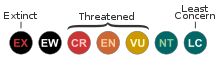
IUCN Red List of Threatened Plants Status : Not listed.
Growth: S = slow M = medium F = fast. Soil: L = light (sandy) M = medium H = heavy (clay). pH: A = acid N = neutral B = basic (alkaline). Shade: F = full shade S = semi-shade N = no shade. Moisture: D = dry M = Moist We = wet Wa = water.
Now available:
Food Forest Plants for Mediterranean Conditions
350+ Perennial Plants For Mediterranean and Drier Food Forests and Permaculture Gardens.
[Paperback and eBook]
This is the third in Plants For A Future's series of plant guides for food forests tailored to
specific climate zones. Following volumes on temperate and tropical ecosystems, this book focuses
on species suited to Mediterranean conditions—regions with hot, dry summers and cool, wet winters,
often facing the added challenge of climate change.
Read More
Expert comment
Author
(Hornem.) Link
Botanical References
Links / References
For a list of references used on this page please go here
Readers comment
| Add a comment |
|
If you have important information about this plant that may help other users please add a comment or link below. Only comments or links that are felt to be directly relevant to a plant will be included. If you think a comment/link or information contained on this page is inaccurate or misleading we would welcome your feedback at [email protected]. If you have questions about a plant please use the Forum on this website as we do not have the resources to answer questions ourselves.
* Please note: the comments by website users are not necessarily those held by PFAF and may give misleading or inaccurate information.
|
Subject : Eragrostis mexicana
|
|
|
|