 |
|
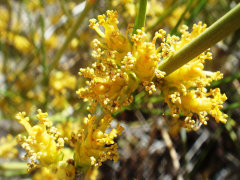
Miwasatoshi. Creative Commons Attribution-Share Alike 4.0 |
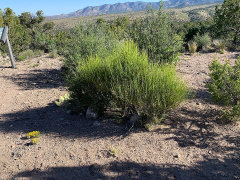 |
| CK Kelly. Creative Commons Attribution 4.0 |
Translate this page:
Summary
Southwestern ephedra is a distinctive desert gymnosperm shrub with green jointed stems, tiny scale-like leaves, and cone-like reproductive structures. It is best understood as a tea shrub rather than a food plant. In dry shrublands and desert margins it can be common enough to notice easily, but its practical value lies mostly in the stems for tea, not in the seeds.
Physical Characteristics

 Ephedra aspera is a SHRUB growing to 1 m (3ft 3in) by 1.2 m (4ft) at a slow rate.
See above for USDA hardiness. It is hardy to UK zone 8. The flowers are pollinated by Wind.
It is noted for attracting wildlife.
Suitable for: light (sandy) and medium (loamy) soils, prefers well-drained soil and can grow in nutritionally poor soil. Suitable pH: neutral and basic (mildly alkaline) soils and can grow in very alkaline soils.
It cannot grow in the shade. It prefers dry or moist soil and can tolerate drought.
UK Hardiness Map
US Hardiness Map
Synonyms
E. nevadensis var. aspera (Engelm. ex S.Watson) L.D.Benson
Plant Habitats
Edible Uses
The stems can be brewed into tea, but the tea should be used in moderation. Seeds of this species are the least reassuring in the group and are better treated as doubtful or unsuitable for regular food use. In practical terms, southwestern ephedra is a beverage plant, not a nut crop [2-3]. Edible Uses & Rating: As a tea plant, southwestern ephedra ranks as fair to moderate. As a seed food, it ranks low. The stems are useful, but the seeds are too acrid and uncertain to recommend as a dependable food [2-3]. Taste, Processing & Kitchen Notes: Tea made from young green stems is the best use. Older wood is weaker and blander. The seeds can look promising because they are small, brown, and nut-like, but they are usually harsh, acrid, and disappointing. Even roasting only partly improves them, so this is not a species to seek out for seeds [2-3]. Seasonality (Phenology): Like other southwestern ephedras, this species flowers in spring into early summer. Tea stems can be clipped in multiple seasons, though fresh green growth generally makes the best beverage. Seeds mature later and can fall quickly once ripe, so harvest timing matters if they are being studied at all. Safety & Cautions (Food Use): Tea should be consumed only in moderation because prolonged or heavy use of ephedra may affect the nervous system. The seeds should be approached with great caution. Sharp stem tips can also make harvest uncomfortable. This is a plant to know well, but not one to overuse [2-3]. Harvest & Processing Workflow: Clip young green stems with scissors; avoid old or infested material; use fresh, dried, or lightly roasted twigs for tea. If seeds are collected, a tarp and stick can help knock them free, but from a practical standpoint, the stems are much more worthwhile than the seeds [2-3]. Cultivar/Selection Notes: There are no food cultivars. The best collection material comes from healthy, green, uninfested shrubs growing in a clean habitat. Look-Alikes & Confusion Risks: It resembles other southwestern ephedras, but the genus as a whole is distinctive enough that confusion with unrelated shrubs is uncommon. The main identification challenge is distinguishing one ephedra species from another, rather than separating ephedra from non-ephedra plants [2-3]. Traditional/Indigenous Use Summary: Southwestern ephedra belongs to the broader Southwestern tradition of ephedra tea use, where these shrubs were valued primarily as medicinal or invigorating beverage plants rather than as staple foods [2-3].
References More on Edible Uses
Medicinal Uses
Plants For A Future can not take any responsibility for any adverse effects from the use of plants. Always seek advice from a professional before using a plant medicinally.
Ephedra aspera, commonly known as canatilla or popotillo, has a history of use in traditional Mexican medicine to treat pneumonia, kidney failure, and venereal diseases. It has also been historically employed as a diuretic and to alleviate respiratory issues such as asthma and coughs. (National Institutes of Health.gov) Traditional Medicinal Uses: Ephedra aspera is utilized in various ways by different indigenous groups, primarily through infusions (teas) of the whole plant, stalks, or roots. Respiratory Illnesses: Used as a remedy for pneumonia and as an antitussive (cough suppressant). Kidney Health: Reported to help with kidney failure and Bright's disease (acute or chronic nephritis). Venereal Diseases: Traditionally used to treat syphilis and gonorrhea, sometimes applied directly as an ointment or ingested as an infusion. Other Uses: Historically cited for treating headaches, dyspepsia (indigestion), and hay fever. Important Safety Warning: While Ephedra aspera is used traditionally, it belongs to the genus Ephedra, which contains active compounds such as ephedrine. FDA Ban: The U.S. Food and Drug Administration (FDA) banned dietary supplements containing ephedrine alkaloids in 2004 due to risks of serious adverse effects, including heart attack, stroke, and death. Species Variability: Alkaloid content varies significantly among species. While Asian species (E. sinica) are high in stimulants, American species often contain lower levels, but still pose risks if misused.
References More on Medicinal Uses
The Bookshop: Edible Plant Books
Our Latest books on Perennial Plants For Food Forests and Permaculture Gardens in paperback or digital formats.
Edible Tropical Plants
Food Forest Plants for Hotter Conditions: 250+ Plants For Tropical Food Forests & Permaculture Gardens.
More
Edible Temperate Plants
Plants for Your Food Forest: 500 Plants for Temperate Food Forests & Permaculture Gardens.
More
More Books
PFAF have eight books available in paperback and digital formats. Browse the shop for more information.
Shop Now
Other Uses
A wiry, open shrub that is more botanically interesting than lush or ornamental. In desert gardens, it works best in native or restoration-style planting. Ecology & Wildlife: It adds cover and structure to dry shrublands and contributes to the evergreen framework of arid habitats. The aerial parts of this species are grazed by animals. The stems are used for their tannins, which are used as dyes [2-6].
Special Uses
References More on Other Uses
Cultivation details
Southwestern ephedra is a useful desert tea shrub with limited food value beyond the stems. It is a worthwhile plant to know for beverage use and identification, but not one to rely on for seeds. Growing Conditions: This species prefers full sun, very well-drained mineral soils, and hot, dry desert or shrubland climates. It tolerates poor soils and drought well once established. Habitat & Range: It is native from southeastern California to Texas and into northern Mexico, mainly in desert and dry shrubland habitats. Size & Landscape Performance: It forms a wiry, open shrub that is more botanically interesting than lush or ornamental. In desert gardens, it works best in native or restoration-style planting. Cultivation (Horticulture): Grow it in full sun with minimal irrigation and sharp drainage. Heavy soils and overwatering are the main reasons desert ephedras fail. Pests & Problems: Infested or swollen stems should be avoided for tea use. Poor drainage is the biggest cultivation problem. Identification & Habit: A green, jointed, photosynthetic shrub with opposite or whorled scale leaves at the nodes and separate male and female cone-like structures. It has the classic, sparse, twiggy ephedra look. Pollinators: Ephedras are wind-pollinated, not insect-pollinated. Southwestern ephedra, now best referred to as Ephedra aspera, belongs to the joint-fir family (Ephedraceae) and the genus Ephedra. Common names include southwestern ephedra, boundary ephedra, and rough jointfir. It is an accepted species native from southeastern California to Texas and into northern Mexico, and it is generally suited to hot, arid landscapes in roughly USDA Zones 7–10. Mature plants are usually low, twiggy shrubs about 30–120 cm tall and often 60–180 cm across.
References Carbon Farming Information and Carbon Sequestration Information
Temperature Converter
Type a value in the Celsius field to convert the value to Fahrenheit:
Fahrenheit:
The PFAF Bookshop
Plants For A Future have a number of books available in paperback and digital form. Book titles include Edible Plants, Edible Perennials, Edible Trees,Edible Shrubs, Woodland Gardening, and Temperate Food Forest Plants. Our new book is Food Forest Plants For Hotter Conditions (Tropical and Sub-Tropical).
Shop Now
Plant Propagation
Propagation is mainly by seed. Establishment can be slow and is best in hot, dry, open ground.
Other Names
If available other names are mentioned here
Canatilla. Popotillo. Southwestern ephedra. Boundary ephedra. Rough jointfir.
Native Range
US. USA. Arizona, California, Mexico Northeast, Mexico Northwest, New Mexico, Texas, Utah.
Weed Potential
Right plant wrong place. We are currently updating this section.
Please note that a plant may be invasive in one area but may not in your area so it's worth checking.
Very low. It is a native desert shrub and not an aggressive spreader.
Conservation Status
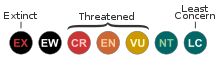
IUCN Red List of Threatened Plants Status : Least Concern
Growth: S = slow M = medium F = fast. Soil: L = light (sandy) M = medium H = heavy (clay). pH: A = acid N = neutral B = basic (alkaline). Shade: F = full shade S = semi-shade N = no shade. Moisture: D = dry M = Moist We = wet Wa = water.
Now available:
Food Forest Plants for Mediterranean Conditions
350+ Perennial Plants For Mediterranean and Drier Food Forests and Permaculture Gardens.
[Paperback and eBook]
This is the third in Plants For A Future's series of plant guides for food forests tailored to
specific climate zones. Following volumes on temperate and tropical ecosystems, this book focuses
on species suited to Mediterranean conditions—regions with hot, dry summers and cool, wet winters,
often facing the added challenge of climate change.
Read More
Expert comment
Author
Engelm. ex S.Watson
Botanical References
Links / References
For a list of references used on this page please go here
Readers comment
| Add a comment |
|
If you have important information about this plant that may help other users please add a comment or link below. Only comments or links that are felt to be directly relevant to a plant will be included. If you think a comment/link or information contained on this page is inaccurate or misleading we would welcome your feedback at [email protected]. If you have questions about a plant please use the Forum on this website as we do not have the resources to answer questions ourselves.
* Please note: the comments by website users are not necessarily those held by PFAF and may give misleading or inaccurate information.
|
|