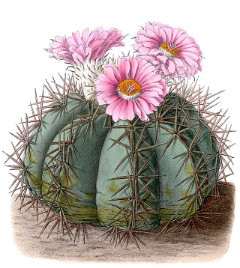
 |
|
Toni Gürke. Public domain |
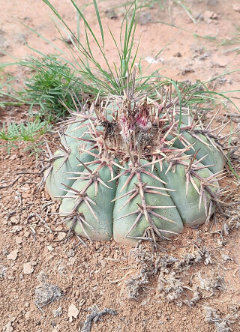 |
| Ana Nuño. Creative Commons Zero, Public Domain Dedication |
Translate this page:
Summary
Eagleclaw cactus is a compact barrel-type cactus native primarily to the Chihuahuan Desert. Its symmetrical ribs and distinctive annulated spines give it strong ornamental appeal, yet it remains uncommon in the wild and is often protected in portions of its range. Historically referenced as a famine food, it is considered a plant of last resort because harvesting the stem kills the cactus. Although fruits were reportedly eaten, they are sparse and short-lived, limiting the species’ practical food value.
Physical Characteristics

 Echinocactus horizonthalonius is an evergreen Shrub growing to 0.3 m (1ft) by 0.3 m (1ft in) at a slow rate.
See above for USDA hardiness. It is hardy to UK zone 8. The flowers are pollinated by Bees, Insects.
It is noted for attracting wildlife.
Suitable for: light (sandy) and medium (loamy) soils and can grow in nutritionally poor soil. Suitable pH: neutral and basic (mildly alkaline) soils and can grow in very alkaline soils.
It cannot grow in the shade. It prefers dry soil and can tolerate drought.
UK Hardiness Map
US Hardiness Map
Synonyms
Meyerocactus horizonthalonius (Lem.) Doweld
Plant Habitats
Edible Uses
The stems are technically edible and were once processed into cactus candy, while the fruits were occasionally consumed. Overall usefulness as a food plant is low due to scarcity, slow growth, and conservation concerns [2-3]. Edible Uses & Rating. Rated low as a foraging species. It may provide emergency carbohydrates but should not be relied upon where conservation laws apply [2-3]. Taste, Processing & Kitchen Notes. Little firsthand tasting information exists, but cactus stems generally require heavy sweetening to become palatable. The reference to candy suggests the flesh is bland rather than inherently flavorful. Fruits reportedly dry quickly, implying limited juiciness and poor culinary versatility. [2-3] Seasonality (Phenology). Pinkish-red flowers may appear from April through September depending on rainfall and temperature. Fruits develop within weeks but often desiccate rapidly in desert conditions [2-3]. Safety & Cautions (Food Use). Harvesting stems kills the plant and may violate legal protections. Given its slow growth, removal should be considered only in genuine survival situations. Spines are formidable and require careful handling [2-3]. Harvest & Processing Workflow. If absolutely necessary, the stem would be carefully de-spined and cooked or candied. Fruits should be gathered promptly after ripening before they dry. Cultivar/Selection Notes. Occasionally cultivated by cactus enthusiasts, particularly spineless or visually symmetrical specimens, but no true food cultivars exist [2-3]. Look-Alikes & Confusion Risks. May resemble smaller barrel cacti (Ferocactus), but eagleclaw fruits and flowers are woolly rather than hairless. Annulate-ridged spines are another diagnostic feature [2-3]. Traditional/Indigenous Use Summary. Documentation is limited, though both fruits and stems were reportedly used in desert regions, likely during periods of scarcity [2-3].
References More on Edible Uses
Medicinal Uses
Plants For A Future can not take any responsibility for any adverse effects from the use of plants. Always seek advice from a professional before using a plant medicinally.
Echinocactus horizonthalonius (often called Eagle's Claw or Turk's Head Cactus) has limited, mostly historical or survival-oriented uses, rather than recognized modern medicinal applications. Based on search results, the following uses have been identified: Emergency Water Source: The pulp of the stem can be used to provide moisture in survival situations. Traditional Uses: Like many cacti in the Echinocactus genus, it may have historically been used for various, though often undocumented, traditional remedies. External Application: The pulp of similar barrel-type cacti has historically been used topically to soothe minor skin issues like cuts, insect bites, or burns. Ecological/Garden Use: It is primarily utilized in horticulture for xeriscaping and as an ornamental plant due to its small size and, in some cases, endangered status (specifically E. horizonthalonius var. nicholii). It is important to note that Echinocactus horizonthalonius is not generally associated with the psychoactive or potent medicinal properties of other cacti, such as San Pedro (Echinopsis pachanoi), and one variety is federally listed as endangered.
References More on Medicinal Uses
The Bookshop: Edible Plant Books
Our Latest books on Perennial Plants For Food Forests and Permaculture Gardens in paperback or digital formats.
Edible Tropical Plants
Food Forest Plants for Hotter Conditions: 250+ Plants For Tropical Food Forests & Permaculture Gardens.
More
Edible Temperate Plants
Plants for Your Food Forest: 500 Plants for Temperate Food Forests & Permaculture Gardens.
More
More Books
PFAF have eight books available in paperback and digital formats. Browse the shop for more information.
Shop Now
Other Uses
The plant is used as an ornamental, specimens are collected from the wild [2-6]. Occasionally cultivated by cactus enthusiasts, particularly spineless or visually symmetrical specimens, but no true food cultivars exist. Echinocactus were used by indigenous populations as functional tools, including for tattooing, fishhooks, and, in some cases, to treat or prevent skin ailments through the removal of spines.
Special Uses
References More on Other Uses
Cultivation details
Eagleclaw cactus is better appreciated as a conservation-sensitive ornamental than as a food plant. Its ecological value and slow maturation outweigh its modest edible potential. Growing Conditions. Requires excellent drainage, full sun, and mineral soils. Limestone substrates are particularly favorable. Habitat & Range. Primarily the Chihuahuan Desert, especially dry rocky slopes and uplands. Size & Landscape Performance. Its sculptural form makes it desirable for xeriscapes and rock gardens, though growth is slow. Cultivation (Horticulture). Best suited to arid gardens or containers with gritty cactus mix. Overwatering is the most common cause of failure. Pests & Problems. Root rot in poorly drained soils is the primary threat. Otherwise resilient. Identification & Habit. A solitary globe-to-barrel cactus with 7–11 ribs, woolly areoles, and ridged spines. Fruits are densely hairy and spineless. Pollinators. Primarily pollinated by native bees, with occasional visits from beetles and other desert insects attracted to the large diurnal blooms. Plant Name: Eagleclaw Cactus. Family: Cactaceae. Genus: Echinocactus. Common Names: Eagleclaw cactus, devil’s head, silverbell cactus. USDA Hardiness Zones: Approximately 8–11. Height/Spread: Typically up to about 30 cm tall and 20–40 cm wide, usually solitary. Native to the arid regions of the southwestern United States and northern Mexico. It is specifically found in the Chihuahuan Desert (extending into the Sonoran Desert) within the following locations and habitats: Geographic Range: Primarily found in west Texas, southern New Mexico, and southern Arizona (specifically Pima and Pinal counties), extending south through Mexico into Chihuahua, Coahuila, Nuevo León, and San Luis Potosí. Substrate/Soil: It thrives almost exclusively on limestone substrates, including rocky slopes, hillsides, and limestone talus. It is sometimes found on gypsum soils. Elevation: It generally occurs at elevations of 600-1,700 meters (roughly 2,000-5,500 feet), though it can be found up to 2,500 meters. Climate/Environment: It inhabits extremely arid areas that receive low, sporadic rainfall (approx. 20-30 cm/year) and experience intense heat and sun. Microhabitat: It is often found growing on sunny slopes, rocky outcrops, and flats with rapid drainage. Key Ecological Notes: Endangered Variety: A specific subspecies, Echinocactus horizonthalonius var. nicholii (Nichol's Turk's Head Cactus), is federally listed as endangered and restricted to a few, specific limestone mountain ranges in Arizona and Sonora, Mexico. Adaptation: The cactus is known to lean towards the south to maximize sun exposure, and its globular shape helps minimize water loss in its hot, rocky environment. Symbiosis: It is sometimes found growing alongside the resurrection fern (Selaginella lepidophylla), which may help protect its roots.
References Carbon Farming Information and Carbon Sequestration Information
Temperature Converter
Type a value in the Celsius field to convert the value to Fahrenheit:
Fahrenheit:
The PFAF Bookshop
Plants For A Future have a number of books available in paperback and digital form. Book titles include Edible Plants, Edible Perennials, Edible Trees,Edible Shrubs, Woodland Gardening, and Temperate Food Forest Plants. Our new book is Food Forest Plants For Hotter Conditions (Tropical and Sub-Tropical).
Shop Now
Plant Propagation
Primarily pollinated by native bees, with occasional visits from beetles and other desert insects attracted to the large diurnal blooms.
Other Names
If available other names are mentioned here
Turk's-head Cactus, Eagleclaw cactus, devil’s head, silverbell cactus.
Native Range
US. USA. Arizona, Mexico Central, Mexico Northeast, Mexico Northwest, New Mexico, Texas.
Weed Potential
Right plant wrong place. We are currently updating this section.
Please note that a plant may be invasive in one area but may not in your area so it's worth checking.
None. This species is slow and non-invasive.
Conservation Status
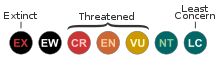
IUCN Red List of Threatened Plants Status : Least Concern.
Growth: S = slow M = medium F = fast. Soil: L = light (sandy) M = medium H = heavy (clay). pH: A = acid N = neutral B = basic (alkaline). Shade: F = full shade S = semi-shade N = no shade. Moisture: D = dry M = Moist We = wet Wa = water.
Now available:
Food Forest Plants for Mediterranean Conditions
350+ Perennial Plants For Mediterranean and Drier Food Forests and Permaculture Gardens.
[Paperback and eBook]
This is the third in Plants For A Future's series of plant guides for food forests tailored to
specific climate zones. Following volumes on temperate and tropical ecosystems, this book focuses
on species suited to Mediterranean conditions—regions with hot, dry summers and cool, wet winters,
often facing the added challenge of climate change.
Read More
Expert comment
Author
Lem.
Botanical References
Links / References
For a list of references used on this page please go here
Readers comment
| Add a comment |
|
If you have important information about this plant that may help other users please add a comment or link below. Only comments or links that are felt to be directly relevant to a plant will be included. If you think a comment/link or information contained on this page is inaccurate or misleading we would welcome your feedback at [email protected]. If you have questions about a plant please use the Forum on this website as we do not have the resources to answer questions ourselves.
* Please note: the comments by website users are not necessarily those held by PFAF and may give misleading or inaccurate information.
|
Subject : Echinocactus horizonthalonius
|
|
|
|