 |
|
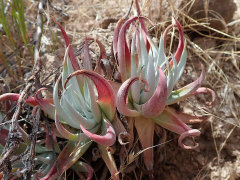
Nolan Exe. Creative Commons Attribution 4.0 |
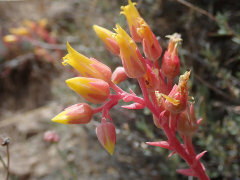 |
| Nolan Exe. Creative Commons Attribution 4.0 |
Translate this page:
Summary
Gila rock lettuce is the Arizona counterpart to the Panamint/lanceleaf rock lettuce group and is one of the few Dudleya taxa centered outside California. It is abundant in rocky habitats of central Arizona and “virtually identical” in use to Panamint rock lettuce. That makes it one of the more important edible Dudleya taxa for Arizona-specific desert and sky-island contexts. Like Panamint rock lettuce, its chief value lies in moisture-bearing leaves in landscapes where green vegetables can be scarce.
Physical Characteristics

 Dudleya saxosa subsp. collomiae is an evergreen Shrub growing to 0.3 m (1ft) by 0.5 m (1ft 8in) at a slow rate.
See above for USDA hardiness. It is hardy to UK zone 9. The flowers are pollinated by Bees, Insects.
It is noted for attracting wildlife.
Suitable for: light (sandy) and medium (loamy) soils, prefers well-drained soil and can grow in nutritionally poor soil. Suitable pH: mildly acid, neutral and basic (mildly alkaline) soils. It can grow in semi-shade (light woodland) or no shade. It prefers dry or moist soil and can tolerate drought.
UK Hardiness Map
US Hardiness Map
Synonyms
Cotyledon lanceolata var. saxosum (M.E.Jones) Jeps. Cotyledon saxosa M.E.Jones. Echeveria lanceolata var. saxosa (M.E.Jones) Jeps. Echeveria saxosa (M.E.Jones) A.Nelson & J.F.Macbr. Accepted Infraspecifics for D. saxosa are D. saxosa subsp. aloides (Rose) Moran. D. saxosa subsp. collomiae (Rose) Moran
Plant Habitats
Edible Uses
The edible part is the leaf. It can be treated as broadly similar in taste and use to Panamint rock lettuce, with older leaves likely preferable to younger ones if astringency follows the same pattern [2-3]. Edible Uses & Rating: Gila rock lettuce serves as a useful emergency or supplementary succulent food in rocky habitats in central Arizona. It is not a staple, but it can be highly valuable in the specific environments where it occurs [2-3]. Taste, Processing & Kitchen Notes: As it is virtually identical to Panamint rock lettuce, the most reasonable culinary expectation is that younger leaves can be more astringent, while older leaves may become milder and more lettuce-like. Bitterness may still be substantial, so the plant is best approached as a cautious, context-specific fresh succulent or lightly cooked emergency green rather than a broad culinary vegetable [2-3]. Seasonality (Phenology): Gila rock lettuce blooms in spring. Leaves persist year-round as a perennial succulent reserve, though quality will vary with age, drought, and exposure. We note its spring bloom period, which matches Arizona records describing spring flowering in rocky habitats. Safety & Cautions (Food Use): As with the other Dudleya species, conservation and legal protection are the major concerns. Treat this plant as an emergency resource, not something to be casually stripped from the wild. Some Arizona populations are local and habitat-specific, and collection pressure should be minimized. Harvest & Processing Workflow. If used, only a few older outer leaves should be removed from a given rosette. Rinse and eat fresh if palatable or cook lightly if astringency is strong. The species should be used conservatively and selectively [2-3]. Cultivar/Selection Notes. There are no food cultivars. Horticultural interest centers on succulent form, flower display, and rarity rather than edible use. Look-Alikes & Confusion Risks. This subspecies is very close to Panamint rock lettuce and other relatives of Dudleya saxosa. Arizona's geography is one of the best practical clues. The flowers are often bright yellow, and the plants occur on rocky slopes, canyons, crevices, and sky-island habitats. Traditional/Indigenous Use Summary. We include Gila rock lettuce among the edible-leaved rock lettuces and note its abundance in rocky habitats in central Arizona, making it a credible regional emergency or supplementary food in that landscape [2-3].
References More on Edible Uses
Medicinal Uses
Plants For A Future can not take any responsibility for any adverse effects from the use of plants. Always seek advice from a professional before using a plant medicinally.
Dudleya saxosa (often referred to as rock live-forever) and other species in the genus Dudleya have a history of medicinal use, particularly among indigenous peoples of the American Southwest and California. Medicinal uses of Dudleya species include: Skin Ailments: The succulent, gel-like interior of the leaves has been applied to minor burns, insect bites, and skin irritations, similar to aloe vera, to provide relief and accelerate healing. Corns and Calluses: Heated, peeled leaves were historically applied directly to the area to remove corns and calluses. Respiratory and Digestive Health: Teas and decoctions made from the plant have been used to help treat asthma and soothe digestive discomfort. Wound Care: Poultices made from mashed leaves have been used to treat wounds and draw out toxins. Oral Health: Pounded roots soaked in water have been used as an astringent for treating gum issues. While these traditional uses are documented, clinical research on Dudleya saxosa is in its early stages, with most evidence derived from traditional use and preliminary studies on related succulent species.
References More on Medicinal Uses
The Bookshop: Edible Plant Books
Our Latest books on Perennial Plants For Food Forests and Permaculture Gardens in paperback or digital formats.
Edible Tropical Plants
Food Forest Plants for Hotter Conditions: 250+ Plants For Tropical Food Forests & Permaculture Gardens.
More
Edible Temperate Plants
Plants for Your Food Forest: 500 Plants for Temperate Food Forests & Permaculture Gardens.
More
More Books
PFAF have eight books available in paperback and digital formats. Browse the shop for more information.
Shop Now
Other Uses
Gila rock lettuce forms attractive rosettes and showy flowering stems, making it a strong candidate for native desert succulent gardens where legal plant material is available. It performs best in rock-focused, low-water designs. Horticultural interest centers on succulent form, flower display, and rarity. Gila rock lettuce provides succulent structure in rocky Arizona habitats and seasonal floral resources to insects, helping fill an otherwise dry, exposed ecological niche.
Special Uses
References More on Other Uses
Cultivation details
Gila rock lettuce is one of the more relevant Dudleya food plants for Arizona. Like Panamint rock lettuce, it is best understood as a moisture-bearing emergency green in rocky country rather than as a staple food. Growing Conditions: It prefers rocky slopes, canyons, crevices, and Sonoran Desert sky-island habitats, with full sun to partial shade depending on exposure and with excellent drainage throughout the year. Habitat & Range: This taxon is centered in central Arizona and occurs on rocky slopes, canyon walls, crevices, and related upland desert habitats. Size & Landscape Performance: Gila rock lettuce forms attractive rosettes and showy flowering stems, making it a strong candidate for native desert succulent gardens where legal plant material is available. It performs best in rock-focused, low-water designs. Cultivation (Horticulture): It requires sharp drainage, restrained irrigation, and a rocky mineral substrate. It is best grown in crevice gardens, troughs, or sharply sloped beds. Pests & Problems: Overwatering and crown rot are the main risks. Snails and slugs can damage leaves in moister garden settings. Identification & Habit: A perennial succulent with rosettes of fleshy leaves, spring-blooming stalks, and yellow flowers, this plant is very similar to Panamint rock lettuce and differs primarily in geography and in some size and floral details. Pollinators: The flowers are likely visited by native bees, flies, and other small generalist pollinators in spring.
References Carbon Farming Information and Carbon Sequestration Information
Temperature Converter
Type a value in the Celsius field to convert the value to Fahrenheit:
Fahrenheit:
The PFAF Bookshop
Plants For A Future have a number of books available in paperback and digital form. Book titles include Edible Plants, Edible Perennials, Edible Trees,Edible Shrubs, Woodland Gardening, and Temperate Food Forest Plants. Our new book is Food Forest Plants For Hotter Conditions (Tropical and Sub-Tropical).
Shop Now
Plant Propagation
Propagation is mainly by seed. Established clumps may occasionally be divided with care in horticulture.
Other Names
If available other names are mentioned here
Gila rock lettuce, Gila County liveforever, and Gila County live-forever.
Native Range
US. USA. Arizona, California, Mexico Northwest.
Weed Potential
Right plant wrong place. We are currently updating this section.
Please note that a plant may be invasive in one area but may not in your area so it's worth checking.
Very low. It is not invasive and remains tightly tied to specialized rocky habitats.
Conservation Status
IUCN Red List of Threatened Plants Status : Not listed.

Growth: S = slow M = medium F = fast. Soil: L = light (sandy) M = medium H = heavy (clay). pH: A = acid N = neutral B = basic (alkaline). Shade: F = full shade S = semi-shade N = no shade. Moisture: D = dry M = Moist We = wet Wa = water.
Now available:
Food Forest Plants for Mediterranean Conditions
350+ Perennial Plants For Mediterranean and Drier Food Forests and Permaculture Gardens.
[Paperback and eBook]
This is the third in Plants For A Future's series of plant guides for food forests tailored to
specific climate zones. Following volumes on temperate and tropical ecosystems, this book focuses
on species suited to Mediterranean conditions—regions with hot, dry summers and cool, wet winters,
often facing the added challenge of climate change.
Read More
Expert comment
Author
(Rose) Moran
Botanical References
Links / References
For a list of references used on this page please go here
Readers comment
| Add a comment |
|
If you have important information about this plant that may help other users please add a comment or link below. Only comments or links that are felt to be directly relevant to a plant will be included. If you think a comment/link or information contained on this page is inaccurate or misleading we would welcome your feedback at [email protected]. If you have questions about a plant please use the Forum on this website as we do not have the resources to answer questions ourselves.
* Please note: the comments by website users are not necessarily those held by PFAF and may give misleading or inaccurate information.
|
Subject : Dudleya saxosa subsp. collomiae
|
|
|
|