 |
|
Patrick Alexander from Las Cruces, NM Creative Commons Zero, Public Domain Dedication |
 |
| JerryFriedman Creative Commons Attribution-Share Alike 3.0 |
Translate this page:
Summary
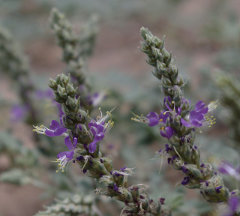
Dalea lanata is a prostrate perennial plant with a deeply penetrating orange-yellow taproot that produces one to a few stems 25 - 70cm long. The stems branch upward from near the base[1359 ]. The plant is harvested from the wild for local use as food and medicine. Woolly prairie-clover is a native southwestern legume with edible roots that are sweet and aromatic but usually woody and fibrous, best boiled for a broth. Leaves have a strong, unusual aroma and are not traditionally eaten. USDA Zones 5–9; native, not invasive.
Physical Characteristics

 Dalea lanata is a PERENNIAL growing to 0.6 m (2ft) by 0.6 m (2ft in).
See above for USDA hardiness. It is hardy to UK zone 5 and is not frost tender. The flowers are pollinated by Bees, insects.
It can fix Nitrogen.
Suitable for: light (sandy) and medium (loamy) soils and prefers well-drained soil. Suitable pH: mildly acid, neutral and basic (mildly alkaline) soils. It cannot grow in the shade. It prefers dry or moist soil.
UK Hardiness Map
US Hardiness Map
Synonyms
Parosela lanata (Spreng.) Britton
Plant Habitats
Edible Uses
Roots are considered edible though often woody [2-3]. Edible Uses & Rating. Provides a minor root food with variable sweetness [2-3]. Taste, Processing & Kitchen Notes. Roots can produce sweet aromatic broths when boiled but are usually too fibrous to eat as a vegetable. Seasonality (Phenology). Flowering occurs in late spring through midsummer. Safety & Cautions (Food Use). Root flavor varies widely between plants [2-3]. Harvest & Processing Workflow. Roots are dug carefully and typically boiled to extract flavor. Cultivar/Selection Notes. Rarely cultivated except in native plantings. Look-Alikes & Confusion Risks. Similar to other prairie-clovers but often more woolly or hairy in appearance [2-3]. Traditional/Indigenous Use Summary. Roots of prairie-clovers were occasionally consumed as sweet wild foods [2-3]. Root - raw[46 , 105 , 257 ]. A sweet flavour, it is regarded as a sugar[257 ]. The skin is scraped off and the root is eaten as a sweet[161 , 257 ]. Woolly prairie-clover (Dalea lanata var. terminalis) is a perennial legume native to the southwestern United States. Like other prairie-clovers, its roots are edible, though quality can vary widely between plants. Roots are generally described as sweet, pleasantly aromatic, and sometimes compared to “natural candy,” but they are also consistently woody, often splintering into irritating fibers when chewed. Even young roots tend to be fibrous rather than tender. Peeling the thin skins usually removes most of the chewable portion, but boiling offers a better solution: the sweetness dissolves into the water, producing a yellow-brown broth or beverage. This broth ranges from mildly pleasant to rich enough to resemble a light syrup, depending on the plant. Leaves of Dalea species were sampled during field studies though not generally recorded as traditional foods. They are aromatic, resinous, and faintly fruity, with evergreen-like notes. While they might be added sparingly to salads or soups for flavor, their food use is not well documented. Overall, woolly prairie-clover roots have potential value as a survival food, but they are rarely abundant or easy to process, and bitterness or soapiness may occur in some plants [2-3].
References More on Edible Uses
Medicinal Uses
Plants For A Future can not take any responsibility for any adverse effects from the use of plants. Always seek advice from a professional before using a plant medicinally.
A poultice of the plant is applied to centipede bites[257 ].
References More on Medicinal Uses
The Bookshop: Edible Plant Books
Our Latest books on Perennial Plants For Food Forests and Permaculture Gardens in paperback or digital formats.

Edible Tropical Plants
Food Forest Plants for Hotter Conditions: 250+ Plants For Tropical Food Forests & Permaculture Gardens.
More

Edible Temperate Plants
Plants for Your Food Forest: 500 Plants for Temperate Food Forests & Permaculture Gardens.
More

More Books
PFAF have eight books available in paperback and digital formats. Browse the shop for more information.
Shop Now
Other Uses
Compact perennial suitable for prairie gardens. Occasionally grown in native wildflower plantings. Improves soil fertility and provides nectar resources.
Special Uses
References More on Other Uses
Cultivation details
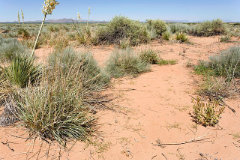
A hardy prairie legume valued mainly for ecological roles rather than culinary importance. Growing Conditions. Prefers full sun and dry soils. Habitat & Range. Occurs in dry prairies and sandy soils across portions of the western plains. Size & Landscape Performance. Compact perennial suitable for prairie gardens. Cultivation (Horticulture). Occasionally grown in native wildflower plantings. Pests & Problems. Generally pest-resistant. Identification & Habit. Perennial herb with hairy stems and compound leaves bearing gland dots. Pollinators. Highly attractive to bees and butterflies. Woolly prairie-clover (Dalea lanata var. terminalis) belongs to the bean family (Fabaceae) and the genus Dalea. It is commonly called woolly prairie-clover. Plants grow in USDA Zones roughly 4–9 and typically reach 20–60 cm tall with a similar spread. Requires a sunny position. Found in the wild only on sandy soils[1359 ]. This species has a symbiotic relationship with certain soil bacteria, these bacteria form nodules on the roots and fix atmospheric nitrogen. Some of this nitrogen is utilized by the growing plant but some can also be used by other plants growing nearby[200 ].
References Carbon Farming Information and Carbon Sequestration Information
Temperature Converter
Type a value in the Celsius field to convert the value to Fahrenheit:
Fahrenheit:
The PFAF Bookshop
Plants For A Future have a number of books available in paperback and digital form. Book titles include Edible Plants, Edible Perennials, Edible Trees,Edible Shrubs, Woodland Gardening, and Temperate Food Forest Plants. Our new book is Food Forest Plants For Hotter Conditions (Tropical and Sub-Tropical).
Shop Now
Plant Propagation
Seed - sow in early spring in a greenhouse. The seed has a hard seed coat and benefits from scarification before sowing in order to speed up and improve germination. This can usually be done by pouring a small amount of nearly boiling water on the seeds (being careful not to cook them!) and then soaking them for 12 - 24 hours in warm water. By this time they should have imbibed moisture and swollen - if they have not, then carefully make a nick in the seedcoat (being careful not to damage the embryo) and soak for a further 12 hours before sowing. When they are large enough to handle, prick the seedlings out into individual pots and plant them into their permanent positions in the summer[200 ].
Other Names
If available other names are mentioned here
Woolly prairie-clover (Dalea lanata var. terminalis)
Native Range
Native to: Arizona, Arkansas, Colorado, Kansas, Louisiana, Mexico Northeast, New Mexico, Oklahoma, Texas, Utah.
Weed Potential
Right plant wrong place. We are currently updating this section.
Please note that a plant may be invasive in one area but may not in your area so it's worth checking.
It is a native species and is not considered invasive or weedy, persisting naturally in its regional habitats.
Conservation Status
IUCN Red List of Threatened Plants Status : Not available
Growth: S = slow M = medium F = fast. Soil: L = light (sandy) M = medium H = heavy (clay). pH: A = acid N = neutral B = basic (alkaline). Shade: F = full shade S = semi-shade N = no shade. Moisture: D = dry M = Moist We = wet Wa = water.
Now available:
Food Forest Plants for Mediterranean Conditions
350+ Perennial Plants For Mediterranean and Drier Food Forests and Permaculture Gardens.
[Paperback and eBook]
This is the third in Plants For A Future's series of plant guides for food forests tailored to
specific climate zones. Following volumes on temperate and tropical ecosystems, this book focuses
on species suited to Mediterranean conditions—regions with hot, dry summers and cool, wet winters,
often facing the added challenge of climate change.
Read More
Expert comment
Author
Spreng.
Botanical References
Links / References
For a list of references used on this page please go here
A special thanks to Ken Fern for some of the information used on this page.
Readers comment
| Add a comment |
|
If you have important information about this plant that may help other users please add a comment or link below. Only comments or links that are felt to be directly relevant to a plant will be included. If you think a comment/link or information contained on this page is inaccurate or misleading we would welcome your feedback at [email protected]. If you have questions about a plant please use the Forum on this website as we do not have the resources to answer questions ourselves.
* Please note: the comments by website users are not necessarily those held by PFAF and may give misleading or inaccurate information.
|
|