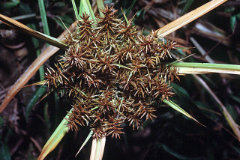
 |
|
Public domain |
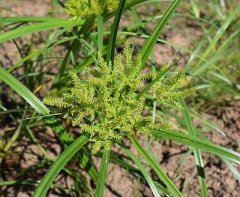 |
| Fredlyfish4. Creative Commons Attribution-Share Alike 4.0 |
Translate this page:
Summary
Redroot flatsedge is a grass-like sedge found in moist soils, wetlands, and disturbed habitats across much of North America. Although it lacks the notoriety of some edible nutsedges, it has historically been valued for its seeds, which resemble those of bulrushes in both structure and utility. The plant’s reddish root system gives rise to its common name and can aid identification in the field. Like many sedges, it occupies ecological niches where few other edible plants thrive, making it a potentially useful supplementary resource for knowledgeable foragers.
Physical Characteristics

 Cyperus erythrorhizos is a ANNUAL growing to 0.8 m (2ft 7in) by 0.2 m (0ft 8in) at a fast rate.
See above for USDA hardiness. It is hardy to UK zone 5. The flowers are pollinated by Wind.
It is noted for attracting wildlife.
Suitable for: light (sandy), medium (loamy) and heavy (clay) soils. Suitable pH: mildly acid, neutral and basic (mildly alkaline) soils. It can grow in semi-shade (light woodland) or no shade. It prefers moist or wet soil.
UK Hardiness Map
US Hardiness Map
Synonyms
Chlorocyperus erythrorhizus (Muhl.) Palla
Plant Habitats
Edible Uses
The seeds are considered edible and were historically gathered as a grain-like resource. Roots are not typically documented as a food source for this species. As with all aquatic or semi-aquatic plants, proper cooking is advisable to reduce pathogen risk [2-3]. Edible Uses & Rating: Seeds may be harvested, dried, and processed into meal or added to grain mixtures. Their overall rating is moderate; they are useful but not exceptional, primarily due to the labor required for collection [2-3]. Taste, Processing & Kitchen Notes: The seeds are comparable to those of bulrushes—mild, slightly nutty, and free of harsh flavors. When ground into flour, they can be incorporated into breads or porridges. Roasting may enhance flavor, while boiling softens the seed coats. The stems, though technically usable, tend to be fibrous and are not recommended as a primary food [2-3]. Seasonality (Phenology): Flowering and seed production can occur nearly year-round in warmer climates but are most reliable from late spring through autumn. Seeds should be collected once fully mature and dry. Safety & Cautions (Food Use): Plants growing in wetlands may harbor parasites or microbial contaminants. Cooking is strongly recommended. Accurate identification is also essential because wetland sedges often grow intermixed with unrelated species [2-3]. Harvest & Processing Workflow: Seed heads should be clipped once they begin to dry, then threshed to separate the achenes. Winnowing removes chaff. Seeds may then be roasted, boiled, or ground. Gathering is easiest during dry weather when the seed heads release readily [2-3]. Cultivar/Selection Notes: No known cultivars exist. This is a strictly wild species with limited horticultural development. Look-Alikes & Confusion Risks: Other Cyperus species may appear similar, but the reddish roots are distinctive when exposed. Sedges can be differentiated from grasses by their typically triangular stems and lack of paired glumes. Traditional/Indigenous Use Summary: Seeds of related flatsedges were important foods among several Native American groups, suggesting that redroot flatsedge likely served as a supplementary grain where available.
References More on Edible Uses
Medicinal Uses
Plants For A Future can not take any responsibility for any adverse effects from the use of plants. Always seek advice from a professional before using a plant medicinally.
Cyperus erythrorhizos, commonly known as red-root flatsedge, has documented traditional, though limited, culinary/subsistence use, rather than broad medicinal application. Traditional Food Use: The Kumeyaay Native Americans have traditionally used the mashed seeds of Cyperus erythrorhizos to make porridge. Characteristics: It is an annual plant identified by its red-pigmented, tangled root mat. It is important not to confuse C. erythrorhizos with Cyperus rotundus (Nutgrass) or Cyperus esculentus (Tigernut), which are well-documented in traditional medicine (Ayurveda, Chinese medicine) for treating digestive issues, inflammation, and skin conditions. Warning: While some Cyperus species are edible, others can be toxic. There is no specific evidence supporting the use of C. erythrorhizos in modern pharmacological applications.
References More on Medicinal Uses
The Bookshop: Edible Plant Books
Our Latest books on Perennial Plants For Food Forests and Permaculture Gardens in paperback or digital formats.
Edible Tropical Plants
Food Forest Plants for Hotter Conditions: 250+ Plants For Tropical Food Forests & Permaculture Gardens.
More
Edible Temperate Plants
Plants for Your Food Forest: 500 Plants for Temperate Food Forests & Permaculture Gardens.
More
More Books
PFAF have eight books available in paperback and digital formats. Browse the shop for more information.
Shop Now
Other Uses
Its upright, tufted growth provides texture in naturalistic plantings but it is seldom used ornamentally. Rarely cultivated intentionally; typically regarded as a volunteer species in wet gardens. Provides seed for birds and cover for small wetland fauna while stabilizing soils. Like most sedges, redroot flatsedge is primarily wind-pollinated and offers minimal nectar resources, though birds may consume the seeds.
Special Uses
References More on Other Uses
Cultivation details
Redroot flatsedge is not a staple wild food but represents a dependable emergency grain in wetland environments. Its ecological resilience adds to its value for traditional foraging systems. Growing Conditions: Prefers moist to saturated soils and tolerates seasonal flooding. It performs well in full sun but can endure partial shade. Habitat & Range: Common across much of North America in marshes, ditches, streambanks, and disturbed wetlands. Size & Landscape Performance: Its upright, tufted growth provides texture in naturalistic plantings but it is seldom used ornamentally. Cultivation (Horticulture): Rarely cultivated intentionally; typically regarded as a volunteer species in wet gardens. Pests & Problems: Generally hardy, though prolonged drought limits vigor. Identification & Habit: A perennial sedge with grass-like leaves, triangular stems, and flattened spikelets arranged in rows. Roots often display reddish coloration. Pollinators: Like most sedges, redroot flatsedge is primarily wind-pollinated and offers minimal nectar resources, though birds may consume the seeds. Plant Name: Redroot Flatsedge. Family: Cyperaceae. Genus: Cyperus. Common Names: Redroot flatsedge, redroot nutgrass. USDA Hardiness Zones: Approximately 4–10. Height/Spread: Typically 20–80 cm tall, spreading gradually via fibrous roots rather than aggressively creeping rhizomes.
References Carbon Farming Information and Carbon Sequestration Information
Temperature Converter
Type a value in the Celsius field to convert the value to Fahrenheit:
Fahrenheit:
The PFAF Bookshop
Plants For A Future have a number of books available in paperback and digital form. Book titles include Edible Plants, Edible Perennials, Edible Trees,Edible Shrubs, Woodland Gardening, and Temperate Food Forest Plants. Our new book is Food Forest Plants For Hotter Conditions (Tropical and Sub-Tropical).
Shop Now
Plant Propagation
Spreads by seed and root division.
Other Names
If available other names are mentioned here
Red-root flatsedge
Native Range
US. USA. Alabama, Arizona, Arkansas, British Columbia, California, Connecticut, Delaware, District of Columbia, Florida, Georgia, Illinois, Indiana, Iowa, Kansas, Kentucky, Louisiana, Maine, Manitoba, Maryland, Massachusetts, Mexico Northwest, Michigan, Minnesota, Mississippi, Missouri, Nebraska, Nevada, New Hampshire, New Jersey, New Mexico, New York, North Carolina, North Dakota, Ohio, Oklahoma, Ontario, Oregon, Pennsylvania, Rhode I., South Carolina, South Dakota, Tennessee, Texas, Utah, Vermont, Virginia, Washington, West Virginia, Wisconsin.
Weed Potential
Right plant wrong place. We are currently updating this section.
Please note that a plant may be invasive in one area but may not in your area so it's worth checking.
Moderate in wet soils but seldom aggressively invasive compared with purple nutsedge.
Conservation Status
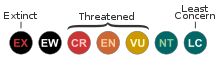
IUCN Red List of Threatened Plants Status : Least Concern.
| Related Plants
|
| Latin Name | Common Name | Habit | Height | Hardiness | Growth | Soil | Shade | Moisture | Edible | Medicinal | Other |
| Cyperus aristatus | Bearded nutsedge | Perennial | 0.5 |
6-10
| | LM | N | MWe | 2 | 0 | 2 |
| Cyperus articulatus | Jointed flatsedge, Priprioca, Piripiri | Perennial | 1.8 |
10-12
| F | LMH | N | MWeWa | 1 | 4 | 2 |
| Cyperus cephalotes | Bhada, Flat Sedges, Nut Sedges or Umbrella Sedge. | Perennial | 0.3 |
10-12
| F | LMH | N | WeWa | 0 | 1 | 2 |
| Cyperus distans | Slender Cyperus, Piedmont flatsedge | Perennial | 0.5 |
0-0
| | LM | N | MWe | 1 | 1 | 2 |
| Cyperus esculentus | Tiger Nut, Yellow nutsedge, Nut Grass | Perennial | 0.9 |
5-10
| F | LMH | N | MWe | 4 | 2 | 3 |
| Cyperus fendlerianus | Fendler's Flatsedge | Perennial | 0.7 |
5-9
| F | LM | N | MWe | 2 | 0 | 2 |
| Cyperus giganteus | Piripiri, Mexican Papyrus | Perennial | 1.5 |
9-11
| F | LMH | N | WeWa | 0 | 2 | 3 |
| Cyperus longus | Galingale | Perennial | 1.2 |
6-9
| F | LMH | N | MWeWa | 2 | 1 | 3 |
| Cyperus odoratus | Fragrant or rusty flatsedge | Annual/Perennial | 0.8 |
6-10
| F | LMH | N | MWe | 3 | 3 | 2 |
| Cyperus papyrus | Papyrus. Papyrus sedge | Perennial | 5.0 |
9-12
| F | LMH | N | WeWa | 2 | 2 | 2 |
| Cyperus rotundus | Purple Nutsedge | Perennial | 0.6 |
7-11
| | LM | N | MWe | 3 | 3 | 2 |
| Cyperus schweinitzii | Flatsedge, Schweinitz's flatsedge | Perennial | 0.8 |
0-0
| | LM | N | MWe | 2 | 0 | 2 |
| Cyperus setigerus | Lean flatsedge | Perennial | 1.0 |
0-0
| | LM | N | MWe | 2 | 0 | 2 |
| Cyperus tegetiformis | | Perennial | 0.0 |
-
| | LM | N | MWe | 0 | 0 | 2 |
| Cyperus textilis | Flat sedge, Basket grass, | Perennial | 1.5 |
9-12
| F | LMH | FSN | MWeWa | 0 | 0 | 4 |
| Cyperus ustulatus | | Perennial | 1.2 |
-
| | LM | N | MWe | 0 | 0 | 2 |
|
Growth: S = slow M = medium F = fast. Soil: L = light (sandy) M = medium H = heavy (clay). pH: A = acid N = neutral B = basic (alkaline). Shade: F = full shade S = semi-shade N = no shade. Moisture: D = dry M = Moist We = wet Wa = water.
Now available:
Food Forest Plants for Mediterranean Conditions
350+ Perennial Plants For Mediterranean and Drier Food Forests and Permaculture Gardens.
[Paperback and eBook]
This is the third in Plants For A Future's series of plant guides for food forests tailored to
specific climate zones. Following volumes on temperate and tropical ecosystems, this book focuses
on species suited to Mediterranean conditions—regions with hot, dry summers and cool, wet winters,
often facing the added challenge of climate change.
Read More
Expert comment
Author
Muhl.
Botanical References
Links / References
For a list of references used on this page please go here
Readers comment
| Add a comment |
|
If you have important information about this plant that may help other users please add a comment or link below. Only comments or links that are felt to be directly relevant to a plant will be included. If you think a comment/link or information contained on this page is inaccurate or misleading we would welcome your feedback at [email protected]. If you have questions about a plant please use the Forum on this website as we do not have the resources to answer questions ourselves.
* Please note: the comments by website users are not necessarily those held by PFAF and may give misleading or inaccurate information.
|
Subject : Cyperus erythrorhizos
|
|
|
|