 |
|
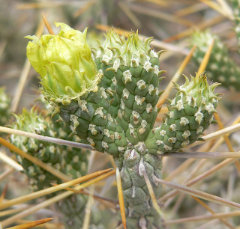
Stan Shebs. Creative Commons Attribution-Share Alike 3.1 |
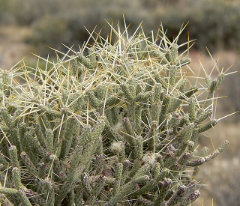 |
| Stan Shebs. Creative Commons Attribution-Share Alike 3.1 |
Translate this page:
Summary
Diamond cholla is a slender, intricately branched cactus recognized for its pencil-thin stems marked by diamond-shaped tubercles. It is structurally elegant rather than imposing, often forming open shrubs that seem almost architectural against desert backdrops. From a food perspective, however, it ranks low among chollas. Both fruits and stems are edible but offer minimal substance, making the plant more botanically interesting than nutritionally important.
Physical Characteristics

 Cylindropuntia ramosissima is an evergreen Shrub growing to 1 m (3ft 3in) by 1 m (3ft 3in) at a medium rate.
See above for USDA hardiness. It is hardy to UK zone 9. The flowers are pollinated by Bees, Insects.
It is noted for attracting wildlife.
Suitable for: light (sandy) and medium (loamy) soils, prefers well-drained soil and can grow in nutritionally poor soil. Suitable pH: neutral and basic (mildly alkaline) soils. It cannot grow in the shade. It prefers dry soil and can tolerate drought.
UK Hardiness Map
US Hardiness Map
Synonyms
Grusonia ramosissima (Engelm.) G.D.Rowley. Opuntia ramosissima Engelm.
Plant Habitats
Edible Uses
Technically edible but rarely worthwhile. The plant offers minimal flesh, modest flavor, and significant handling challenges — placing it firmly among the lesser food-producing chollas [2-3]. Edible Uses & Rating: Both stems and fruits are edible but considered minor resources. Their small size and dryness reduce their value compared with other chollas [2-3]. Overall rating: Low-value wild food, primarily of theoretical rather than practical importance [2-3]. Fruit - raw, cooked, or dried for later use[257 ]. Sweet and gelatinous[85 ]. Lean and insipid[95 ]. The unripe fruits can be added to soups, etc., imparting an okra-like mucilaginous quality[183 ]. The ellipsoid to stipitate-ellipsoid fruit is dry at maturity; it is around 15 - 30mm long and 10 - 15mm in diameter[270 ]. The fruit can remain on the plant year-round [160]. Be careful of the plant's irritant hairs; see the notes above on toxicity. Stem segments - raw, cooked, or dried for later use[62 , 160 ]. Watery and very mucilaginous[85 ]. A traditional method of cooking is to first boil, then strip off the outer skin and spines, fry them in oil with onions and chillis, and season them with salt and pepper, producing a slimy, acid-tasting, palatable green.[1981 ]. The cylindrical segments are around 20 - 100mm long and 4 - 10mm in diameter[1987 ]. Seed - briefly roasted then ground into a powder[62 ]. It is also used as a thickener[62 ]. Taste, Processing & Kitchen Notes: The fruits are dry and somewhat tannic with little sweetness. Flesh is sparse, making processing inefficient relative to caloric return. The stems can be eaten after spine removal, but they offer little flavor or texture worth pursuing. Like most chollas, glochid removal is the primary labor barrier. If processed, boiling is preferable, though culinary payoff remains modest. Seasonality (Phenology): Diamond cholla blooms from spring into midsummer, with fruits typically developing from mid to late summer through autumn. Because fruits are small and inconspicuous, they are often overlooked unless deliberately sought. Safety & Cautions (Food Use): Hair-like glochids embed easily in skin and are difficult to remove. Gloves, tools, and careful food straining are essential. As with all chollas, glochids are unaffected by cooking and must be removed prior to consumption [2-3]. Harvest & Processing Workflow: Harvest with tongs. Remove spines by brushing, burning, or abrasion, recognizing that none is perfectly effective. Boil edible portions to soften tissues, then strain thoroughly if producing liquids [2-3]. Given the plant’s low yield, harvesting is rarely efficient. Traditional / Indigenous Use Summary: Documentation of significant traditional use is sparse. Its minor food value likely relegated it to occasional or opportunistic use rather than staple status among desert peoples. Cultivar/Selection Notes: No cultivated varieties exist. Wild plants vary slightly in branching density and spine coverage. Look-Alikes & Confusion Risks: May be confused with pencil cholla species, but the distinctive diamond-patterned tubercles help separate it from most relatives. All chollas should be handled with equal caution regardless of species.
References More on Edible Uses
Medicinal Uses
Plants For A Future can not take any responsibility for any adverse effects from the use of plants. Always seek advice from a professional before using a plant medicinally.
Cylindropuntia ramosissima, commonly known as the diamond cholla or pencil cholla, has historical, traditional, and nutritional uses, though it is less commonly cited in modern clinical studies compared to other Opuntia species. Key traditional and potential medicinal uses include: Anti-diarrheal and Medical Treatment: Historically, components of the plant were used as an anti-diarrheal medicine and as a treatment for venereal diseases. Dental Aid: A tea made from the pith of the plant has been used in traditional medicine for treating toothaches. Nutritional Support: The buds and fruits are edible and high in nutrients, historically serving as important food sources for Native American cultures, which can act as a dietary source of calcium. Topical Uses: While specific medical studies on C. ramosissima are limited, related cholla species have been used for their anti-inflammatory properties, with boiled stems being used for skin ailments [3-1]. Important Safety Note: Cylindropuntia species have glochids (tiny, barbed spines) that can become lodged in the skin, causing irritation.
References More on Medicinal Uses
The Bookshop: Edible Plant Books
Our Latest books on Perennial Plants For Food Forests and Permaculture Gardens in paperback or digital formats.
Edible Tropical Plants
Food Forest Plants for Hotter Conditions: 250+ Plants For Tropical Food Forests & Permaculture Gardens.
More
Edible Temperate Plants
Plants for Your Food Forest: 500 Plants for Temperate Food Forests & Permaculture Gardens.
More
More Books
PFAF have eight books available in paperback and digital formats. Browse the shop for more information.
Shop Now
Other Uses
The species is currently cultivated as an ornamental. Exceptionally drought-tolerant and well-suited to xeriscapes. Requires minimal maintenance once established. Its refined branching pattern makes it attractive for collectors of structural desert plants, though it lacks the dramatic blooms or fruits of more ornamental species. Provides shelter for small desert animals and nesting birds. Though fruits are not especially fleshy, they may still serve as occasional wildlife food. The plant contributes to desert structural diversity, helping stabilize soils in harsh environments.
Special Uses
References More on Other Uses
Cultivation details
Diamond cholla is best appreciated as a structural desert cactus rather than a serious food plant. Its resilience and sculptural form contribute meaningfully to desert ecosystems, even if its culinary value is limited. Growing Conditions: Thrives in intense sunlight and sharply drained soils. It tolerates extreme heat, drought, and nutrient-poor substrates — conditions that would challenge many desert shrubs. Overwatering is the chief cultivation risk. Habitat & Range: Diamond cholla is primarily found in southern California, southern Nevada, and western Arizona, often on rocky slopes, desert flats, and open scrublands. It favors arid transition zones and sparse desert communities. Size & Landscape Performance: Typically growing between 0.6 and 2 meters tall, this cactus creates a delicate, branching silhouette that contrasts beautifully with heavier desert plants. In landscape settings, it contributes texture rather than bold color. Placement should avoid foot traffic due to spine hazards. Cultivation (Horticulture): Exceptionally drought-tolerant and well-suited to xeriscapes. Requires minimal maintenance once established. Its refined branching pattern makes it attractive for collectors of structural desert plants, though it lacks the dramatic blooms or fruits of more ornamental species. Pollinators: Flowers attract native solitary bees, small cactus bees, and occasional beetles. Pollinator activity tends to be moderate due to the relatively subdued floral display. Pests & Problems: Highly resilient. Root rot from excessive moisture is the primary threat. Physical damage is rare due to the plant’s drought-adapted physiology. Human encounters with glochids remain the most common “problem.” Identification & Habit: This species forms a many-branched shrub composed of narrow, cylindrical joints that appear almost twig-like from a distance. The joints are covered with pronounced diamond-shaped tubercles — a key identification trait that inspired the common name. Spines are present but typically less intimidating than those of larger chollas. Glochids remain a hazard nonetheless. Flowers range from pale yellow to greenish tones and are relatively modest. Fruits are small, tannish-yellow, and often heavily armed despite their limited flesh. Family: Cactus family (Cactaceae). Genus: Cylindropuntia. Common names: Diamond cholla, branched pencil cholla. USDA Hardiness Zones: Approx. Zones 8–11. Typical Height: 0.6–2 m. Typical Spread: 1–3 m. Cylindropuntia species (commonly known as Cholla) generally exhibit a moderate growth rate compared to other cacti, typically growing between 6 to 12 inches (15–30 cm) per year under optimal conditions. While some specific species are categorized as slow-growing, the genus as a whole is recognized as one of the faster-growing types of cacti in desert landscapes.
References Carbon Farming Information and Carbon Sequestration Information
Temperature Converter
Type a value in the Celsius field to convert the value to Fahrenheit:
Fahrenheit:
The PFAF Bookshop
Plants For A Future have a number of books available in paperback and digital form. Book titles include Edible Plants, Edible Perennials, Edible Trees,Edible Shrubs, Woodland Gardening, and Temperate Food Forest Plants. Our new book is Food Forest Plants For Hotter Conditions (Tropical and Sub-Tropical).
Shop Now
Plant Propagation
Propagation is straightforward via detached stem segments that root readily in well-drained soil. Seed propagation is possible but slower.
Other Names
If available other names are mentioned here
Diamond cholla, branched pencil cholla
Native Range
US. USA. Arizona, California, Mexico Northwest, Nevada.
Weed Potential
Right plant wrong place. We are currently updating this section.
Please note that a plant may be invasive in one area but may not in your area so it's worth checking.
Low. Detached joints may root locally but do not typically create aggressive colonies.
Conservation Status
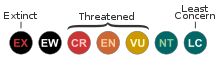
IUCN Red List of Threatened Plants Status : Least Concern.
Growth: S = slow M = medium F = fast. Soil: L = light (sandy) M = medium H = heavy (clay). pH: A = acid N = neutral B = basic (alkaline). Shade: F = full shade S = semi-shade N = no shade. Moisture: D = dry M = Moist We = wet Wa = water.
Now available:
Food Forest Plants for Mediterranean Conditions
350+ Perennial Plants For Mediterranean and Drier Food Forests and Permaculture Gardens.
[Paperback and eBook]
This is the third in Plants For A Future's series of plant guides for food forests tailored to
specific climate zones. Following volumes on temperate and tropical ecosystems, this book focuses
on species suited to Mediterranean conditions—regions with hot, dry summers and cool, wet winters,
often facing the added challenge of climate change.
Read More
Expert comment
Author
(Engelm.) F.M.Knuth
Botanical References
Links / References
For a list of references used on this page please go here
Readers comment
| Add a comment |
|
If you have important information about this plant that may help other users please add a comment or link below. Only comments or links that are felt to be directly relevant to a plant will be included. If you think a comment/link or information contained on this page is inaccurate or misleading we would welcome your feedback at [email protected]. If you have questions about a plant please use the Forum on this website as we do not have the resources to answer questions ourselves.
* Please note: the comments by website users are not necessarily those held by PFAF and may give misleading or inaccurate information.
|
Subject : Cylindropuntia ramosissima
|
|
|
|