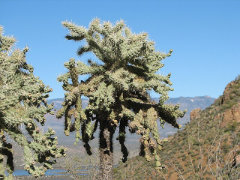
 |
|
Bernard Gagnon. Creative Commons Attribution-Share Alike 3.0 |
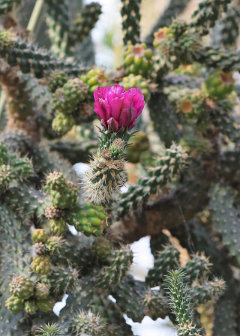 |
| Krzysztof Ziarnek, Kenraiz. Creative Commons Attribution-Share Alike 4.0 |
Translate this page:
Summary
Chainfruit cholla is among the most recognizable cacti of the Sonoran Desert, famous for its long chains of persistent fruits that may remain attached for years as new fruits emerge from older ones. This architectural cactus plays an important ecological role while also providing edible stems, flower buds, and fruits. Compared with several other chollas, it offers a somewhat more palatable fruit, though still complicated by heavy armament of spines and glochids. Historically, chollas were valued survival foods across the Southwest, and chainfruit cholla likely contributed to that tradition where locally abundant. Despite processing challenges, it remains one of the more worthwhile chollas for knowledgeable foragers.
Physical Characteristics

 Cylindropuntia fulgida is an evergreen Shrub growing to 3 m (9ft) by 3 m (9ft) at a medium rate.
See above for USDA hardiness. It is hardy to UK zone 9. The flowers are pollinated by Bees.
It is noted for attracting wildlife.
Suitable for: light (sandy) and medium (loamy) soils, prefers well-drained soil and can grow in nutritionally poor soil. Suitable pH: neutral and basic (mildly alkaline) soils. It cannot grow in the shade. It prefers dry soil and can tolerate drought.
UK Hardiness Map
US Hardiness Map
Synonyms
Grusonia fulgida (Engelm.) G.D.Rowley. Opuntia fulgida Engelm.
Plant Habitats
Edible Uses
Edible with effort. Fruits, buds, and stems can provide nutrition when properly prepared, making chainfruit cholla one of the more practical food-bearing chollas despite its formidable defenses [2-3]. Edible Uses & Rating: The stems, flower buds, and fruits are edible, placing this species in the moderate-value category of wild foods. Fruits are more substantial than those of many chollas and contain usable pulp along with numerous seeds. Flower buds were traditionally harvested before blooming and prepared as vegetables. While not a gourmet food, chainfruit cholla is a meaningful desert resource when processed properly [2-3]. Taste, Processing & Kitchen Notes: The fruits are described as firm, semi-sweet, tangy, and distinctly mucilaginous. The slime can be excessive, yet the flavor is generally palatable rather than merely tolerable. Cooking helps integrate the texture into soups or stews where mucilage acts as a natural thickener. Seeds provide bulk but are rarely highlighted as a primary food source [2-3]. Removing glochids is the central culinary challenge. Brushing, burning, or sieving reduces hazards but rarely eliminates them completely. Fruits should be opened carefully—preferably without slicing through spines—to prevent embedding glochids into the pulp. Once cleaned, the fruit can be boiled to produce cactus broth or strained to produce juice [2-3]. Flower buds benefit from roasting or pit cooking, which softens fibers and enhances digestibility. Seasonality (Phenology): Chainfruit cholla typically blooms from April through October, reflecting its adaptation to prolonged warm conditions. Fruits develop after flowering and may persist for multiple years, though new fruits are preferred for consumption because older ones become fibrous and depleted. Safety & Cautions (Food Use): Glochids can cause intense irritation and are not neutralized by cooking. Gloves, long sleeves, and tools are essential during harvest. All edible material must be thoroughly cleaned and filtered. Harvest & Processing Workflow: Harvest young flower buds in spring using tongs. Remove spines through brushing or controlled burning. Roast or boil before eating. Collect only fresh fruits, then de-spine carefully. Open fruits without forcing spines into the flesh, boil if desired, and strain liquids through fine cloth to remove glochids [2-3]. Traditional / Indigenous Use Summary: Chollas were broadly important to Indigenous cultures of the Southwest, especially as a seasonal vegetable source from flower buds. While documentation on chainfruit cholla is limited, its abundance suggests that it likely contributed to regional food traditions when available. Cultivar/Selection Notes: No cultivated varieties are recognized. Plants are typically wild-type specimens. Look-Alikes & Confusion Risks: Chainfruit cholla may resemble other tall chollas, such as cane or tree cholla, but the distinctive chains of fruits provide reliable identification. Regardless of species, all chollas demand careful handling.
References More on Edible Uses
Medicinal Uses
Plants For A Future can not take any responsibility for any adverse effects from the use of plants. Always seek advice from a professional before using a plant medicinally.
Cylindropuntia fulgida has documented, traditional, and modern medicinal uses, particularly in folk medicine. It is considered to have properties similar to other cacti in the Opuntia family. Traditional Medicinal Uses: Ailment Treatment: In regions like Sonora, Mexico, the fruit's pulp, skin, juice, and roots have been used in traditional medicine to treat diarrhea, fever, and pain, including joint pain. Wound Care: The plant has been used for treating skin wounds. Respiratory Support: A gum extracted from the plant has been used as a remedy for diarrhea and shortness of breath. Other Uses: It has been used in rural areas as a snake barrier. Potential Health and Pharmaceutical Benefits: Antidiabetic Potential: Similar to other cholla species, Cylindropuntia fulgida is thought to have potential anti-diabetic properties that may help manage type 2 diabetes by slowing the release of sugar into the bloodstream. Nutritional/Antioxidant Value: The plant is a source of dietary fiber, antioxidants, and carbohydrates. Antimicrobial Agents: Research has explored the use of Cylindropuntia fulgida mucilage (a gel-like substance) in creating antibacterial and antioxidant packaging films [1565].
References More on Medicinal Uses
The Bookshop: Edible Plant Books
Our Latest books on Perennial Plants For Food Forests and Permaculture Gardens in paperback or digital formats.
Edible Tropical Plants
Food Forest Plants for Hotter Conditions: 250+ Plants For Tropical Food Forests & Permaculture Gardens.
More
Edible Temperate Plants
Plants for Your Food Forest: 500 Plants for Temperate Food Forests & Permaculture Gardens.
More
More Books
PFAF have eight books available in paperback and digital formats. Browse the shop for more information.
Shop Now
Other Uses
Chainfruit cholla is occasionally cultivated in arid gardens for its dramatic form and drought tolerance. It requires minimal care but must be sited carefully due to falling joints that can root wherever they land. Landscapers often use it as a barrier plant or a wildlife shelter component. The species is widely cultivated in the horticultural trade and has been introduced to countries worldwide. Chainfruit cholla provides nesting habitat for desert birds and protective cover for small mammals. Fallen segments create microhabitats that moderate soil temperature and moisture. Fruits may be consumed by wildlife during dry periods, helping sustain desert food webs.
Special Uses
References More on Other Uses
Cultivation details
Chainfruit cholla stands out as both an ecological cornerstone and a visually iconic desert cactus. Though challenging to process, it offers meaningful food potential and supports wildlife across harsh landscapes. Growing Conditions: This cactus thrives in intense sunlight, extreme heat, and sharply drained desert soils. It tolerates drought exceptionally well and performs best in low-humidity conditions. Supplemental irrigation is unnecessary once established. Habitat & Range: Chainfruit cholla is a common cactus of southern Arizona, especially within the Sonoran Desert. It occupies desert flats, bajadas, rocky slopes, and disturbed ground, often forming scattered stands that punctuate otherwise open landscapes. Size & Landscape Performance: Mature plants typically reach 1.5 to 4.5 meters in height with spreads of 2 to 4 meters. Their tree-like structure makes them valuable focal plants in desert landscapes, though their spines require thoughtful placement away from foot traffic. Cultivation (Horticulture): Chainfruit cholla is occasionally cultivated in arid gardens for its dramatic form and drought tolerance. It requires minimal care but must be sited carefully because its joints can root wherever they land. Landscapers often use it as a barrier plant or as a component of a wildlife shelter. Pollinators: Flowers attract a diverse suite of native solitary bees, particularly cactus-specialist bees such as Diadasia. Carpenter bees, leafcutter bees, sweat bees, and pollen-gathering beetles also visit the blooms. Because flowering can extend across much of the warm season, chainfruit cholla serves as a dependable nectar and pollen source in arid ecosystems. Pests & Problems: Serious pest issues are rare. Excess moisture may promote rot, and occasional insect feeding occurs, but overall, the plant is extremely resilient. Identification & Habit: Chainfruit cholla grows as a tree-like cactus with a sturdy trunk and elevated branching structure. Cylindrical joints are densely covered with spines that detach easily, contributing to the plant’s “jumping” reputation when segments cling to passing animals. The defining feature is the hanging chain of fruits, sometimes extending several links long. These chains give the plant a sculptural silhouette visible from great distances across open desert terrain. Rose-magenta flowers appear near the stem tips and contrast vividly with the pale spines. Family: Cactus family (Cactaceae). Genus: Cylindropuntia. Common names: Chainfruit cholla, jumping cholla. USDA Hardiness Zones: Approx. Zones 8–11. Typical Height: 1.5–4.5 m. Typical Spread: 2–4 m. Native to: Arizona, Mexico Northeast, Mexico Northwest. Introduced into: Botswana, Canary Is., Cape Provinces, New South Wales, New Zealand North, Northern Provinces, Northern Territory, Queensland, South Australia, Spain, Western Australia, Zimbabwe. Cylindropuntia species (commonly known as Cholla) generally exhibit a moderate growth rate compared to other cacti, typically growing between 6 to 12 inches (15–30 cm) per year under optimal conditions. While some specific species are categorized as slow-growing, the genus as a whole is recognized as one of the faster-growing types of cacti in desert landscapes.
References Carbon Farming Information and Carbon Sequestration Information
Temperature Converter
Type a value in the Celsius field to convert the value to Fahrenheit:
Fahrenheit:
The PFAF Bookshop
Plants For A Future have a number of books available in paperback and digital form. Book titles include Edible Plants, Edible Perennials, Edible Trees,Edible Shrubs, Woodland Gardening, and Temperate Food Forest Plants. Our new book is Food Forest Plants For Hotter Conditions (Tropical and Sub-Tropical).
Shop Now
Plant Propagation
Propagation occurs easily through detached joints that root after rainfall. Seeds also germinate in favorable conditions but are slower to establish than vegetative segments.
Other Names
If available other names are mentioned here
Chainfruit cholla, jumping cholla,
Native Range
US. USA. Arizona, Mexico Northeast, Mexico Northwest.
Weed Potential
Right plant wrong place. We are currently updating this section.
Please note that a plant may be invasive in one area but may not in your area so it's worth checking.
The plant is not considered invasive in its natural habitat but can expand locally via dispersed fragments. In native desert ecosystems, this behavior contributes to habitat complexity rather than ecological disruption. This species has been introduced to other parts of the world where it has escaped and has become invasive, such as South Africa and Australia[338].
Conservation Status
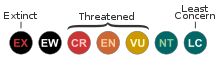
IUCN Red List of Threatened Plants Status : Least Concern.
Growth: S = slow M = medium F = fast. Soil: L = light (sandy) M = medium H = heavy (clay). pH: A = acid N = neutral B = basic (alkaline). Shade: F = full shade S = semi-shade N = no shade. Moisture: D = dry M = Moist We = wet Wa = water.
Now available:
Food Forest Plants for Mediterranean Conditions
350+ Perennial Plants For Mediterranean and Drier Food Forests and Permaculture Gardens.
[Paperback and eBook]
This is the third in Plants For A Future's series of plant guides for food forests tailored to
specific climate zones. Following volumes on temperate and tropical ecosystems, this book focuses
on species suited to Mediterranean conditions—regions with hot, dry summers and cool, wet winters,
often facing the added challenge of climate change.
Read More
Expert comment
Author
(Engelm.) F.M.Knuth
Botanical References
Links / References
For a list of references used on this page please go here
Readers comment
| Add a comment |
|
If you have important information about this plant that may help other users please add a comment or link below. Only comments or links that are felt to be directly relevant to a plant will be included. If you think a comment/link or information contained on this page is inaccurate or misleading we would welcome your feedback at [email protected]. If you have questions about a plant please use the Forum on this website as we do not have the resources to answer questions ourselves.
* Please note: the comments by website users are not necessarily those held by PFAF and may give misleading or inaccurate information.
|
Subject : Cylindropuntia fulgida
|
|
|
|